






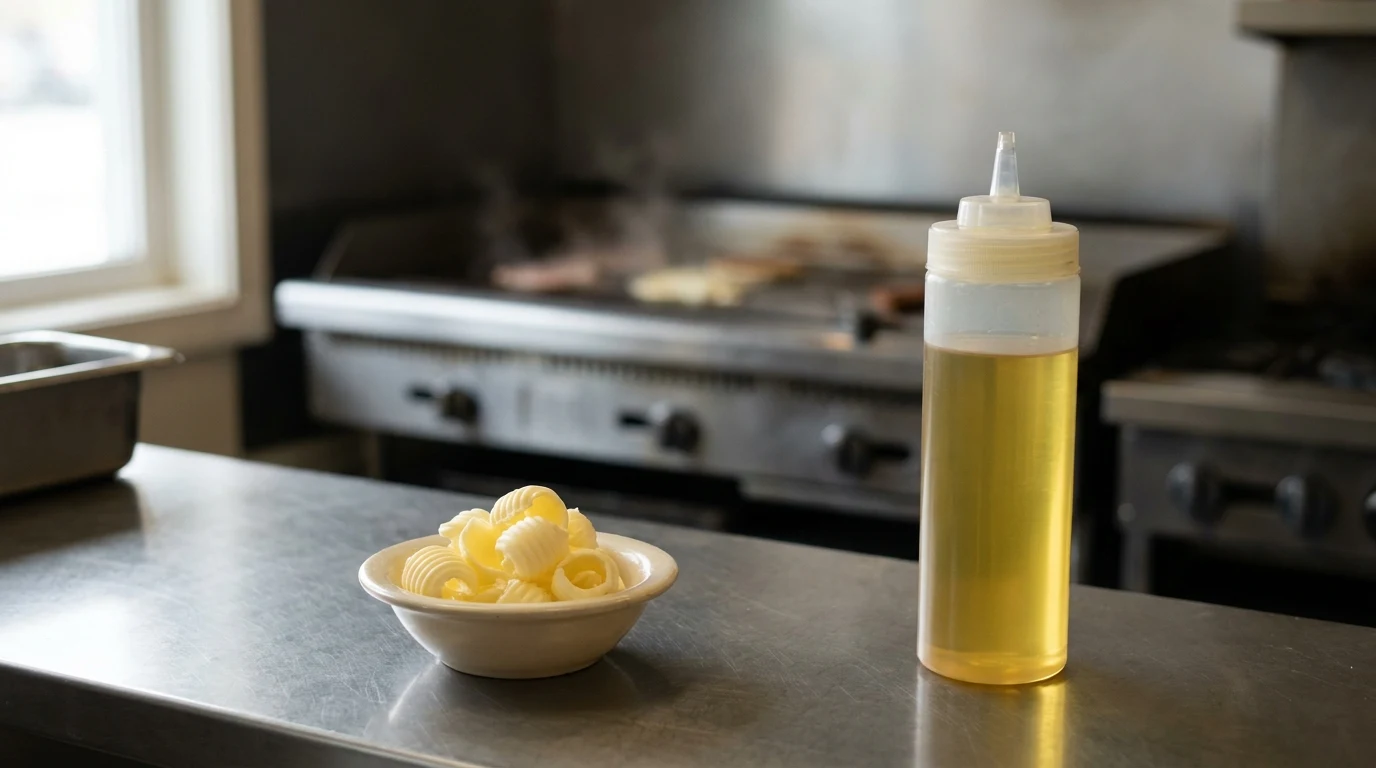
I first used Whirl butter-flavored oil as a young cook in respected Catskill kitchens. Those were serious operations with talented chefs, and the yellow liquid in the squeeze bottle was not real butter. It was a butter substitute built for cost, speed, and high-volume cooking.
I need to be honest about my part in that story. I used it too. When you work in another chef’s kitchen, you follow the system, cook with what purchasing buys, and stay inside somebody else’s food budget.
I still see gallon jugs of Whirl at Restaurant Depot, often in carts belonging to restaurant owners I recognize. It remains a common breakfast restaurant butter substitute. That does not prove a national usage percentage, and I will not invent one. Whirl is only one brand in a much larger category that includes Phase, Butter-It, Chef’s Quality, and private-label liquid butter alternatives.
Decades in professional kitchens taught me this. Butter-flavored oil is common in diners, hotels, banquet kitchens and breakfast restaurants. Menus often do not identify the fat under eggs, pancakes, home fries, garlic bread, or grilled sandwiches.

What Is Whirl Butter-Flavored Oil?
Whirl is not butter. It is not melted butter. It is not clarified butter, and it is not ghee.
Whirl is a shelf-stable butter-flavored oil manufactured by Stratas Foods. The company markets it as a butter or margarine replacement. Suggested uses include sautéing, grilling, baking, sauces, garlic bread and pizza crusts.
The Whirl butter ingredients list starts with soybean oil and hydrogenated soybean oil. It also lists 2% or less of salt, sunflower lecithin and artificial butter flavor. Beta-carotene and yeast extract follow.
It contains no milk solids or added water. It needs no refrigeration, and Stratas lists a 12-month shelf life. The company says it will not spatter, foam, scorch or burn. It also promotes Whirl as costing up to half as much as butter. Those are the product’s real selling points: price, shelf life, consistency and convenience. Read the current Whirl technical specification.
Strip away the yellow color, salt, savory flavoring and artificial butter aroma, and the product is primarily soybean oil.
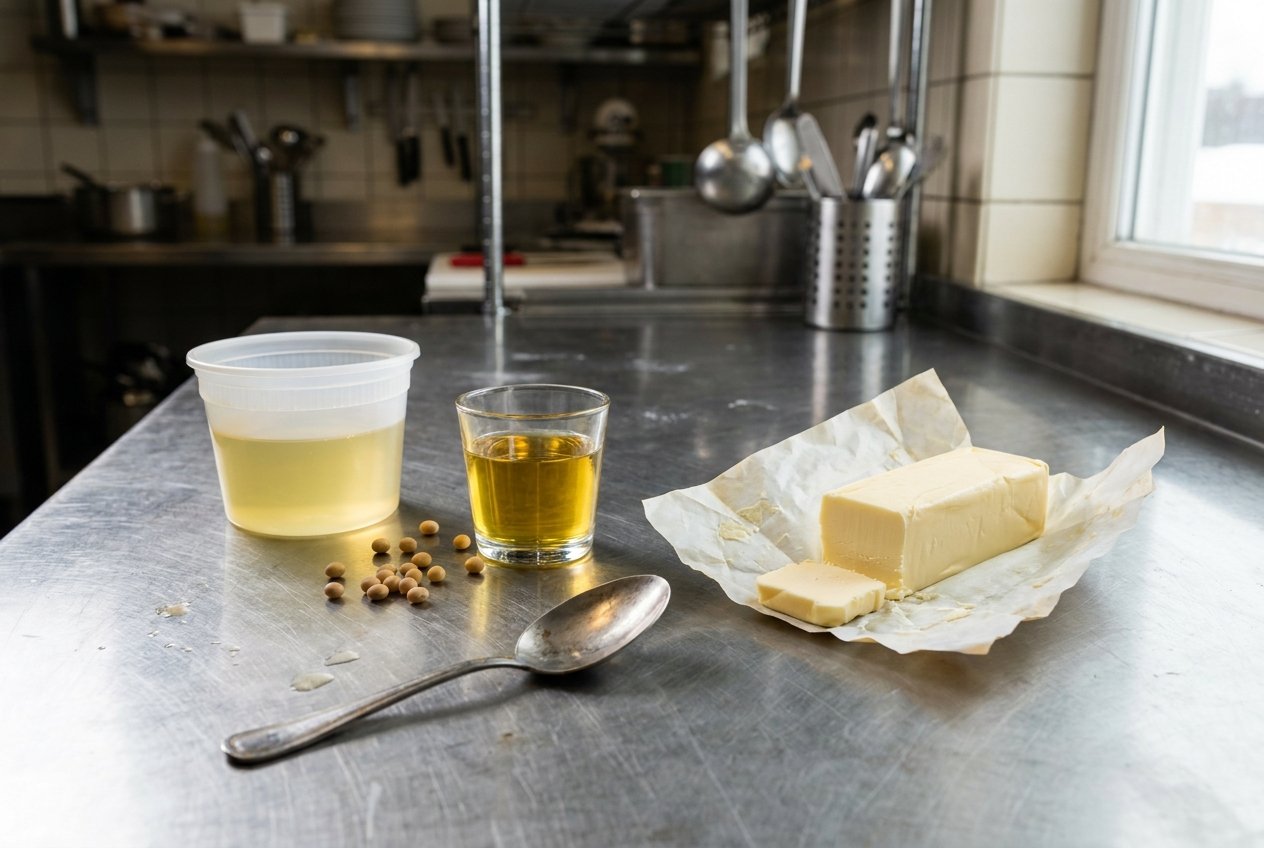
Why Does Whirl Look and Taste Like Butter?
Every added ingredient has a job.
- Soybean oil supplies most of the liquid fat.
- Hydrogenated soybean oil changes the texture and stability of the blend.
- Artificial butter flavor supplies the aroma customers associate with butter. The current label says “artificial butter flavor.” The manufacturer does not disclose the individual compounds in that flavor system.
- Beta-carotene gives the pale soybean oil a yellow, butter-like color.
- Salt makes the flavor more convincing and contributes 110 milligrams of sodium per tablespoon.
- Sunflower lecithin helps keep the ingredients evenly dispersed.
- Yeast extract contributes savory umami flavor.
Yeast extract is not purified monosodium glutamate. It can contain free glutamates that activate the savory system in my guide to umami. Research describes yeast extract as an important commercial flavoring used alongside MSG and hydrolyzed proteins. Review the research on yeast extract and food flavoring.
The FDA considers added MSG generally recognized as safe. Controlled studies have not consistently reproduced reported symptoms. That is important scientific context. My objection is not that yeast extract proves Whirl is poisonous. My objection is that a restaurant is using industrial techniques to make inexpensive soybean oil look, smell and taste like an ingredient it is not. Read the FDA’s review of MSG.
The Old Whirl and the Current Whirl Are Not the Same
This distinction matters if we are going to be accurate.
Older Whirl formulas contained partially hydrogenated soybean oil. Listings from that period show about 2 grams of trans fat per tablespoon. Those old numbers still show up online. See an archived nutrition listing for the older formula.
In 2015, the FDA found that partially hydrogenated oils were no longer generally recognized as safe. The agency required their removal from most foods. Their trans fat raises LDL cholesterol and increases heart risk. Read the FDA determination on partially hydrogenated oils.
Whirl was reformulated. The current Stratas specification describes Whirl butter-flavored oil as free from partially hydrogenated oil.
That means it is inaccurate to take the old 2-gram trans-fat number and apply it to every jug being sold today. If I criticize a product, I want to address what is sold now. Recycling an old label only creates a scarier headline.
Partially Hydrogenated vs. Fully Hydrogenated Oil
Hydrogenation adds hydrogen to an unsaturated oil’s double bonds. The process usually uses heat, pressure and a metal catalyst.
Stopping the process early creates partially hydrogenated oil. Some bonds can shift into a trans form and create industrial trans fat.
Full hydrogenation continues until almost all double bonds are saturated. The result has little trans fat and becomes hard and waxy at room temperature.
Current Whirl lists “hydrogenated soybean oil.” Stratas also says the product contains no partially hydrogenated oil. That points to a fully hydrogenated component blended with liquid soybean oil.
Is fully hydrogenated oil the same trans-fat disaster as old partially hydrogenated oil? No.
Does that make it natural? No.
It remains an industrially modified fat used to engineer performance and texture. “Less harmful than the old formula” and “an ingredient I want to feed my family” are two entirely different standards.
What the Current Nutrition Numbers Actually Say
One tablespoon of current Whirl contains approximately:
- 120 calories
- 14 grams of fat
- 2.5 grams of saturated fat
- 7 grams of polyunsaturated fat
- 3 grams of monounsaturated fat
- 110 milligrams of sodium
- No significant vitamins, minerals, protein or fiber
| Comparison | Current Whirl, 1 tbsp | Salted butter, 1 tbsp |
|---|---|---|
| Calories | About 120 | About 102 |
| Total fat | 14 g | About 11.5 g |
| Saturated fat | 2.5 g | About 7 g |
| Water and milk solids | None listed | Present |
| Primary identity | Flavored soybean-oil blend | Dairy fat |
The technical sheet for Whirl butter-flavored oil reports 1.1 grams of trans fat per 100 grams. That equals about 0.15 gram per 14-gram tablespoon. The old formula listed 2 grams per tablespoon. FDA trans fat labeling rules round a serving below 0.5 gram down to zero. A “0 g trans fat” label does not always mean a laboratory would find none. See the FDA trans-fat rounding rule.
Butter is approximately 80% fat and also contains water and milk solids. One tablespoon of salted butter has about 102 calories and 11.5 grams of fat. About 7 grams are saturated fat. Butter therefore contains substantially more saturated fat than Whirl. Butter also supplies vitamin A and small amounts of other fat-soluble nutrients. Still, butter is not a multivitamin or fiber source. Review the USDA salted butter nutrition sheet.
This is where the conversation needs intellectual honesty. Current Whirl is not worse than butter in every nutritional measurement. Its saturated-fat number is lower. That does not erase concerns about processing, artificial flavor, high heat, portion size or truthful menu descriptions.
Is Whirl Butter Bad for You?
The blunt answer is that Whirl is not a health food, but calling the current product “poison” goes beyond the available evidence.
I did not find a long-term clinical trial comparing Whirl with real butter for disease outcomes. Claims of proven product-specific harm need direct evidence. Anyone claiming that Whirl itself has been proven to cause cancer, heart disease or another specific condition needs to produce that research.
There are, however, several legitimate concerns.
- Whirl is easy to overuse.
Because it comes in a squeeze bottle and pours like oil, cooks can use far more than they realize. It may go onto the griddle for the eggs, again for the pancakes and again for the home fries.
Two tablespoons add 240 calories and 28 grams of fat before considering the eggs, bacon, toast, cheese or potatoes. The portion may be more important than the front-label claim.
- It is predominantly refined soybean oil.
Commodity soybean oil is generally extracted and then refined, bleached and deodorized. The EPA describes soybean flakes being washed with hexane. Processors remove the solvent, then refine the crude soybean oil. The Whirl sheet does not state how its soybean oil was extracted. Without lab evidence, I cannot claim that a tested amount of hexane remains in a jug. Review the EPA description of conventional soybean processing.
What we can say is that Whirl is not cold-pressed farm oil. It is a highly engineered, industrial foodservice fat.
- Polyunsaturated oil is vulnerable to heat and oxidation.
Whirl contains approximately 7 grams of polyunsaturated fat per tablespoon. Polyunsaturated fats have more double bonds than other fats. That makes them more open to oxidation during long heating, air exposure and reuse.
Laboratory studies demonstrate that heating soybean oil produces volatile oxidation compounds and aldehydes. The amount and type depend on heat, cooking time, air exposure and the oil’s fat makeup. Read a study of volatile compounds produced by heating soybean oil.
That does not mean an egg cooked once on a controlled griddle is identical to food from a neglected deep fryer that has held the same oil for days. Dose, time and kitchen practices matter. The strongest argument is not that one bite is toxic. The issue is repeated use across several foods on hot equipment. The guest often does not know the flavored oil is there.
- The broader seed-oil debate is not settled by social media.
Seed oils have become one of the loudest nutrition arguments online. Some health influencers blame them for much of America’s chronic disease burden. A few make outrageous comparisons suggesting that consuming seed oils is worse than smoking cigarettes.
That cigarette comparison is not supported by credible evidence and should not be repeated as fact. Smoking is a well-established cause of cancer, heart disease, lung disease and premature death. Making an extreme comparison does not strengthen the case against poor-quality restaurant oils. It makes the argument easier to dismiss.
The controlled human evidence also does not support the simple claim that linoleic acid automatically causes inflammation. A review of randomized trials found no clear rise in common inflammation markers when healthy people ate more linoleic acid. Read the randomized-trial review.
The American Heart Association says replacing saturated fat with polyunsaturated fat can lower LDL and heart risk. Read the American Heart Association advisory.
I run a seed-oil-free kitchen because I prefer traditional fats, identifiable ingredients and cooking oils with better heat stability. But I do not need to distort the science to explain that choice. The case against Whirl should rest on three facts: what it is, why restaurants buy it and what guests are told.
Why Restaurants Use Whirl
Restaurants operate under enormous financial pressure. Food, labor, utilities, insurance, rent, repairs, fees and waste keep climbing. Distributors sell liquid butter for restaurants because it cuts cost and simplifies labor.
Whirl butter-flavored oil also fits the restaurant griddle fats category because it stays liquid and resists scorching. Whirl offers operators several advantages:
- It can cost substantially less than butter.
- It stays liquid and can be poured from a squeeze bottle.
- It requires no refrigeration.
- It does not need to be clarified.
- It contains no water, so it does not splatter like butter.
- It contains no milk solids to brown or burn.
- It creates consistent color on pancakes, French toast and grilled food.
- It lets cooks work at higher temperatures without managing real butter carefully.
- The current formula contains no milk allergen according to its specification.
Those are meaningful operational advantages. They benefit the purchasing budget and make production easier. The guest usually gets no price cut. The kitchen may not share that the buttery taste came from flavored hydrogenated soybean oil.
That is where this becomes an integrity issue.
Are Chefs Educated About What They Are Buying?
Some chefs know exactly what Whirl is and choose it because it saves money. Others have never seriously studied the label. They know it browns food, does not burn and costs less. That is enough for them.
Many culinary careers begin in kitchens where nutrition is treated as somebody else’s problem. I have written about the opposite standard before. A chef should answer a guest clearly, whether the topic is cooking fat or anisette versus sambuca.
As a young apprentice, I worked for Chef Peter Timmins, CMC. Born in Dublin, he led kitchens at The Greenbrier, Gasparilla Inn and The Everglades Club. He died in 2014 at age 57. The Club + Resort Chef Hall of Fame selected him for its 2026 class. Rest in peace, Chef Peter. He had an enormous influence on generations of chefs. Read about Chef Peter Timmins’ career and legacy.
Chef Peter used to tell me, in his Irish accent:
“People do not go out for their vitamins and fiber.”
I understood what he meant. Guests go out for hospitality, pleasure, flavor and an experience. That line also reflects an idea drilled into young cooks. Nutrition is treated as somebody else’s job because guests came for dinner, not a health lesson.
I eventually rejected that part of the industry’s thinking.
Guests may not go out specifically for vitamins and fiber, but that does not give us permission to stop caring about what we feed them. Flavor and ingredient integrity are not enemies. A skilled chef should be capable of delivering both.
Why I Opened Aroma Thyme Bistro
I decided long before opening Aroma Thyme that I would not build a kitchen around products like Whirl.
In fact, that is one reason I opened my own restaurant. I reached a point where I could not work under another owner’s food budget. I knew the difference between a smart purchase and a bad compromise.
I promised myself that I would never compete on price.
Somebody will always buy cheaper ingredients and sell a lower-priced plate. You cannot win that race without compromising the food.
I compete on integrity.
That means buying ingredients I am willing to eat, serve my children and explain honestly to a guest. Whirl does not meet that standard for me. I would not use it at Aroma Thyme, and I would not knowingly feed it to my family.
Is Calling Whirl “Butter” Dishonest?
In my opinion, the product is built around imitation. It is soybean oil designed to look, smell and perform like butter while costing the restaurant less.
But the more important ethical line is what the restaurant tells the guest.
Menu transparency starts with exact wording. If a menu merely says that eggs are “griddled,” it may not promise any particular cooking fat. If a server or menu explicitly says the food is cooked in butter while the kitchen uses Whirl, that is a different situation. The restaurant is representing one ingredient while serving another.
Truth-in-menu and consumer-protection rules vary by state. Wisconsin has a direct rule on this issue. A restaurant cannot serve colored margarine as table butter unless the guest requests it. Other jurisdictions address misleading menu descriptions through broader consumer-protection standards. The legal outcome depends on the wording, product and location. I am not claiming every undisclosed use of Whirl is illegal. Review Wisconsin’s butter-substitution rule.
Legality is the minimum standard anyway. The better question is: Are you telling the guest the truth?
What Should Breakfast Restaurants Use Instead?
There are better options. They cost more, and cooks need to understand how to use them. That is called cooking.
Eggs and omelets:
Use real butter at a controlled temperature. Another option is clarified butter, followed by a small amount of whole butter at the end. Adding whole butter near the end gives scrambled eggs real flavor. It also keeps the milk solids from burning through the full cook.
Pancakes and French toast:
Use real butter, clarified butter or ghee. These foods are sold partly on the promise of butter flavor. Artificial butter aroma in soybean oil is not an equal culinary substitute.
Home fries and high-temperature griddle cooking:
My first choice is a verified pure avocado oil. It has a neutral flavor, a high proportion of monounsaturated fat and performs well at higher temperatures. Purity matters. Restaurants should use a trusted supplier instead of the cheapest jug marked “avocado.”
Clarified butter or ghee also works when butter flavor is desirable.
Garlic bread:
Use real butter, extra-virgin olive oil or a combination of the two. Good garlic, olive oil, real butter, herbs and salt do not need artificial butter flavor and yeast extract to taste savory. It is the same ingredients-first logic behind why good tomato sauce does not need sugar.
General sautéing:
Use extra-virgin olive oil, verified avocado oil, clarified butter or the appropriate traditional animal fat for the dish. No single fat is perfect for every application. Match the fat to the temperature, flavor and cooking method.
Butter, ghee and animal fats contain more saturated fat. Traditional does not mean medically stronger for every person. Avocado and olive oils are usually the stronger choices when a restaurant wants high monounsaturated fat alongside a clean, recognizable label.
What Should You Ask at a Breakfast Restaurant?
Do not ask only, “Do you use butter?” That question is too vague, and a busy server may assume the answer.
Ask this instead:
“Could you check which fat the kitchen uses on the eggs and potatoes? I want real butter, olive oil or avocado oil. Please avoid margarine, Whirl, Phase and other butter-flavored oils.”
If you have an allergy or diagnosed sensitivity, say so clearly. The kitchen can then follow its allergy process. Do not invent an allergy to force a request. False claims add work and can weaken trust when another guest faces a real threat.
You can also ask:
- Are the eggs cooked in real butter or a butter-flavored oil?
- What oil is used on the griddle?
- What are the home fries cooked in?
- Is the garlic bread made with real butter or liquid butter alternative?
- Can my food be cooked in a clean pan with real butter or olive oil?
If nobody can answer, that tells you something about the restaurant’s ingredient knowledge.
The Real Problem Is Bigger Than One Jug of Oil
Whirl butter substitute represents a much larger problem in the restaurant business.
Food makers pitch products that cost less and need less skill. Each one promises to solve a kitchen problem. Too often, the compromise lands on the guest.
The chef saves money. The distributor moves another case. The manufacturer grows the category. The customer eats an ingredient they would probably never purchase for their own kitchen.
Some chefs do not understand the difference. Some never read the specification sheet. Some know and do not care. Others feel trapped by a food budget imposed by an owner or corporate office.
I understand the financial pressure. I have operated a restaurant since 2003. I know exactly what real butter, extra-virgin olive oil and avocado oil cost.
But a restaurant’s financial pressure does not eliminate its responsibility.
Final Thoughts: Restaurants Must Choose What They Stand For
Replacing real butter with Whirl may look minor on a purchasing report. It reveals how the business views both food and the guest.
Customers need to understand what is in their food. They also need to understand restaurant finances. Large food companies use cheaper products to appeal to that pressure.
Restaurant owners and chefs need more education. They need to read labels and understand cooking fats. A product is not right merely because it performs well and arrives cheaply.
I am not claiming that one serving of current Whirl will poison you. I am saying Whirl butter-flavored oil is not butter. It is a formulated soybean-oil product with hydrogenated oil, artificial flavor, color, salt, lecithin and yeast extract. It exists primarily to lower cost and make cooking easier.
At Aroma Thyme Bistro, I made a different choice. I chose a long time ago not to compete on price. I compete on integrity.
That costs more. It requires better sourcing, more knowledgeable cooks and real technique.
It is also the only way I know how to cook.
Frequently Asked Questions About Whirl Butter Substitute
Is Whirl real butter?
No. Current Whirl is a butter-flavored oil made primarily from soybean oil and hydrogenated soybean oil. Its current specification lists artificial butter flavor but no dairy butter or milk solids.
Is Whirl dairy-free?
The current U.S. Stratas specification lists no milk allergen and describes Whirl as vegan. Formulas and suppliers can change. Anyone with a serious allergy should ask the restaurant to check the current container and cross-contact process.
Does Whirl contain trans fat?
The current specification reports 1.1 grams of trans fat per 100 grams. That equals about 0.15 gram per tablespoon. Because that is below 0.5 gram per serving, the Nutrition Facts label can declare zero. Older Whirl formulations containing partially hydrogenated oil reportedly contained about 2 grams per tablespoon.
Is fully hydrogenated soybean oil the same as partially hydrogenated oil?
No. Partial hydrogenation can generate substantial industrial trans fat. Full hydrogenation converts almost all unsaturated bonds to saturated bonds. It produces a harder fat with little trans fat. Fully hydrogenated oil is still industrially modified and generally higher in saturated fat than the original liquid oil.
Why do restaurants use Whirl?
Restaurants use it because it is cheap, shelf-stable, pourable and resistant to scorching. It requires no refrigeration or clarification and can be easier for high-volume kitchens to manage than butter.
What percentage of breakfast restaurants uses Whirl?
No reliable national percentage has been published. Whirl and similar products are widely sold to foodservice. An exact usage rate would require purchase data or a representative restaurant survey.
What is the best replacement for Whirl?
Use real butter or clarified butter when butter flavor matters. Use verified avocado oil for home fries and high-temperature griddle cooking. Extra-virgin olive oil is another option for sautéing and garlic bread.
Medical note: This article provides general food and ingredient information, not medical advice. People with allergies or health conditions should confirm current labels and consult a qualified clinician.
Last reviewed: August 3, 2026.