





At the end of every summer, my grandmother’s kitchen turned into a tomato factory. And not once did sugar in tomato sauce enter the picture.
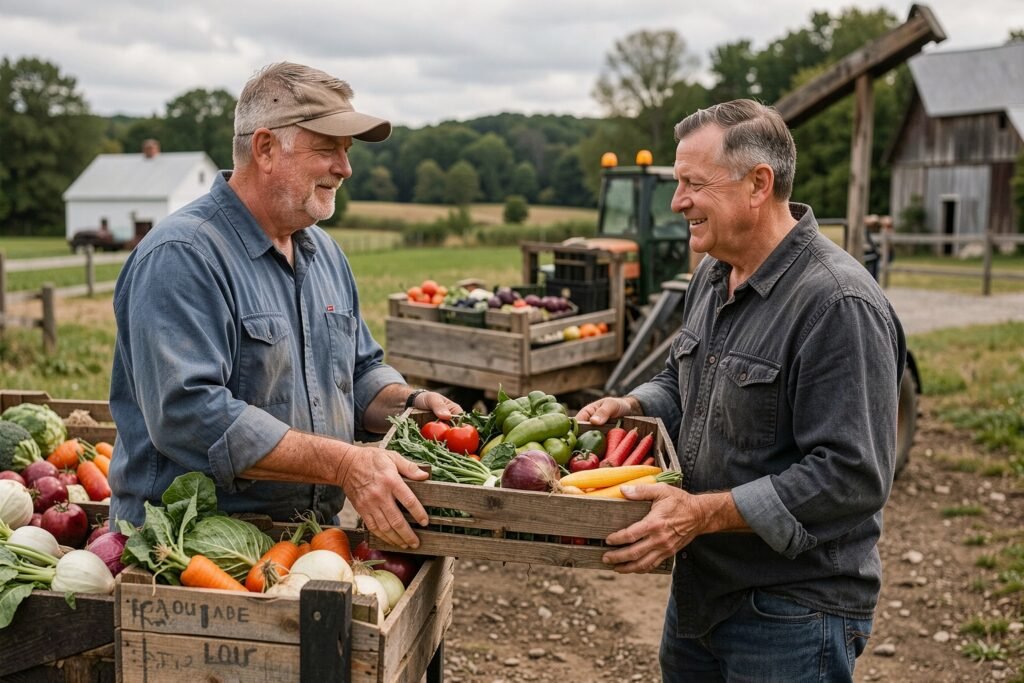
Not a cute little “let’s make sauce” afternoon. I’m talking about work. Real work. Southern Italian work. Puglia work in upstate New York’s Hudson Valley. Tomatoes everywhere. Baskets of them. Crates of them. Ripe, heavy, sun-warmed tomatoes that had to be dealt with now, because when the tomatoes are ready, you don’t negotiate with them.
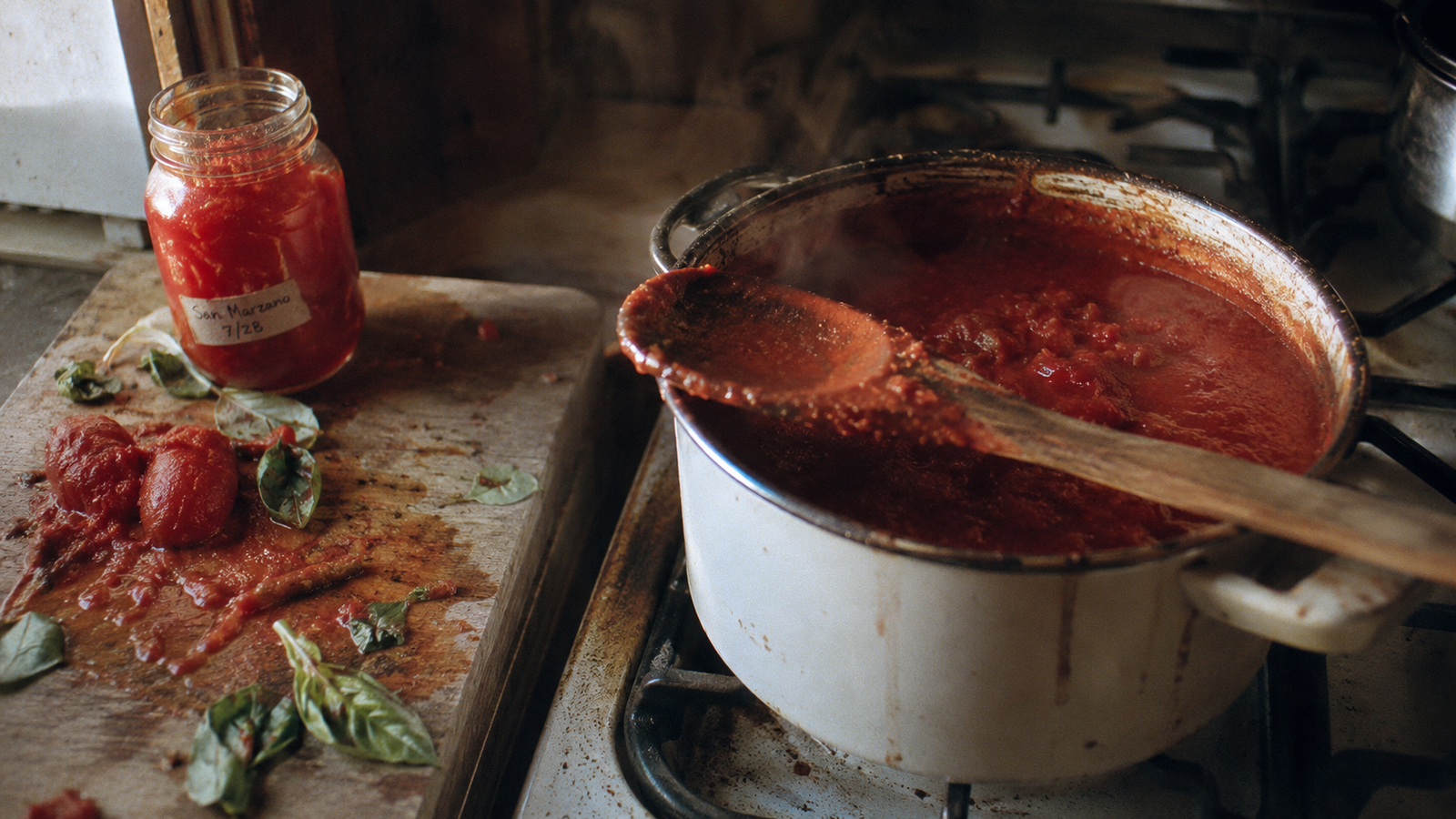
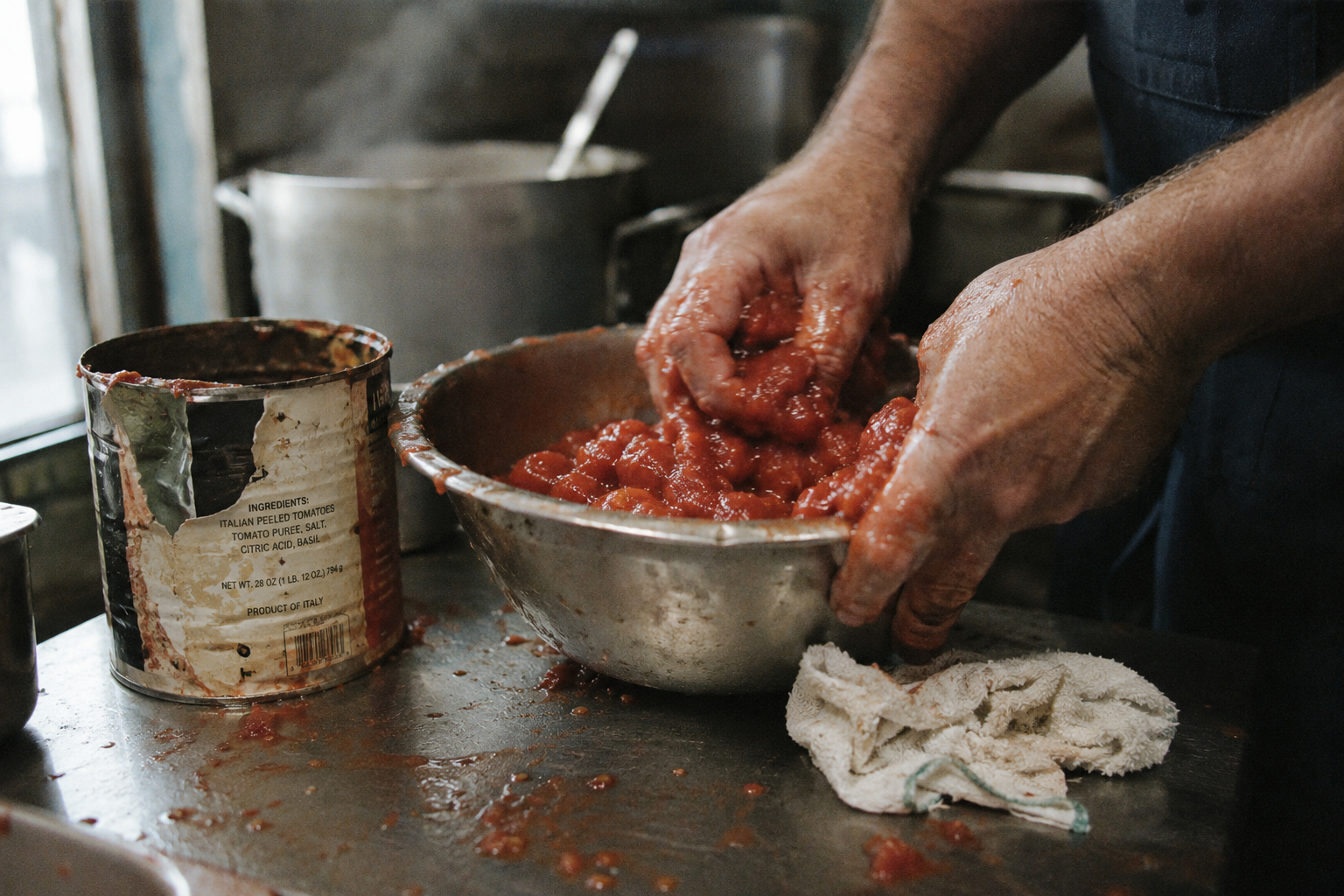
She would peel them. Run them through the food mill. Crush them. Jar them. Line them up like little soldiers for the winter.
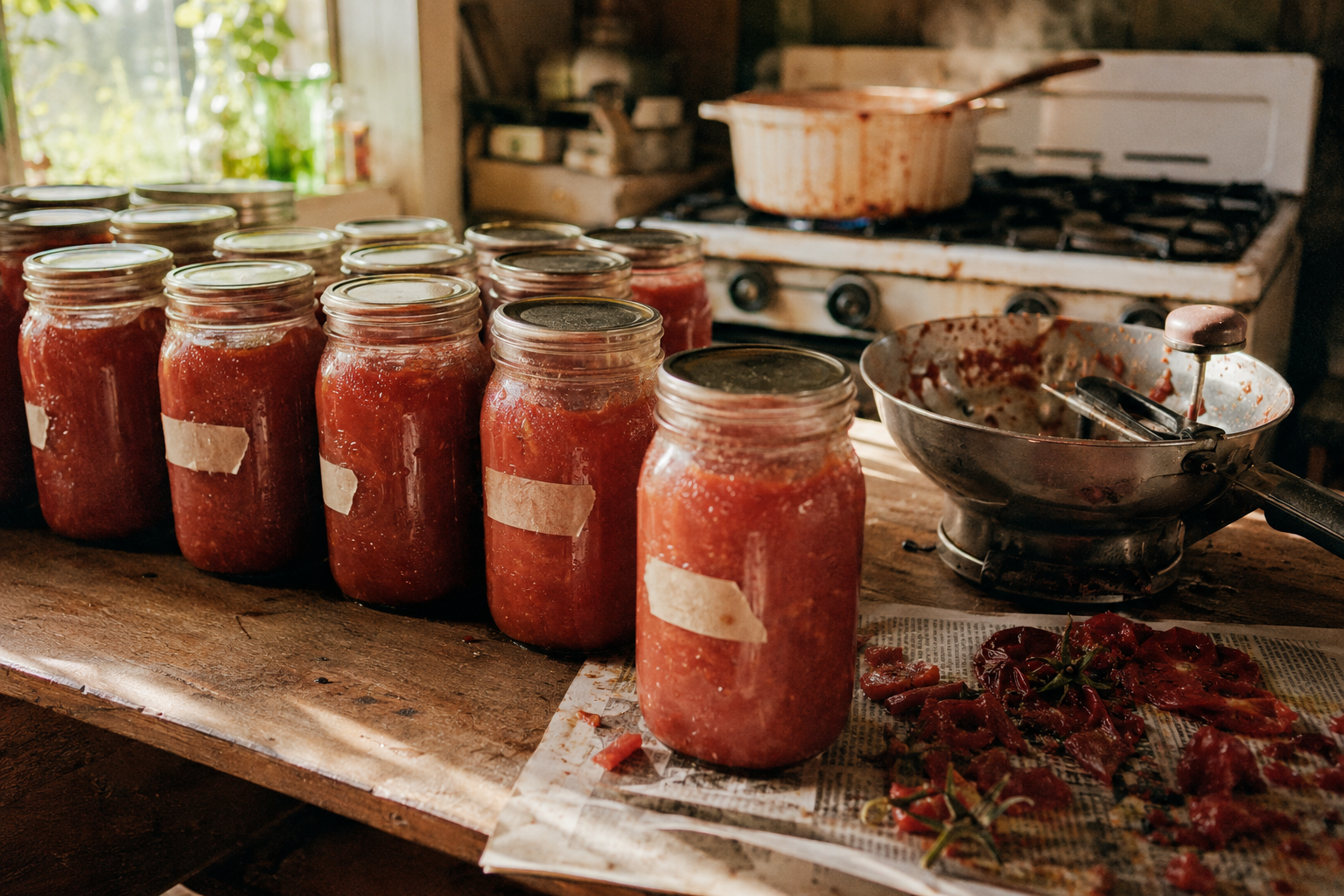
And as a kid, I remember the smell more than anything. That fresh, bright, almost green-sweet tomato smell. The skins. The steam. The jars. The whole kitchen alive with the reward of summer.
Those tomatoes were not an ingredient. They were insurance.
All winter long, when she made tomato sauce, she would go grab one of those jars. That was the base. That was the flavor. That was the sweetness. That was the acidity. That was the sauce.
And you know what she didn’t grab?
Sugar.
My grandmother never put sugar in tomato sauce. I don’t put sugar in tomato sauce. And if you start with good tomatoes, you don’t need sugar in tomato sauce.
Ah fongoo with the sugar.
Now, let’s talk about why.
Sugar Does Not Fix Tomato Sauce
This is one of the great kitchen debates: do you add sugar to tomato sauce or not?
People will argue about this like they’re defending a family inheritance. Some say, “My mother always added a pinch.” Some say, “My grandmother added a spoonful.” Some restaurants do it. Some home cooks swear by it.
Here’s the truth: sugar does not remove acidity. It masks acidity.
That’s an important distinction.
When tomatoes taste sharp, flat, metallic, sour, or thin, people often think the solution is sugar in tomato sauce. But sugar is not correcting the sauce. It is covering up the problem. It can make a harsh sauce taste softer, but it can also blur the character of the tomato.
I have spent 25 years watching sweetness cover up problems in food. It is the same story I told in my breakdown of the dangers of artificial sweeteners. Sweetness is the easiest way to hide a flaw, and hiding flaws is not cooking.
A great tomato sauce should taste alive. It should have brightness. It should have natural sweetness. It should have balance. It should not taste like dessert. It should not taste like ketchup. And it should not taste like somebody panicked and dumped white sugar into the pot because the tomatoes weren’t good enough.
The better question is not, “Should I add sugar?”
The better question is, “Why do I feel like this sauce needs sugar?”
That question makes you a better cook.
How to Make Tomato Sauce Less Acidic: Better Tomatoes, Salt, Time, and Technique
Most tomato sauce problems start before the pot ever hits the stove.
If the tomatoes are underripe, overprocessed, watery, metallic, packed with too much citric acid, or just low quality, you are already fighting uphill. Sugar becomes damage control.
But when you start with ripe tomatoes, whether fresh at the end of summer or properly canned at peak season, the sauce already has what it needs.
Tomatoes naturally contain sugar and acid. The magic is in the balance. When you simmer sauce gently, you reduce water. As water evaporates, the natural sugars and tomato flavor become more concentrated. You are not creating new sugar. You are concentrating what is already there.
That is why a sauce can taste sweeter after a slow simmer without adding anything sweet.
Salt matters too. Proper seasoning does not just make food salty. Salt wakes up flavor. It can soften bitterness, sharpen sweetness, and make acidity feel more balanced. Many cooks reach for sugar before they have properly seasoned the sauce. That is backwards.
Before sugar, taste for salt.
Before sugar, give the sauce time.
Before sugar, ask whether the tomatoes were good enough in the first place.
Fresh Tomatoes Versus Canned Tomatoes
Now, let’s be honest about restaurant kitchens.
Most restaurants are not making their everyday tomato sauce from fresh tomatoes.
They just aren’t.
Unless it is a very specific summer dish, a quick pan sauce, a concassé tomato preparation, or an à la minute special, restaurants rely on canned tomatoes. And there is a good reason for that.
Canned tomatoes are consistent. They are costable. They are available year-round. They are usually harvested and packed during tomato season. A good canned tomato in January can be far better than a pale, hard, out-of-season fresh tomato sitting in a produce case.
Fresh tomatoes are beautiful when they are truly ripe. That is what my grandmother understood. She was not grabbing supermarket tomatoes in February and pretending they were August tomatoes from the garden. She preserved peak ripeness.
That is the whole point of canning.
The can is not the enemy. Bad tomatoes are the enemy.
A good canned tomato is summer preserved.
A bad fresh tomato is just disappointment with a stem scar.
Why California Is Canned and Florida Is Fresh
People ask, “Why do I see so many canned tomatoes from California, but almost never from Florida?”
Simple: California grows for the can. Florida grows for the produce aisle.
That line explains a lot.
California dominates the U.S. processing tomato industry. Processing tomatoes are grown for sauce, paste, canned tomatoes, ketchup, and other tomato products. USDA’s California processing tomato reports track that industry every year, and California is the center of gravity for processing tomatoes in the United States.
Florida, on the other hand, is a major fresh-market tomato state, especially for winter supply. University of Florida research notes that Florida fresh tomatoes are produced from October to June, with peak periods in April–May and November–January.
The reason is climate and infrastructure.
Processing tomatoes love a hot, dry growing season and controlled irrigation. California has that. The state also has the processing plants, contracts, trucks, growers, and entire supply chain built around getting tomatoes from field to factory fast.
Florida is warm and humid. It has rain pressure, disease pressure, and a fresh-market business model. Those tomatoes are grown to be picked, packed, shipped, sliced, and sold fresh.
So when you walk into a store and see canned tomatoes from California, that is not an accident. That is the industry doing what it was built to do.
Italy, Campania, Puglia, Emilia-Romagna, and the Tomato Shelf
People often ask me, do Italians put sugar in tomato sauce? In the kitchens I grew up around and the ones I have visited across Italy, the answer is no. The tomato is expected to carry its own sweetness. That expectation starts with where the tomatoes come from.
When people think canned Italian tomatoes, they usually think San Marzano.
And for good reason.
Real San Marzano DOP tomatoes come from the Sarnese-Nocerino area near Naples and Salerno in Campania. The Italian Ministry of Agriculture’s PDO profile describes it as a tomato grown exclusively in that production area, with strict controls and manual cultivation practices.
San Marzano tomatoes are prized because they are meaty, balanced, relatively low in seeds, and excellent for sauce. But here is where people get fooled: not every can that says “San Marzano style” is real San Marzano DOP. Read the label. It is the same shell game I called out in what “authentic Italian” really means. The romance is on the front of the can. The truth is on the back.
And also, San Marzano is not the only great canned tomato.
Puglia grows beautiful plum and cherry tomatoes. Campania gives us legendary sauce tomatoes. Emilia-Romagna is home to serious tomato processing. California produces excellent processing tomatoes. New Jersey has a smaller but proud tomato culture. Israel and other Mediterranean regions also show up on specialty shelves.
But here is the chef’s rule: don’t buy by romance alone. Buy by producer.
The best question is not just, “What country is this from?”
The better question is, “Who packed it, when was it packed, what variety is it, and what else is in the can?”
The Best Canned Tomatoes for Sauce: Plum, Cherry, Datterino, Crushed, or Whole Peeled?
For traditional tomato sauce, whole peeled plum tomatoes are still the gold standard.
Plum tomatoes, including Roma and San Marzano types, are meaty. They have fewer seeds, less water, and more body. That makes them ideal for sauces that need depth.
Whole peeled tomatoes also give you control. You can crush them by hand. You can mill them. You can leave some texture. You can cook them down slowly. You are not locked into someone else’s idea of “crushed.”
Crushed tomatoes are convenient and can be great for faster sauces, but quality varies wildly. Some are beautiful. Some are watery. Some are packed with purée. Some taste cooked before you even cook them.
Diced tomatoes are often the worst choice for sauce. Many diced tomatoes contain firming agents like calcium chloride so they hold their cube shape. That is fine for chili or certain preparations, but if you want a sauce where the tomatoes melt, diced tomatoes can fight you.
Passata is smooth, strained tomato. It is not tomato paste. It is not heavily reduced. It is great when you want a smooth, quick sauce, a pizza base, a soup base, or a refined texture.
Tomato purée, depending on the producer and country, can mean a thicker cooked tomato product. In the Mutti lineup, for example, tomato puree is described as sweet and velvety, while paste is the concentrated product used for intensity and texture.
Tomato paste is the power tool. It is concentrated. It brings color, body, and deep tomato intensity. But it should usually be cooked in fat for a minute or two to bloom and darken slightly before you build the sauce. Raw tomato paste dumped into liquid tastes flat and metallic.
Now let’s talk about canned cherry tomatoes.
This is where I’ve personally shifted.
I love canned cherry tomatoes for certain sauces. They bring natural sweetness, brightness, and a fresh tomato character that you do not always get from standard plum tomatoes. Mutti describes cherry tomatoes as rich, sweet, and intense, and their product line also identifies cherry and datterini tomatoes as sweet, succulent specialty tomatoes.
That is exactly why they work so well in a sauce where you do not want to add sugar.
I’m making albóndigas right now with canned cherry tomatoes, smoked paprika, a touch of saffron, and pepper flakes. That sauce does not need sugar. The cherry tomatoes bring the lift. The paprika brings smoke and depth. The saffron brings perfume. The pepper flakes bring heat. The job of the cook is not to sweeten it. The job of the cook is to balance it.
Here is the direct comparison I give cooks who ask which can to grab:
| Tomato product | Best for | Watch out for |
|---|---|---|
| Whole peeled plum | Classic slow-simmered sauce | Watery packing juice in cheap brands |
| Cherry or datterini | Bright sauces with natural sweetness | Higher price per can |
| Crushed | Faster weeknight sauces | Wild quality swings and added purée |
| Passata | Smooth pizza and quick sauces | Confusing it with paste |
| Diced | Chili and chunky dishes | Calcium chloride blocks melting |
| Paste | Deep backbone in ragù and braises | Must bloom in fat first |
Mutti and the Modern Tomato Shelf
Mutti is a great example of why producer matters.
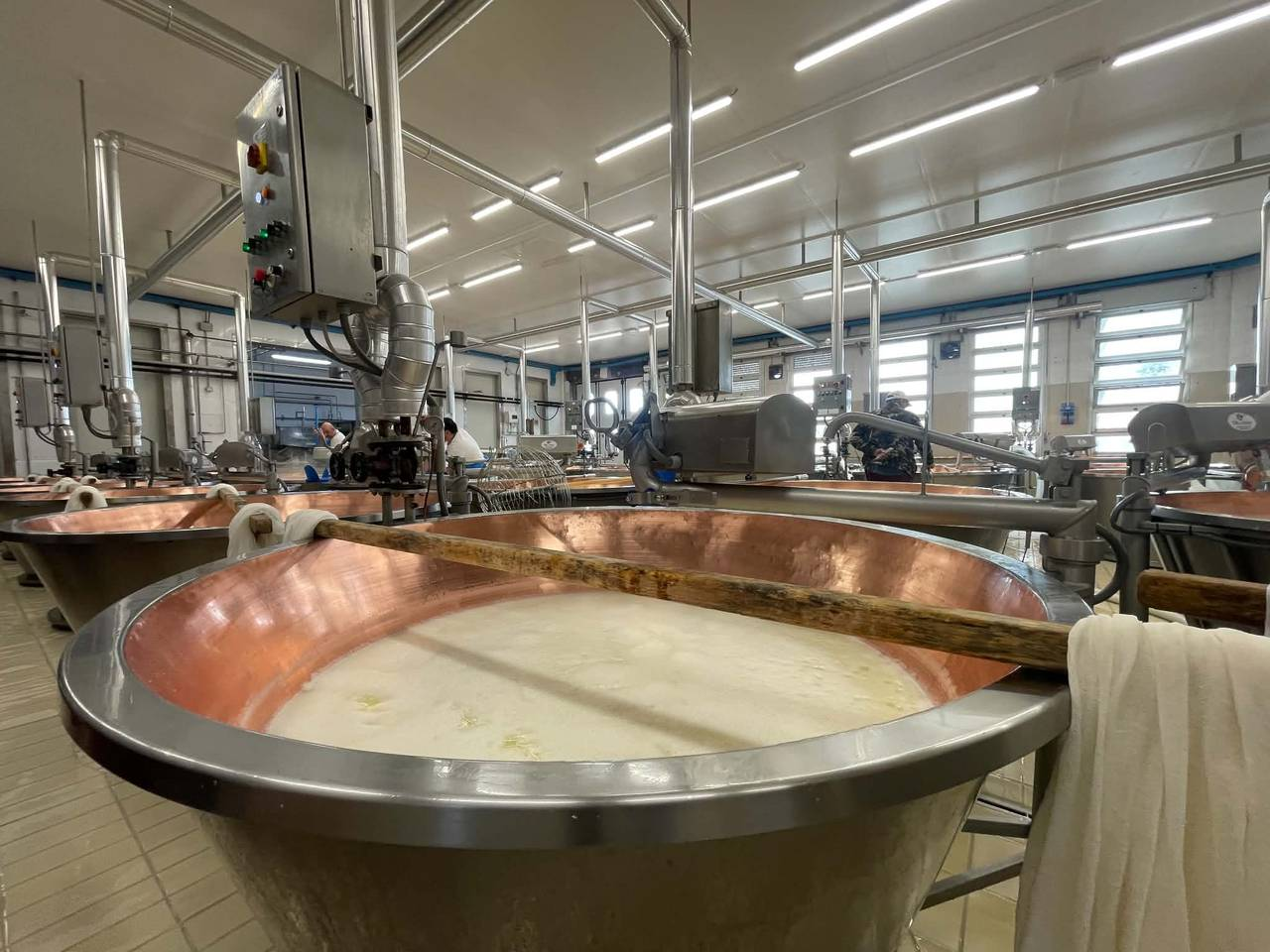
The company is based in Parma and has become one of the most recognizable premium Italian tomato brands. Their own field to table material emphasizes full maturity, fast processing, and quality control, including measuring sugar content, acidity, and color before tomatoes go into finished products. Mutti says tomatoes are transformed in less than 24 hours after harvest.
That matters.
Because good tomato products are not an accident. They are agriculture plus timing plus processing.
Mutti also makes different products for different uses: polpa, passata, concentrati, pelati, cherry tomatoes, datterini, and San Marzano tomatoes. Their own product guide separates crushed tomatoes, tomato puree, paste, whole peeled tomatoes, cherry tomatoes, San Marzano tomatoes, and datterini tomatoes by texture and use.
That is how cooks should think.
Do not just grab “tomatoes.”
Grab the right tomato product for the job.
If I want a rustic, slow-cooked Sunday sauce, I’m probably reaching for whole peeled plum tomatoes.
If I want bright, fast, sweet tomato energy, I may grab canned cherry tomatoes.
If I want smooth pizza sauce or a silky base, passata makes sense.
If I want deep tomato backbone in a braise, stew, ragù, or Spanish-style sauce, tomato paste has a job.
Each product has a purpose.
What About Carrots?
Here is another classic move: “Add a carrot to tomato sauce instead of sugar.”
You will see this all over the place.
Some people grate carrot into the sauce. Some simmer a whole carrot and remove it. Some use carrot as part of a soffritto.
Let’s separate two things.
In Bolognese, ragù, and many northern or central Italian meat sauces, carrot is part of the aromatic base: onion, celery, and carrot. The French call a similar aromatic base mirepoix. In Italian cooking, soffritto gives depth, sweetness, and structure. But that does not mean the carrot is there as a sugar substitute.
In a simple southern-style tomato sauce, carrot is not automatically required.
Can it help soften a sharp sauce? Yes.
Is it traditional everywhere? No.
Is it better than white sugar? Usually, yes, because it brings vegetable sweetness and body instead of just sweetness.
But again, I come back to the same standard: if you need carrots to rescue your tomato sauce, ask what went wrong with the tomatoes.
Carrot is a tool. It is not a rule.
What About Wine?
Wine in tomato sauce is another misunderstood ingredient.
Some sauces call for wine. Many ragùs use wine. Bolognese often uses wine. Tuscan meat sauces may use red or white wine. Spanish-influenced sauces may use wine. Braised meat sauces love wine.
But a simple tomato sauce does not need wine just because you have an open bottle.
Wine adds acidity. It also adds aroma, fruit, tannin, and complexity. Red wine can make a sauce darker, deeper, and more robust. White wine keeps things brighter and more delicate.
But wine does not “fix” acidity. It can actually add more.
The reason wine works is because you cook it down. The alcohol and sharp volatile notes reduce. What remains is complexity.
So use wine when the sauce calls for layers. Do not use wine because you think tomato sauce automatically needs it.
And do not use wine as a cover-up for bad tomatoes.
The Professional Kitchen Reality
In professional kitchens, consistency matters.
If you are making five gallons of tomato sauce, you need to know how that sauce will taste every time. You need the same body. The same acidity. The same yield. The same food cost.
That is why canned tomatoes are the workhorse.
A chef may use fresh tomatoes for a summer special, a quick seafood pasta, a concassé garnish, a blistered cherry tomato pan sauce, or a dish where the fresh tomato is the point.
But for a house marinara, pizza sauce, braised meat sauce, lasagna sauce, or volume production, good canned tomatoes usually win.
That is not cheating.
That is smart cooking.
It is also one of the fastest ways to judge a restaurant. I said it in my truth about food influencers: tomatoes do not lie. A kitchen that invests in great tomatoes cares.
The real skill is knowing which canned tomato to buy and how to handle it.
How to Read the Can
Here is what I look for:
- Ingredients should be simple. Tomatoes. Tomato juice or tomato purée. Maybe salt. Maybe basil. That is about it.
- Watch for added sugar. You do not need it.
- Watch for too much citric acid. A little acidity regulator is common in canned tomatoes, but if the tomato already tastes sharp, you may feel it in the final sauce.
- Watch for calcium chloride in diced tomatoes. It keeps tomatoes firm, which is exactly why they often refuse to melt into sauce.
- Look for whole peeled tomatoes when making classic sauce.
- Look for cherry tomatoes or datterini when you want natural sweetness and brightness.
- Look for passata when you want smoothness.
- Look for tomato paste when you want concentration.
And most of all, taste the tomatoes before you build the sauce.
Open the can. Taste them.
Do they taste ripe? Do they taste metallic? Do they taste sweet? Do they taste flat? Do they taste like something you actually want to eat?
The sauce starts there.
My Rules for Tomato Sauce
- Start with the best tomatoes you can afford.
- Use whole peeled plum tomatoes for classic sauce.
- Use canned cherry tomatoes when you want brightness and natural sweetness.
- Use passata for smooth, quick sauces.
- Use tomato paste when you need depth, but cook it properly.
- Salt before sugar.
- Simmer gently. Do not beat the sauce to death.
- Do not add sugar just because a recipe says so.
- Use carrots when they belong, not as a confession that the tomatoes failed.
- Use wine when the sauce needs complexity, not as a reflex.
- Remember: reduction concentrates flavor. Time rounds edges. Good tomatoes do not need a disguise.
My secret hack for depth: sundried tomatoes. Not the ones packed in oil, nor the ones treated with sulfites. Good old-fashioned sundried tomatoes, soaked and pureed, melted into the sauce.
Master chef tip: Marco Pierre White likes to grate the onion to release the water. He explains that the onion water is acidic. Just one more step to avoid sugar. That is fundamentals-first thinking, the same lesson I took from Pierre Koffmann’s kitchen in Fundamentals Over Flash.
FAQ: Sugar in Tomato Sauce
Should you add sugar to tomato sauce?
No. Sugar masks acidity instead of fixing it. If a sauce tastes sharp, the problem is usually the tomatoes, the seasoning, or the cooking time. Fix those and the sauce will not ask for sugar.
Do Italians put sugar in tomato sauce?
Traditional Italian home cooking does not call for it. My grandmother from Puglia never used sugar. Her tradition started with ripe tomatoes preserved at peak season, so the sweetness was already in the jar.
Why do people put sugar in spaghetti sauce?
Usually because the tomatoes were not good enough. Underripe, watery, or overly acidic tomatoes make a sharp sauce, and sugar in spaghetti sauce is the fastest cover-up. It softens the harshness but blurs the tomato flavor.
How do you make tomato sauce less acidic without sugar?
Salt properly, simmer gently, and give the sauce time. Reduction concentrates the natural sugars already in the tomato. Grated onion, a proper soffritto, or pureed sundried tomatoes add body and sweetness without white sugar.
What are the best canned tomatoes for sauce?
Whole peeled plum tomatoes are the gold standard for classic sauce. Canned cherry or datterini tomatoes bring natural sweetness and brightness. Buy by producer, keep the ingredient list short, and taste the tomatoes before you cook.
The Bottom Line
My grandmother from Puglia did not put sugar in tomato sauce.
She did not need to.
She started with ripe tomatoes at the end of summer, when tomatoes taste the way tomatoes are supposed to taste. She preserved them. She respected them. She let the ingredient do the talking.
That is still the lesson.
Whether you are using tomatoes from your garden, San Marzano DOP from Campania, cherry tomatoes from Puglia, a great California canned tomato, a New Jersey summer pack, or a premium producer like Mutti, the principle does not change.
Start with quality.
Cook with patience.
Season with intelligence.
And stop trying to fix tomato sauce with sugar.
Because real tomatoes, treated right, already know what to do.