



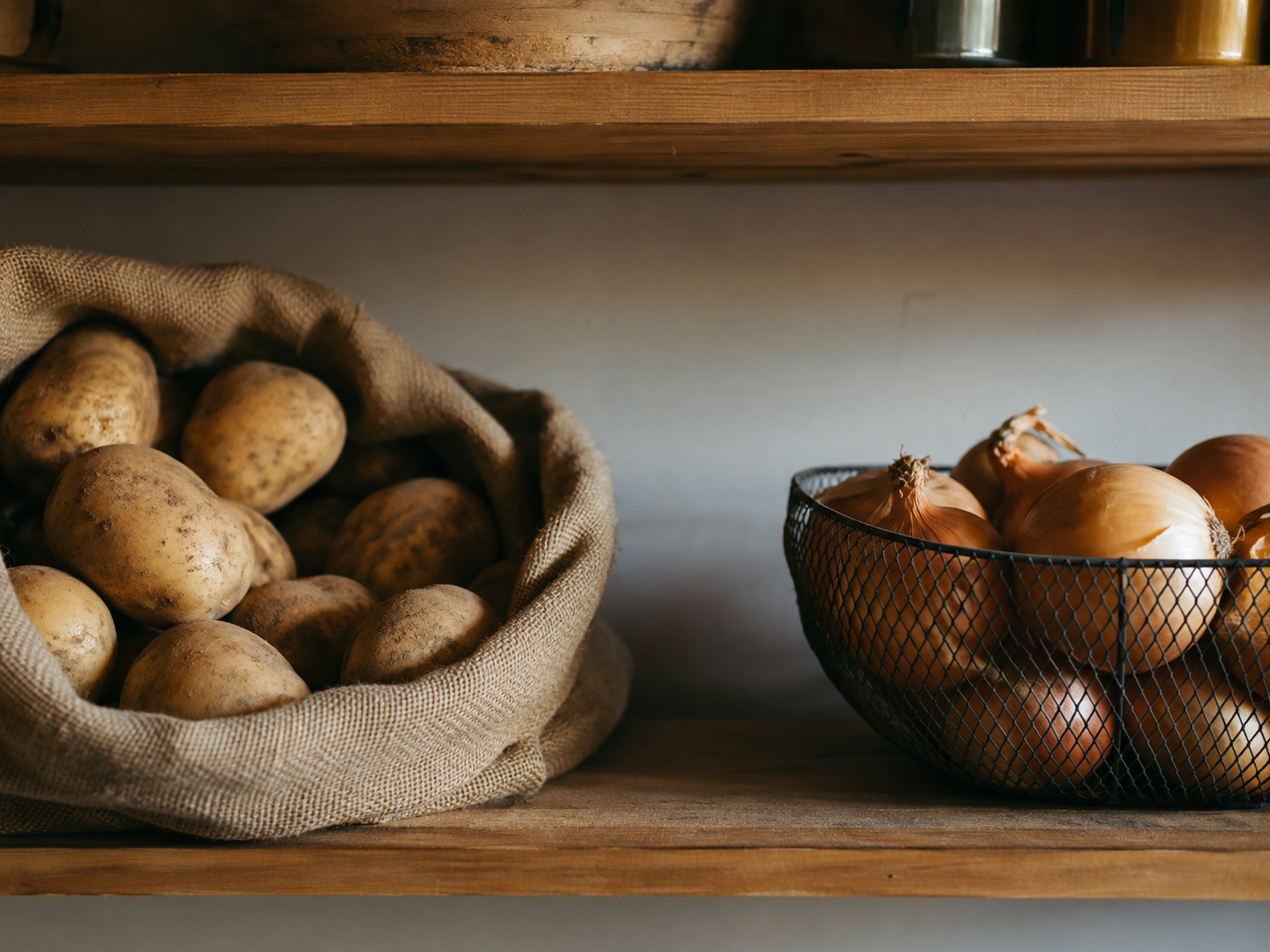
After more than 40 years in kitchens, I still remember one storage lesson from my mid-twenties. Should potatoes and onions be stored together? No.
I learned that at the Woodmoore Country Club, not at La Tante Claire in London or The Greenbrier in West Virginia. A Shamrock Foods produce salesman taught me. That detail still matters because most cooks I meet store both crops side by side. For a home cook, one change saves groceries and cuts waste.
Should Potatoes and Onions Be Stored Together? No.
At 25, I became Executive Chef of the Woodmoore Country Club. I thought I knew professional storage. Then my Shamrock Foods representative started asking questions. He asked about berries, greens, onions, and potatoes.
He looked at our setup and told me the potatoes and onions should not share the same storage area. I remember thinking, “Wait, what?” Every kitchen I had worked in seemed to put them together. That included trained cooks who cared about food quality and cost.
If you ask should potatoes and onions be stored together, my answer is simple. Each crop needs its own airflow and storage.
Key Takeaways: At the Woodmoore Country Club, one produce salesman showed me that two familiar storage crops need separate spaces. Keeping them apart helps each crop stay closer to the conditions it needs.
The Produce Salesman Who Changed My Storage Habits
That Shamrock Foods visit stayed with me for decades because it exposed a gap in chef training. I had already worked in serious kitchens by then. Later, I trained at La Tante Claire under Pierre Koffmann and worked at The Broadmoor and The Greenbrier. Those kitchens taught technique and discipline.
Yet the storage lesson came from the person delivering produce. That still makes me smile after more than 23 years of owning Aroma Thyme Bistro. I have hired hundreds of cooks over 23 years. Very few arrive talking about the storage needs of onions and potatoes.
That is why the question, can you store potatoes and onions together, deserves more than a quick yes or no. The better question is what each crop needs. A great cook does not only ask how to prepare an ingredient. The better question is what keeps it at its best.
Key Takeaways: Marcus learned this lesson from a Shamrock Foods produce representative around age 25. The story shows that useful kitchen knowledge can come from growers, buyers, vendors, and delivery people as well as chefs.
Why Storing Potatoes and Onions Together Causes Trouble
Potatoes and onions look like pantry neighbors because both can sit outside the refrigerator. Their storage needs still differ in useful ways.
Potatoes prefer a cool, dark place with airflow and enough humidity to limit drying. Onions do better in a drier area with strong ventilation. Put both crops in one closed bin, and you create a compromise. One crop may face more moisture, warmth, or trapped air than it handles well.
Both crops stay biologically active after harvest. They respond to temperature, humidity, gases, light, and the condition of nearby produce. The CDC food safety guidelines explain why proper storage conditions matter for food safety. That is why storing potatoes and onions is not just a matter of finding an empty basket. The surrounding environment affects sprouting and spoilage.
| Potatoes | Onions | |
|---|---|---|
| Temperature | Cool (45-50°F) | Cool and dry |
| Humidity | Moderate | Low |
| Ventilation | Good airflow | Excellent airflow |
| Light | Complete darkness | Darkness |
| Container | Paper bag, burlap, ventilated bin | Mesh bag, open basket |
| Near each other? | Keep apart | Keep apart |
One thing I learned from restaurant purchasing is that storage mistakes rarely show up on day one. Damage builds slowly.
By the time a potato softens or an onion turns wet, the problem may have been building for days. That is why I check airflow, moisture, light, and temperature before a case at Aroma Thyme Bistro looks spoiled.
The same idea appears across food science. My guide to what umami really means starts with the same habit: ask why.
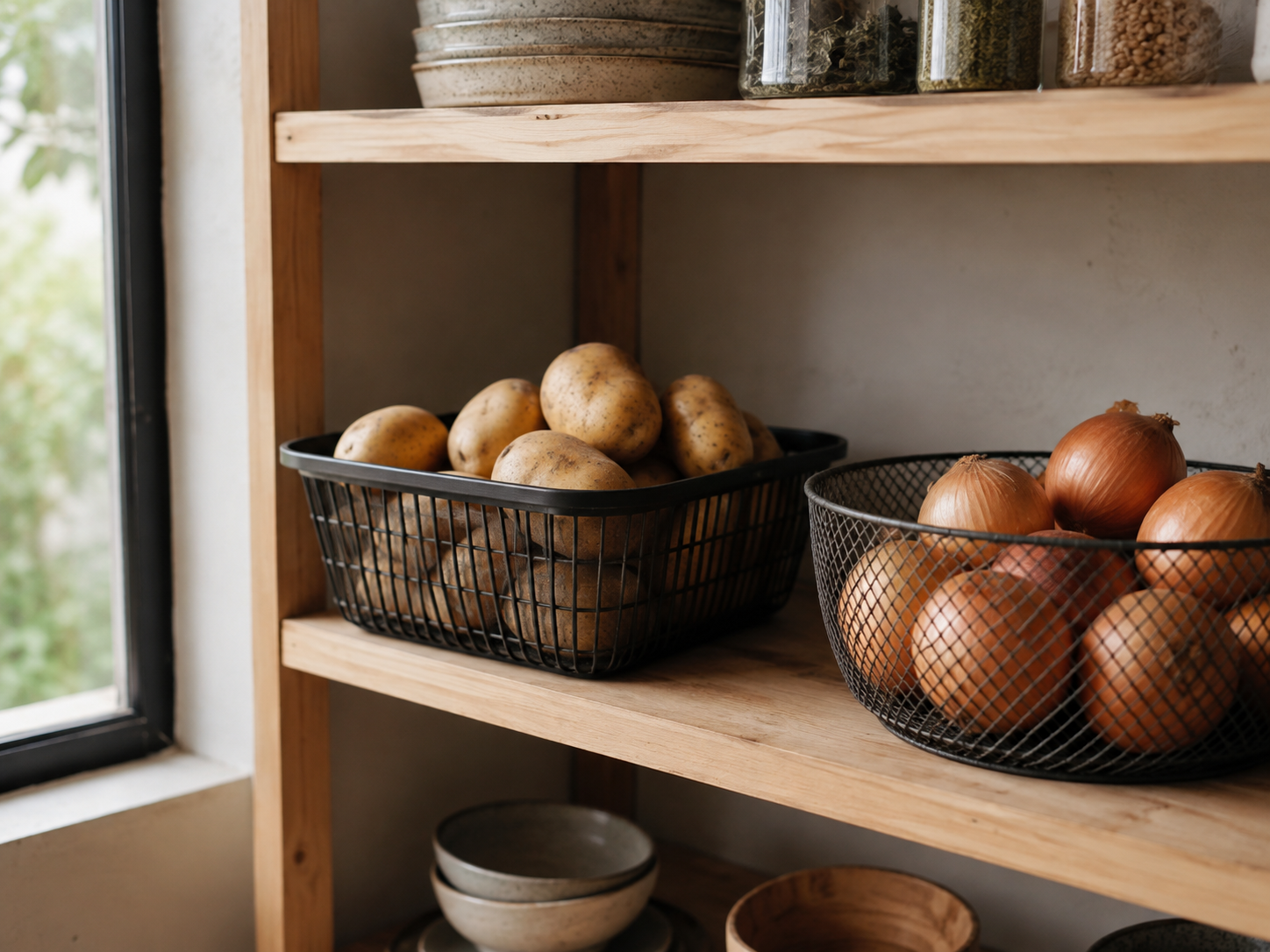
Key Takeaways: Potatoes need cool darkness and onions need dry ventilation. A shared closed container can create the wrong balance of moisture and airflow, which can shorten usable storage time.
How to Keep Potatoes Fresh Longer
At Aroma Thyme Bistro, potatoes do not sit beside onions. I treat their storage area as part of prep, not as leftover pantry space. The first rule is darkness because light can damage potato quality. Sealed plastic is a poor choice for potatoes.
The second rule is cool storage without putting raw potatoes in a typical refrigerator. Home refrigerators often run much colder than a pantry.
For home cooks asking how to keep potatoes fresh longer, I use five simple checks:
- Keep potatoes in a dark place.
- Give the container steady airflow.
- Keep them away from onions.
- Check the batch for soft or damaged potatoes.
- Remove problem potatoes before they affect the rest.
In a restaurant, I rotate the oldest potatoes forward before a new delivery goes into storage. That habit costs nothing. At home, do the same after each grocery run and look for cuts, wet spots, or early softening. A five-pound bag is easier to manage when the oldest potatoes stay visible instead of disappearing under the newest ones.
A five-pound bag can last longer when you inspect it instead of forgetting it for two weeks. One soft potato is easier to remove than five spoiled ones.
I use the same thinking with fish. My fresh and frozen fish guide follows the same handling rule.
Key Takeaways: Potato storage works best with darkness, airflow, regular checks, and distance from onions. Check the potato bag for five minutes each week.
How to Keep Onions Fresh Longer
Onions need a different setup because dryness and ventilation matter more. At Aroma Thyme Bistro, I want air moving around them. A mesh bag, open basket, or ventilated crate gives whole onions room to breathe. Sealed plastic traps moisture around onions.
If you are learning how to keep onions fresh longer, start with three habits:
- Keep whole onions in a cool, dry, dark place.
- Use a container that allows air to move.
- Keep them away from potatoes and wet produce.
Cut onions are different. Once an onion is cut, it belongs in the refrigerator in a covered food-safe container.
At Aroma Thyme Bistro, I also keep whole onions where I can see and inspect them. Hidden produce is easy to forget. If one onion feels wet or starts to break down, I remove it before the next prep shift. An open basket makes that check easier.
At Aroma Thyme Bistro, that habit protects each delivery.
That distinction is basic, but it prevents a common pantry mistake. Whole and cut onions need different storage.
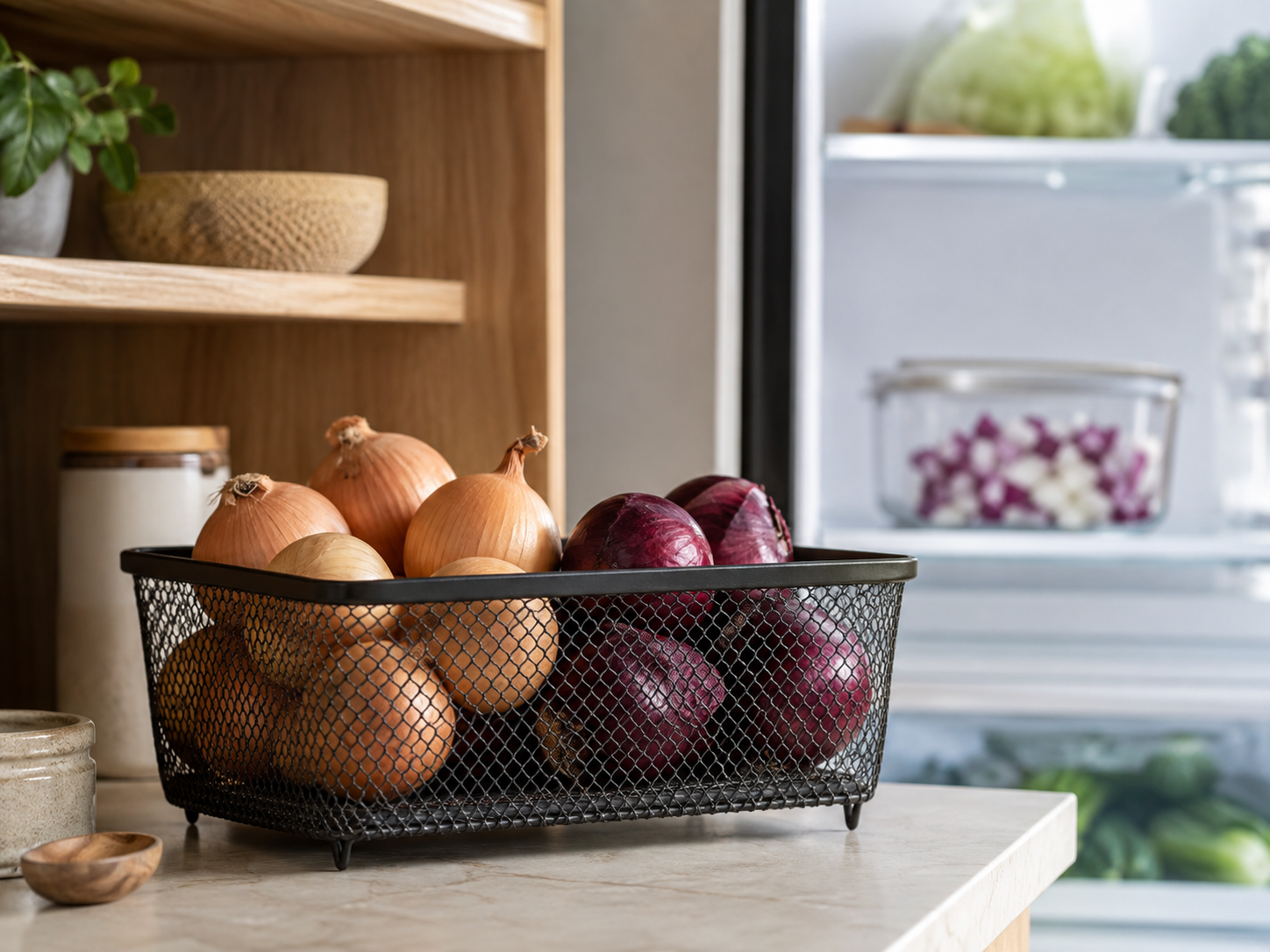
Key Takeaways: Whole onions need a dry, ventilated pantry space, while cut onions need refrigeration. Whole and cut onions need different handling.
What New York’s Black Dirt Region Taught Me
About 30 minutes from Aroma Thyme Bistro is New York’s Black Dirt Region. The dark organic soil there, documented by Cornell Cooperative Extension, supports farms known for onions and other crops. An ancient glacial lake once covered that land. Farmers there understand that storage protects months of work.
That matters after a full growing season of planting, watering, harvesting, and packing. Storage protects that work. That farmer mindset changed how I think about shelf life. A crop does not stop costing money once it leaves the field.
For a restaurant, a spoiled case affects food cost. For a family, a spoiled bag means another grocery purchase that did not need to happen. This is where shelf life of fruits and vegetables becomes practical.
An extra week can save several meals.
Key Takeaways: The Black Dirt Region sits about 30 minutes from Aroma Thyme Bistro, and its farms make storage feel concrete. Every extra usable day protects the work, water, labor, and money already invested in a crop.
Produce Storage Is Really Food Waste Reduction
For more than 23 years at Aroma Thyme Bistro, I have watched small handling choices affect purchasing. Waste rarely begins at the trash can. Over 23 years at Aroma Thyme Bistro, food cost has never been an abstract number. Every spoiled case shows up somewhere.
Home kitchens work on a smaller scale, but the math is the same. That can mean 12 fewer replacement bags in a year. It often starts when a case goes into the wrong corner, a bag stays sealed, or one damaged item gets ignored. Produce storage is part of cooking.
That is also why sustainable cooking is not only about buying local or choosing seasonal food. It includes using more of what you already bought. Food waste reduction can start with one shelf and two baskets. Separate the two crops, then check them each week.
I use the same pantry mindset when I talk about real versus fake balsamic vinegar. Better buying and better storage belong together.
If a household saves two onions and three potatoes each month, that is 60 pieces of produce over a year. Small habits become real numbers.
Key Takeaways: Food waste reduction starts before food reaches the cutting board. A weekly check helps use what you already bought.
Food Science Taught Me to Keep Asking Why
Harold McGee and Shirley Corriher changed how many chefs think about the kitchen. I had the privilege of cooking alongside both of them. I still recommend McGee’s On Food and Cooking and Corriher’s CookWise to serious cooks. Recipes tell you what to do, but science explains why.
Alton Brown built much of his work around that same question. Why does one ingredient sprout while another wilts? That question turned one produce delivery at the Woodmoore Country Club into a career lesson for me. I never forgot the storage conversation.
The same habit applies to mushrooms, berries, leafy greens, herbs, tomatoes, and garlic. Each ingredient has its own limits and ideal conditions. If you care about the should potatoes and onions be stored together question, keep going. Ask what each ingredient needs before heat touches it.
Key Takeaways: Marcus connects one Woodmoore Country Club storage lesson with decades of food science study. Asking why helps cooks understand ingredients instead of memorizing isolated kitchen rules.
What This Means for Your Kitchen
I still think about that Shamrock Foods salesman. One question about a storeroom changed how I handled produce. The rule is easy to remember: should potatoes and onions be stored together? Keep them separate.
You do not need restaurant equipment to do this. Two ventilated containers and a darker pantry corner can change how much produce you throw away. That is a useful form of sustainable cooking because it starts with food already in your home. Less spoilage means fewer replacement purchases.
The bigger lesson came from a produce salesman when I was about 25. Keep asking why when a kitchen habit seems normal.
Key Takeaways: Keep potatoes and onions apart, use ventilation, and check both during the week. The goal is not a perfect pantry. It is better shelf life, lower waste, and more respect for the food you already bought.