




Order a Caesar salad at almost any restaurant and there is a good chance you are eating a version that misses the mark. Not because the romaine is limp or the dressing came from a bottle. It misses for two reasons that have become so common most cooks no longer notice them.
The first mistake is treating Caesar salad as an Italian dish. The second is misunderstanding what anchovies are supposed to do in the bowl. Both trace back to the same place, the real caesar salad origin, and once you know that story the whole salad starts to make sense.
I have made this salad the wrong way. I have made it the right way. The gap between the two is where this post lives.
Where the Caesar Salad Origin Really Begins
The salad was not born in Rome, Tuscany, or anywhere in Italy. The caesar salad origin traces to 1924 in Tijuana, Mexico, at a restaurant run by an Italian immigrant named Caesar Cardini.
Cardini cooked for American tourists who crossed the border during Prohibition, chasing a good meal and a legal drink. The documented history of the dish puts its invention there, on a holiday weekend when the kitchen was running short on supplies.
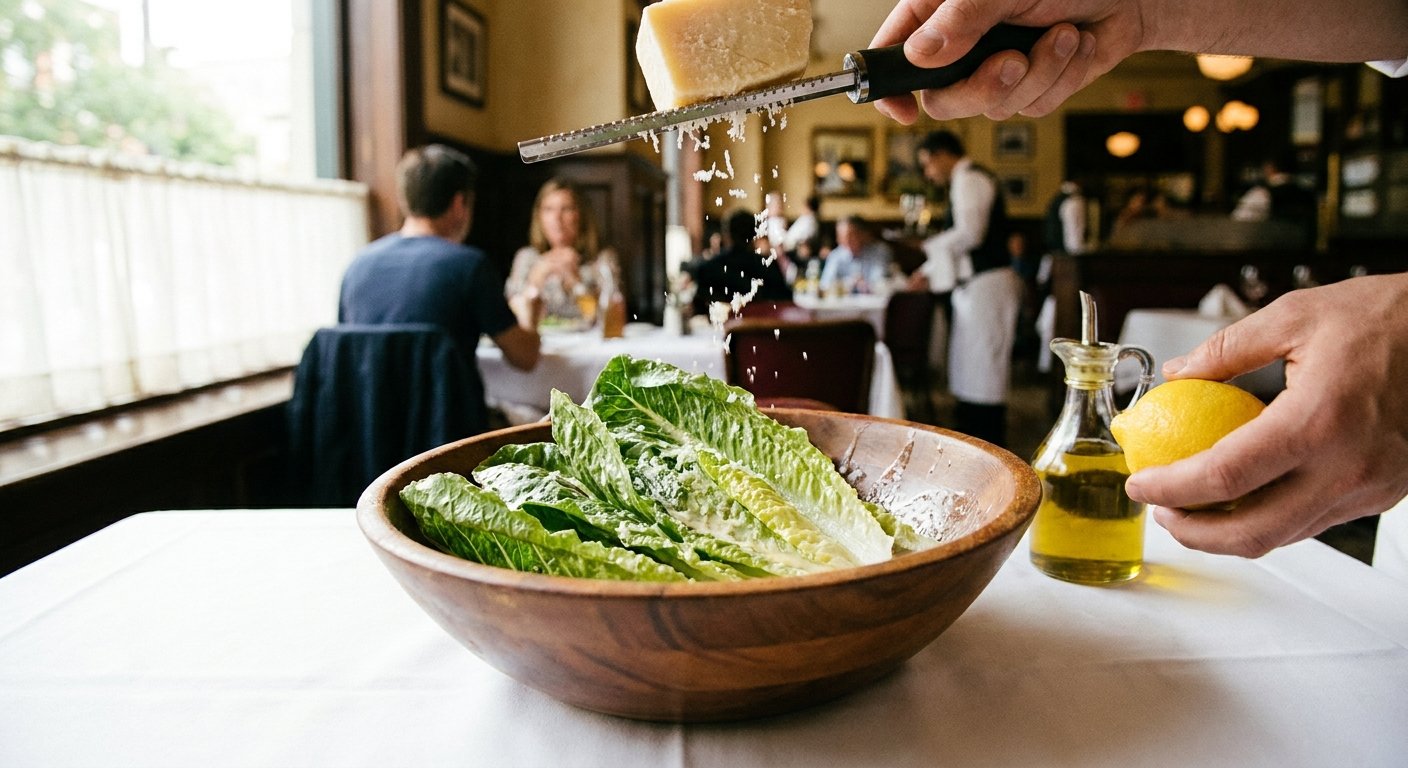
He built it from what he had on hand. Romaine, garlic, olive oil, lemon, coddled egg, Parmesan, Worcestershire, and croutons, tossed tableside for a full dining room. This was continental restaurant food made for travelers, not a regional recipe handed down through a family.
You will still see Caesar salad on menus all over Italy. That is not heritage. That is a kitchen giving tourists the dish they already expect.
Key takeaway: Caesar salad was invented in 1924 in Tijuana, Mexico, by Italian immigrant Caesar Cardini. Its roots are in border tourism and continental restaurant cooking, not Italian regional tradition.
Is Caesar Salad Italian?
The short answer is no. Cardini was Italian by birth, but the dish he created was not Italian food, and the two are easy to confuse.
This is the same trap I wrote about in what authentic Italian really means. A name, a heritage, or an accent on the menu does not make a dish traditional. Place and lineage do.
Caesar salad is a great dish with a great story. It just happens to be an American continental restaurant creation with an Italian surname, and calling it Italian rewrites where it came from.
Key takeaway: The creator's Italian heritage does not make the dish Italian. Caesar salad was built in an American continental restaurant in Tijuana for tourists, not handed down through an Italian regional cuisine.
The Anchovy Mistake in Caesar Salad
Here is where nearly every kitchen loses the plot. Some cooks pile in six anchovy fillets. Others skip anchovies entirely because a guest once said, “I do not like anchovies.” Both moves miss the point.
A properly made Caesar dressing should not taste like anchovies. Read that again, because it is the whole game. You should not bite into a Caesar and immediately think fish.
The anchovy is not there to announce itself. Its job is to disappear into the dressing and quietly make everything around it taste better. When you can pick it out, there is too much of it.
Key takeaway: Well made Caesar dressing never tastes like fish. The anchovy should dissolve into the background and lift the other flavors instead of standing out.
What Anchovies Actually Do
Anchovies are one of the great natural sources of umami, the deep savory taste I broke down in my guide to the fifth taste. That savory depth is exactly what a good Caesar needs.
They bring savory richness, body, and balance. Umami research ties that effect to glutamate, which occurs naturally in cured fish, aged cheese, and ripe tomatoes.
Think of the anchovy like the bass player in a band. Nobody leaves the show talking about the bass. Take it away, though, and the whole thing sounds thin and empty. That is the anchovy in Caesar dressing. Harmony, not dominance.
Key takeaway: Anchovies work in Caesar dressing because they are rich in natural glutamate, the compound behind umami. That adds savory depth and balance rather than an obvious fishy flavor.
What Is an Anchovy, Really?
Most people picture the wrong fish. The dark anchovies used in Caesar dressing are salt-cured anchovies, and the curing is what creates their flavor.
Fresh anchovies are small silver fish. Packed in salt and aged for months, often six to twelve, they undergo an enzymatic breakdown. That process concentrates flavor and builds their rich umami. The result reads as savory and deep, not harshly fishy.
Then there are white anchovies, often sold as boquerones. These are cured in vinegar and oil, so they stay pale, bright, and tangy. They are delicious, but they are a different product and the wrong choice for a traditional Caesar. Here is how the three options compare.
| Type | How it is made | Flavor | Right for Caesar? |
|---|---|---|---|
| Salt-cured (dark) | Packed in salt, aged 6 to 12 months | Deep, savory umami, not harsh | Yes, the traditional choice |
| White (boquerones) | Cured in vinegar and oil | Bright, tangy, fresh | No, wrong profile |
| Anchovy paste | Ground salt-cured anchovies | Concentrated and consistent | Yes, best for precision |
Key takeaway: The anchovies that belong in Caesar are salt-cured and aged for months for deep umami. Vinegar-cured white boquerones are a brighter, tangier product meant for other dishes.
How I Learned to Hide the Anchovy
My first Caesar dressings were wrong. Early in my career I worked in kitchens that made it the way many still do, with too much garlic and too much anchovy fighting each other for attention. Nothing was in balance.
Then I cooked at places like The Greenbrier and The Broadmoor. That is where the lesson landed. The best chefs were not trying to show off the anchovy. They were trying to hide it.
Not out of shame. Out of understanding. They knew the anchovy was there to build something bigger than itself, not to be tasted on its own. That is technique, and it changed how I have made this dressing ever since.
Key takeaway: Top kitchens like The Greenbrier and The Broadmoor bury the anchovy so it strengthens the dressing without being detected. That is the opposite of the heavy hand most cooks learn first.
How to Make Caesar Dressing the Right Way
Most recipes give you the worst possible instruction: add six anchovy fillets. That is terrible advice, because fillets vary wildly in size, saltiness, moisture, and intensity. Six from one tin is not six from another.
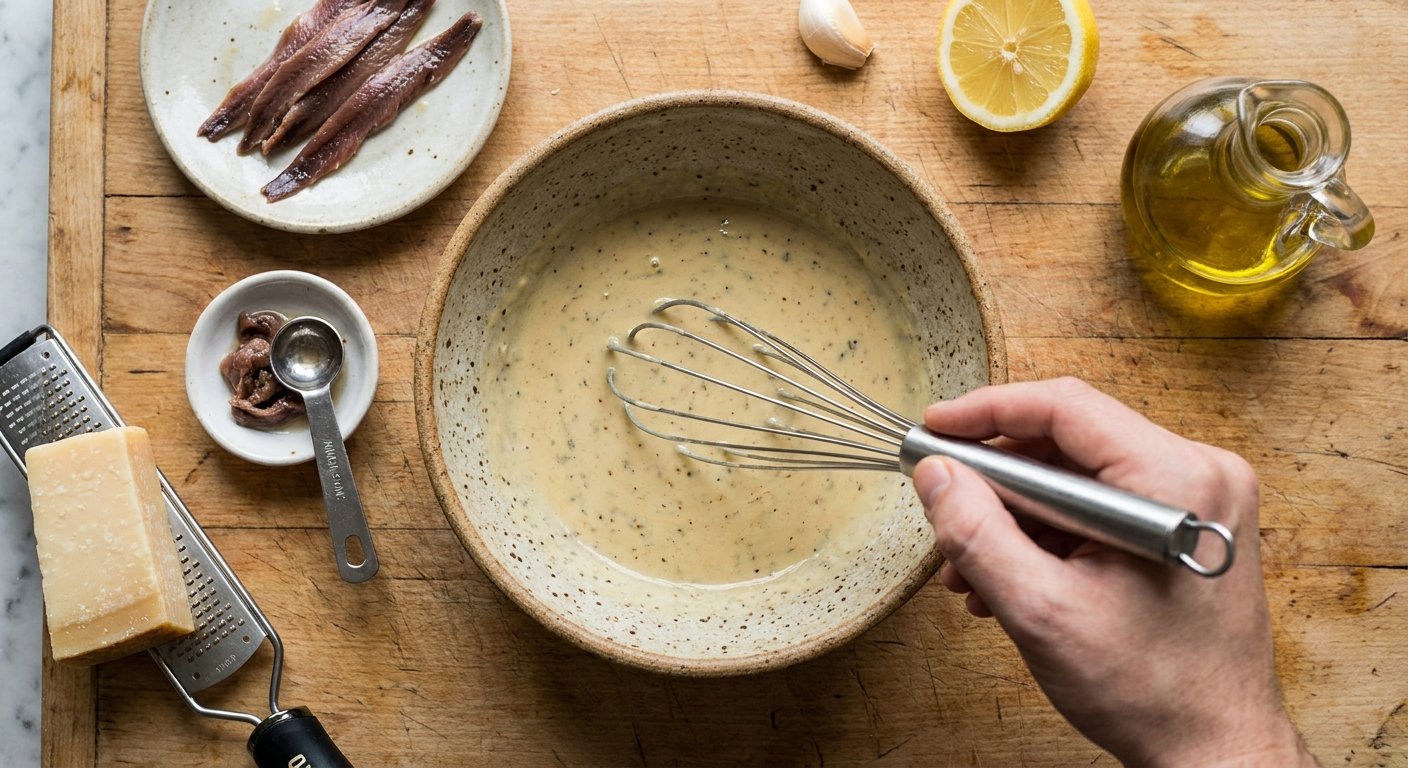
Measure the flavor instead of counting fish. I work with anchovy paste for exactly this reason. I can add a quarter teaspoon, taste, and adjust until the balance is right. That is how professional kitchens build consistency.
Everything else should support, not shout. Use good extra virgin olive oil, fresh lemon juice, real garlic in a light hand, and freshly grated Parmigiano Reggiano. Skip the bagged stuff, for the reasons I laid out in what is really in pre-shredded cheese.
Here is the compliment I have heard for years: “I love your Caesar because it has no anchovies.” It always does. The anchovy is simply doing its job so well that nobody catches it.
Key takeaway: Skip the six-fillet rule and use about a quarter teaspoon of anchovy paste, tasting as you go. Build around fresh lemon, good oil, restrained garlic, and freshly grated Parmigiano.
The Bigger Lesson
This was never really about salad. The caesar salad origin is one story, but the deeper one is about restraint. Too many cooks believe more is better. More garlic, more anchovy, more cheese, more of everything.
Professional cooking runs the other way. It is about balance and knowing when to stop. The skill is not in piling ingredients on. It is in making them work together until no single one is fighting for the spotlight.
That is the difference between assembling food and actually creating flavor.
Key takeaway: The real lesson behind Caesar salad is restraint. Balance and knowing when to stop separate thoughtful cooking from the habit of adding more of everything.
Frequently Asked Questions
Where does Caesar salad come from?
Caesar salad was created in 1924 in Tijuana, Mexico, by Italian immigrant Caesar Cardini. He ran a restaurant popular with American tourists during Prohibition and built the salad from pantry staples.
Is Caesar salad Italian?
No. Its creator was Italian, but the dish was born in an American continental restaurant in Tijuana that cooked for American travelers. It is not part of any Italian regional cooking tradition.
Should Caesar salad taste like anchovies?
No. Anchovies should add savory depth and richness, not dominate. If anchovy is the first thing you taste, the dressing has too much.
What do anchovies add to Caesar dressing?
They add umami, the deep savory taste tied to natural glutamate. Their role is to round out and strengthen the dressing, not to make it taste like fish.
What is the difference between dark and white anchovies?
Dark anchovies are salt-cured and aged for months, giving intense umami. White anchovies, or boquerones, are cured in vinegar and oil for a brighter, fresher flavor. They are not interchangeable in a traditional Caesar.
Is anchovy paste better than whole anchovies?
For Caesar dressing, paste offers control. You can add a small measured amount, taste, and adjust, which is much harder with whole fillets that vary from tin to tin.
The Bottom Line
Next time a Caesar lands in front of you, ask two questions. Is this really an Italian dish, and can you taste the anchovy? If the honest answer to the second one is yes, you have just found the mistake that trips up countless restaurants and even trained chefs.
Get both right and the payoff is a salad that tastes balanced, savory, and complete. That is the whole promise hiding inside the caesar salad origin, and it starts with treating one small fish with respect.
You can taste this philosophy in practice at Aroma Thyme Bistro, Marcus’s restaurant in Ellenville, NY.
About the author. Chef Marcus Guiliano has spent 30+ years in professional kitchens. Those include The Greenbrier, The Broadmoor, and Michelin 3-star La Tante Claire in London under chef Pierre Koffmann. He is the chef-owner of Aroma Thyme Bistro in Ellenville, NY, and a longtime advocate for real food and honest sourcing.
Internal fact-check (Phase 6a, Gemini 3 Pro). Remove before publishing.
| Claim | Verdict | Source and notes |
|---|---|---|
| Caesar salad was created in 1924 in Tijuana, Mexico, by Italian immigrant Caesar Cardini. | Verified | Wikipedia and Serious Eats confirm 1924, Tijuana, and Cardini. A minor dispute credits brother Alex Cardini or cook Livio Santini, but consensus credits Caesar Cardini. |
| The salad was invented during a busy Prohibition-era holiday weekend when supplies ran short. | Verified | Documented as the July 4, 1924 tourist rush; Prohibition drove US visitors across the border to Tijuana. |
| Despite Cardini’s Italian heritage, the dish is not Italian regional cuisine. | Verified | Created in a Mexican border restaurant for American tourists, not handed down through Italian tradition. |
| Original build: romaine, garlic, olive oil, lemon, coddled egg, Parmesan, Worcestershire, and croutons, tossed tableside. | Verified | Matches the documented original recipe and tableside service. |
| Anchovies are traditional to Caesar and provide its savory backbone. | Accurate with nuance | Cardini’s original used Worcestershire sauce, which contains anchovy, rather than whole anchovy fillets; fillets were added by other chefs in the 1930s. Modern traditional Caesar commonly includes anchovy, so the culinary point holds. (Serious Eats) |
| Anchovies are rich in glutamate, the compound behind umami, also found in aged cheese and ripe tomatoes. | Verified | Established food science. |
| Salt-cured dark anchovies are aged about 6 to 12 months, deepening umami through enzymatic breakdown. | Verified | Accurate description of salt-curing and fermentation. |
| White anchovies, sold as boquerones, are cured in vinegar and oil for a brighter, tangier profile. | Verified | Accurate; boquerones are a distinct product. |
| Anchovy paste is ground salt-cured anchovy, useful for measured, consistent dosing. | Verified | Accurate. |
| Author credentials: Chef Marcus Guiliano, 30 plus years, including The Greenbrier, The Broadmoor, and Michelin 3-star La Tante Claire under Pierre Koffmann; chef-owner of Aroma Thyme Bistro, Ellenville NY. | Verified (author profile) | Matches the Marcus E-E-A-T profile; La Tante Claire held three Michelin stars under Koffmann in London. |