



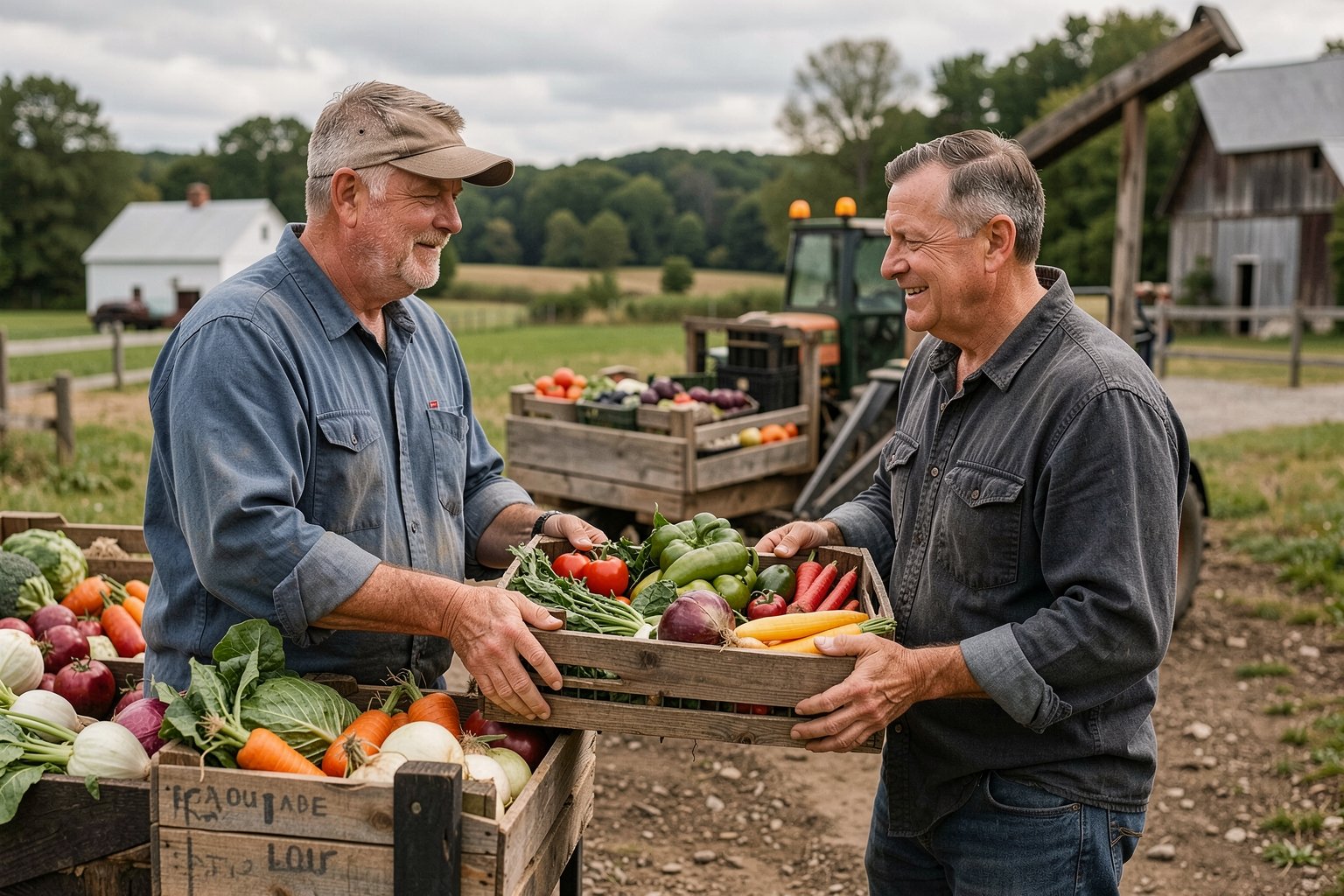
An ethical restaurant is not proven by a farm-to-table label. One test happens long before a guest sits down. When a farmer names a price, does the restaurant respect it? Does it treat that price as part of the cost of producing food? Or does it try to push the price lower right away?
I have spent decades buying from farmers and producers. I do not negotiate a farmer’s asking price down. That choice does not prove everything about a restaurant’s ethics. But it reveals how the business treats the people at the beginning of its supply chain.
Why does paying farmers their asking price matter when choosing a restaurant?
Because a farm price is not just a number pulled from the air. It has to cover inputs, labor, equipment, land or ownership costs, and losses. It also needs to leave enough return for the farm to remain viable. Cornell Small Farms’ guide to pricing farm products tells growers to account for variable costs, fixed costs, and profit. It warns against simply matching whatever another seller charges.
That does not mean every price is automatically beyond discussion in every kind of business transaction. It means I approach a farmer’s price differently from a commodity bid. When a farmer I know tells me what a crop costs, I do not start by asking, “How much can I knock off?” I want to know whether the ingredient, the relationship, and the menu make sense at that price.
For a diner choosing an ethical restaurant, that matters. A slogan can be invented. Purchasing behavior leaves evidence. A restaurant can say it wants to support local farmers. The test is whether its buying decisions give those farmers room to price for a functioning business.
Why I Don’t Negotiate With Farmers
This philosophy came from experience, not a branding exercise. Earlier in my career, while working at Walt’s Bistro in Colorado, I sourced from more than 50 local farms. I visited farms, walked the land, and talked with growers. Their reality was nothing like ordering cases through a distributor.
That changed the question for me. A farmer knows the cost of seed, fuel, labor, equipment, insurance, and land. The farmer also knows what weather losses and months of work can do to a crop. I did not think it was my place to tell that farmer the work was worth less. My restaurant wanting more margin was not enough reason.
That is also why I separate this article from the question of what “local” means. I have written before that local food sourcing is about relationships, not a mileage rule. Here, the point is price. A relationship means very little if the buyer praises the farmer in public. It means even less if that same buyer pressures the farmer in private.
My sourcing philosophy also predates the farm-to-table marketing cycle. The standards I learned early in my career shaped how I later approached direct sourcing. I discuss that background in my piece about what Michelin-level training taught me about sourcing. The thread is accountability. Know who produced the food, understand why you are buying it, and be prepared to stand behind the decision.
What Farmer Prices Mean for Restaurant Menu Economics
The concern is food cost. Restaurants operate on margins, and ingredient prices matter. The mistake is assuming that a farm price has to produce the same percentage increase on the menu.
One historical example from my own purchasing illustrates the difference. At one point, commodity pasta cost me roughly 25 cents per portion. A local pasta cost me about $1 per portion. Those were my purchasing numbers at the time, not current market quotes. The difference was about 75 cents on the plate. It did not require a fourfold increase in the menu price.
For an ethical restaurant, menu economics involve more than multiplying every ingredient cost by the same factor. A chef can change the dish, adjust the portion, or build around seasonal abundance. A higher-cost ingredient can also be paired with lower-cost farm staples. A chef can also decide that an ingredient simply does not fit the menu. Ethical food sourcing still has to work as a business, but “make the farmer take less” is not the only lever available.
Cornell also notes that prices vary by locality and market channel. That is why growers need local and wholesale price information rather than one universal number. A restaurant buying from farms should expect those differences. The goal is not to romanticize cost. It is to understand what the cost represents before trying to erase it.
This is where menu transparency matters. If I choose a producer whose ingredient costs more, I should explain why I made that choice. An honest restaurant menu should make sourcing more specific. It should not hide that decision behind the same vague language used for commodity food.
How can you tell if a restaurant truly supports local farmers?
Look for specific, checkable sourcing behavior. A restaurant that truly supports local farmers should be able to tell you who it buys from. It should also adjust when seasons or harvests change and explain why those relationships matter. No clue proves the business is ethical, but specificity gives you something to evaluate.
If you are comparing restaurants that support local farmers, look for signals such as:
- Farms or producers named on the menu, website, or by staff when relevant.
- Seasonal changes that reflect what producers can actually supply rather than a fixed “local” story all year.
- Staff who can answer a basic sourcing question or find someone who can.
- Purchasing choices that make room for producer realities, including crop changes, availability, and fair farmer pricing.
- A willingness to explain why a local or directly sourced ingredient may cost more. The restaurant should not hide behind a premium label.
Restaurants are an established part of local-food marketing channels. A USDA Economic Research Service study covers direct and intermediated marketing of local foods. It includes farmers who sell through local grocers and restaurants. That means restaurant purchasing is not a side issue in the local-food system; it is one of the ways farm products reach customers.
These signals also need context. My guide to spotting restaurant greenwashing covers the problem of vague sustainability claims. This article asks what the restaurant does when the farmer’s invoice arrives.
What Paying the Asking Price Does Not Prove
Calling a place an ethical restaurant does not turn one purchasing habit into a halo. Paying a farmer’s asking price does not prove that every ingredient is local, organic, or environmentally better. It also does not prove that every ingredient is more nutritious or fairly produced at every stage. It does not show that every ingredient is managed perfectly inside the restaurant.
It also does not mean a chef should buy every product offered by every local farm. Restaurants still have to evaluate quality, consistency, food safety, flavor, availability, and menu fit. The business also has to decide whether it can actually use what it buys. Respecting a price and agreeing to a purchase are two decisions.
That distinction matters because restaurant ethics go beyond one transaction. The asking-price test is useful precisely because it is concrete, not because it is complete. It gives diners one window into how a restaurant buys from suppliers. Diners can still ask about the rest of the operation.
The same caution applies to claims like “local is healthier” or “small farms are always better than certified organic farms.” Those statements are too broad to use as a rule. Sourcing requires evidence and context, not a new set of feel-good labels.
What Restaurant Ethics Look Like Before the Food Reaches Your Table
Guests usually meet a restaurant at the finished plate. The ethical choices started earlier. They include which supplier got the order and which product was rejected. They also include whether the menu changed when a crop was unavailable. They also include whether the restaurant treated the producer like a partner or just another cost to cut.
For me, paying the farmer’s asking price fits inside that pattern. It tells the producer that I am not asking them to absorb my restaurant’s margin pressure. My job is to decide whether I can build a dish I can stand behind. Then I have to price it around that ingredient.
That does not remove financial pressure from restaurants. It puts the pressure in the right place. Chefs and owners can redesign menus, control waste, manage portions, and train staff. They can choose other ingredients or accept that an item is not viable. The farmer does not have to become the automatic discount line.
There is also a trust benefit. When a restaurant can name a producer and explain a purchasing decision, the guest gets more than a claim. They get a reason for why that ingredient is on the plate. They can also understand why it may cost more than a commodity alternative.
Before You Choose an Ethical Restaurant, Ask One Better Question
You do not need to interrogate a server or demand a farm ledger. Ask one question: “Which farms or producers are you buying from right now?” An answer might come from the server, chef, menu, or website. What matters is whether the answer becomes more specific when you ask for detail.
Then listen for the difference between a story and a system. “We support local” is a story. A system names a producer and explains what comes from that farm. It changes with the season and can explain the purchasing choice.
That is what I would look for when choosing an ethical restaurant. Paying farmers their asking price is only one part of the picture. It is revealing because it happens before the marketing and menu language. It happens before the plate reaches the dining room.
If a restaurant wants credit for supporting farmers, it should show what that support looks like in practice. Start there.