






I didn’t learn umami from a textbook. I learned it standing in my grandmother’s kitchen.
I was young Marcus, watching, listening, smelling, and quietly becoming an apprentice without even knowing it.
There was pasta on the stove. Broccoli in the pan. Olive oil warming with garlic. Breadcrumbs being worked into the dish like they meant something, because they did.
In many Italian immigrant kitchens, breadcrumbs were more than filler. They were survival. They were resourcefulness. They were poor man’s Parmesan.
When families came to New York and couldn’t always afford expensive imported cheese, they learned how to create depth with what they had. Toasted breadcrumbs. Olive oil. Garlic. Maybe a little pasta water. And then the magic move: just a touch of anchovy.
Not a whole can. Not enough to scream “fish.” Just enough.
That tiny bit of anchovy gave the dish body. Depth. A savory backbone. It made those humble breadcrumbs feel richer, almost like cheese. It pulled the whole dish together.
At the time, I didn’t know the word umami. But I knew what it did. It made the food hit deeper.
That is where this conversation begins. Not in a laboratory. Not in a trendy restaurant. Not on a processed food label. In a grandmother’s kitchen, where real cooks understood flavor long before most people had language for it.
Key takeaways: Umami is the fifth basic taste alongside sweet, sour, salty, and bitter, and it comes from glutamate that occurs naturally in foods like aged cheese, mushrooms, tomatoes, anchovies, miso, and broths. Japanese chemist Kikunae Ikeda named it in 1908, yet cooks worldwide built umami long before it had a name, and you can create real umami at home with a few natural ingredients used with restraint, no processed flavor enhancers required.
What Is Umami?
Umami is one of the five basic tastes: sweet, sour, salty, bitter, and umami.
Most people know the first four. Umami is the one that gets left behind. That is part of the problem.
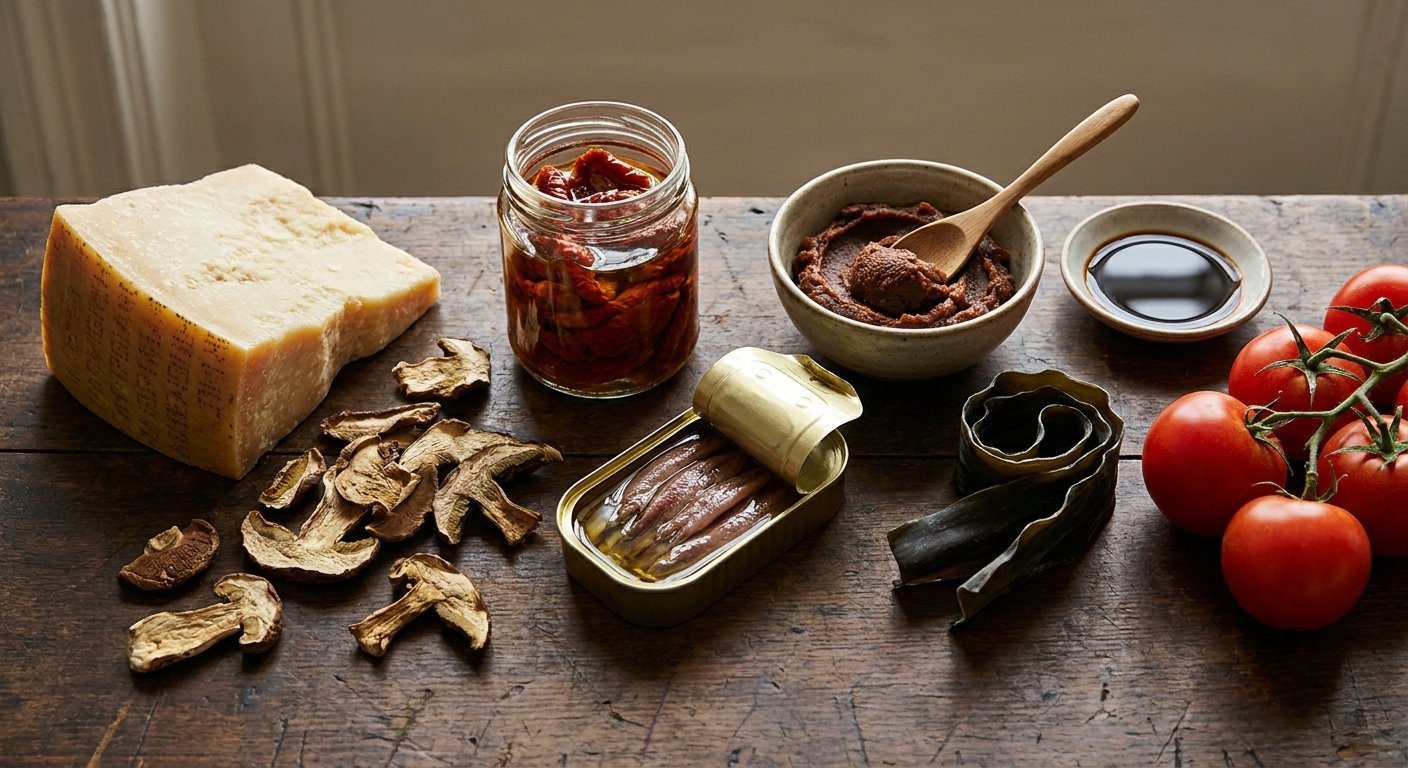
People think of food as sweet or salty. Maybe savory. Maybe spicy. But umami is different. It is the deep, mouth-filling, savory taste you get from many foods. Think aged cheese, mushrooms, slow-cooked meats, tomatoes, anchovies, soy sauce, miso, broths, and fermented foods.
Scientifically, umami is closely connected to glutamate, an amino acid naturally found in many foods. Japanese chemist Kikunae Ikeda identified glutamate as the source of this distinct taste in kombu seaweed broth in 1908 and named it “umami.”
The word itself is Japanese. It is often translated as a pleasant savory taste. That is one reason people associate umami with Japanese food. And yes, Japanese cuisine has an incredible understanding of umami through ingredients like kombu, bonito flakes, miso, soy sauce, and dashi.
But umami is not only Japanese. It is Italian. It is French. It is Mexican. It is Spanish. It is found in aged cheeses, sun-dried tomatoes, cured meats, mushrooms, fermented sauces, broths, seafood, beans, and slow-cooked foods worldwide.
The Japanese gave us the word and the scientific identification. But cooks around the world were using umami long before they had the name for it.
Why Umami Feels Like an Afterthought
Here is the truth: umami feels like an afterthought because most people were never taught how to taste.
We teach kids sweet, sour, salty, and bitter. But we rarely teach them savory depth. Then the food industry steps in.
Processed foods are engineered to be hyper-palatable. They are designed to hit your tongue hard and keep you eating. When people grow up eating foods built with artificial or isolated flavor enhancers, their palate can get confused.
They stop recognizing real depth. They chase intensity instead. That is not the same thing.
A real tomato sauce simmered with garlic, olive oil, mushrooms, and a little anchovy has depth. A powdered seasoning packet has impact. Those are not the same.
One builds flavor. The other tricks the palate.
How Umami Tastes
Umami is hard to describe because it is not simply salty. It is not sour. It is not sweet.
The way I like to explain it is this: umami makes your palate pucker a little bit. Not sour pucker. Not lemon pucker. It is more of a cheek-pulling effect. Something happens in your mouth where the food feels deeper, rounder, more satisfying. It makes you want another bite, not because it is sugary or salty, but because it has body.
Think about:
- A spoonful of rich tomato sauce
- A bite of aged Parmesan
- Mushrooms sautéed in olive oil
- A broth that coats your mouth
- Anchovy melted into garlic and oil
- A little soy sauce or shoyu in a dish
- Sun-dried tomatoes blended into a sauce
That is umami working. It gives food backbone.
The Natural Umami Ingredients Every Home Cook Should Know
If you want to cook better food, learn how to build natural umami. You do not need a lab. You do not need a processed base. You do not need a mystery powder. You need real ingredients.
| Ingredient | Umami source | How to use it |
|---|---|---|
| Anchovies | Cured fish | Melt a little into olive oil and garlic as a savory base |
| Sun-dried tomatoes | Concentrated tomato | Blend into a paste for sauces, beans, or polenta |
| Dried porcini | Mushrooms | Grind to a powder for sauces, risotto, or soups |
| Parmigiano Reggiano | Aged cheese | Grate over dishes or simmer the rind in broths |
| Soy sauce or shoyu | Fermented soy | Add a small splash for background depth |
| Miso | Fermented soy paste | Whisk into dressings, broths, or glazes |
Anchovies
This is one of the old-school Italian secrets. A little anchovy melted into olive oil with garlic can transform a dish. It does not have to taste fishy. Used correctly, it disappears into the background and gives the food depth.
This is what my mother and grandmother understood. Just a touch. That is the key.
Sun-Dried Tomatoes
Sun-dried tomatoes are concentrated flavor. Chop them fine. Blend them into a paste. Add them to a sauce, vinaigrette, polenta dish, pasta, beans, or roasted vegetables. A little goes a long way.
We had a polenta dish at the restaurant where we used beautiful sun-dried tomatoes pureed into the sauce. That paste helped bring out the richness of the tomato, the olive oil, and the Reggiano cheese. It did the trick because it gave the dish depth without overpowering it.
Mushrooms
Mushrooms are umami powerhouses. Shiitakes, wild mushrooms, morels, and porcini all bring serious savory depth. Dried porcini powder is one of those ingredients more home cooks should understand.
Put a little porcini powder into:
- Butter sauce
- White wine sauce
- Pasta sauce
- Chicken dishes
- Risotto
- Soups
- Braised vegetables
You do not need a lot. That is the lesson with umami. Respect it. Do not abuse it.
Aged Cheese
Parmigiano Reggiano is one of the great natural umami ingredients. The longer aging gives it deeper savory notes. That is why a little real Reggiano can change a dish.
And this is also why those old Italian breadcrumbs mattered so much. When cheese was too expensive, breadcrumbs became a substitute. Add olive oil, garlic, anchovy, and technique, and suddenly you had something humble that still carried depth.
That is immigrant cooking. That is real cooking.
Soy Sauce and Shoyu
Naturally brewed soy sauce and shoyu can add umami fast. But again, restraint matters. You are not trying to make every dish taste like soy sauce. You are using it to build background depth. That is the difference between cooking and dumping.
Fermented Foods
Miso, tamari, fish sauce, aged vinegars, fermented vegetables, and certain cured products can all bring umami. But this is where transparency matters.
If you are cooking for guests, customers, or clients, you need to know what is in your food. You cannot secretly put fish sauce into everything and ignore dietary concerns. Some people do not eat fish. Some people have allergies. Some people avoid certain ingredients for religious, ethical, or personal reasons.
Flavor is not an excuse to hide ingredients.
The Mistake: Chefs and Food Companies Taking Shortcuts
I once worked with a chef who put Vietnamese fish sauce in everything. Everything.
Yes, fish sauce has umami. Yes, it can make food taste deeper. But when you rely on it as a secret weapon in every dish, you are not cooking with intention anymore. You are using a crutch. And worse, you may be serving fish to people who have no idea they are eating fish. That is a problem.
The same thing happens in processed foods. Food companies know umami works. They know people crave savory depth. So instead of building that flavor with real ingredients, they use shortcuts. It is the same pattern I write about with processed soda in the kitchen and the dangers of artificial sweeteners.
You will see ingredients like:
- MSG
- Autolyzed yeast extract
- Hydrolyzed vegetable protein
- Hydrolyzed soy protein
- Isolated soy protein
- Artificial flavor enhancers
- Processed chicken bases
- Processed beef bases
- Commercial soup bases
These ingredients are often used to intensify flavor quickly and cheaply.
Now, let’s be clear and accurate. The FDA considers MSG generally recognized as safe, and studies have not consistently confirmed reactions even among people who identify as MSG-sensitive. But that is not my main point. My point is not just about whether something is legally allowed. My point is about food integrity.
There is a major difference between building umami naturally through mushrooms, tomatoes, anchovies, aged cheese, fermented foods, and real cooking techniques. The other path is relying on industrial flavor boosters to make cheap food taste more exciting than it really is.
That is where I draw the line. Not everything legal belongs in great food.
MSG, Glutamates, and Excitotoxins: What Consumers Need to Understand
This is where people get confused.
Glutamate naturally exists in real food. Tomatoes have glutamate. Mushrooms have glutamate. Cheese has glutamate. Kombu has glutamate. Meat has glutamate. That does not mean all glutamate-containing foods are bad. That would be ridiculous.
The issue is context. Are you getting savory depth from whole, real foods? Or are you eating ultra-processed foods that use isolated flavor enhancers to make low-quality ingredients taste better? That is the conversation consumers need to have.
The word “excitotoxin” gets used because glutamate is an excitatory neurotransmitter in the body. Excess glutamate activity in the nervous system is part of the scientific discussion around excitotoxicity. But dietary MSG and naturally occurring glutamates in food are not the same conversation as neurological excitotoxicity in a clinical setting.
So I am careful with the language. I am not here to make wild medical claims. I am here to tell people this:
Stop letting processed food companies manipulate your palate. Stop thinking a powdered base is the same thing as a stock. Stop thinking a flavor enhancer is the same thing as technique. And stop letting cheap food chemistry replace real cooking.
Natural Umami Versus Artificial Intensity
Real umami has balance. Artificial intensity often has aggression.
Real umami makes food feel complete. Artificial intensity makes food feel addictive.
Real umami supports the ingredient. Artificial intensity often hides weak ingredients.
That is why natural umami matters. A mushroom tastes like a mushroom. A sun-dried tomato tastes like a tomato concentrated by time. Anchovy, used properly, melts into a dish and gives it backbone. Reggiano brings salt, nuttiness, age, and depth. A good broth carries the soul of what went into it.
That is cooking. That is not trickery.
A Little Goes a Long Way
Here is my contrarian opinion about umami: most people overdo it.
They learn that umami means “savory” and suddenly they want to blast every dish with fish sauce, soy sauce, miso, mushroom powder, MSG, or some kind of seasoning bomb. That is not the goal.
The goal is not to make everything taste loud. The goal is to make food taste complete.
A little anchovy in pasta. A spoonful of sun-dried tomato paste in a sauce. A dusting of porcini powder in a butter sauce. A rind of Parmigiano Reggiano in a soup. A splash of shoyu in the background. That is enough.
Great cooking is restraint.
How to Use Umami Tonight
If you are cooking at home and want to experiment with umami tonight, start simple. Add a touch of anchovy. That is it.
Melt a small amount into olive oil with garlic before adding broccoli, greens, tomatoes, beans, or pasta. Do not announce it. Do not overdo it. Just let it work.
You will notice the dish tastes deeper. More complete. More satisfying. That is umami.
Practical Takeaways
If you want to understand umami, here is where to start:
- First, recognize that umami is a fundamental taste, not a trend.
- Second, stop thinking umami only belongs to Japanese food. Japanese science named it, but world cuisines have used it forever.
- Third, learn the natural sources: anchovies, mushrooms, sun-dried tomatoes, aged cheese, fermented foods, broths, seaweed, soy sauce, miso, cured meats, and slow-cooked foods.
- Fourth, use restraint. A little goes a long way.
- Fifth, read labels. If a product needs a long list of flavor enhancers to taste good, ask yourself what is missing.
- Sixth, cook with real ingredients instead of relying on processed bases and shortcuts. If you want the bigger picture, here is what clean eating actually means.
That is how you rebuild your palate. That is how you cook with integrity.
FAQs About Umami
What is umami in simple terms?
Umami is the deep, savory, mouth-filling taste in foods like aged cheese, mushrooms, tomatoes, anchovies, broths, soy sauce, miso, and roasted meats. It is one of the five basic tastes, along with sweet, sour, salty, and bitter.
Why is umami a Japanese word?
The word comes from Japan because Japanese chemist Kikunae Ikeda identified and named the taste in 1908 after studying kombu seaweed broth. He found that glutamate was responsible for this distinct savory taste.
Is umami only found in Japanese food?
No. Japanese cuisine has a deep tradition of umami through dashi, kombu, miso, and soy sauce, but umami exists in many cuisines. Italian tomato sauce, aged Parmesan, anchovy pasta, French stocks, Spanish cured meats, Mexican moles, mushrooms, and slow-cooked dishes all use umami.
What foods are naturally high in umami?
Natural umami foods include mushrooms, tomatoes, sun-dried tomatoes, anchovies, sardines, and aged cheese. Others include soy sauce, miso, seaweed, cured meats, slow-cooked meats, broths, fermented foods, shellfish, and dried porcini.
Is MSG the same as umami?
MSG is monosodium glutamate, a refined flavor enhancer associated with umami taste. But umami itself is broader than MSG. Real foods like tomatoes, mushrooms, cheeses, seaweed, and meats naturally contain glutamate and other umami compounds.
Is MSG bad for you?
The FDA considers MSG generally recognized as safe, and research has not consistently shown reactions in people who identify as sensitive to MSG. My concern is bigger than MSG alone. I want people paying attention to processed foods that use isolated flavor enhancers to make cheap ingredients taste better than they really are.
What are excitotoxins?
The term excitotoxin is often used in conversations about substances that can overstimulate nerve cells under certain conditions. Glutamate has a role in the nervous system, but that does not mean naturally glutamate-rich foods like tomatoes, mushrooms, and cheese are dangerous. The better consumer question is this: are you eating real food with natural flavor, or ultra-processed food engineered with isolated flavor enhancers?
What is the easiest way to add umami to food?
Use a small amount of anchovy, sun-dried tomato, mushroom powder, aged cheese, soy sauce, miso, or a real homemade stock. Start small. Umami should support the dish, not take it over.
Can umami make food taste better without adding more salt?
Yes. Umami-rich ingredients can make food taste fuller and more satisfying, which may reduce the need to rely only on salt for flavor. Ingredients like mushrooms, tomatoes, anchovies, and aged cheese can add depth without simply making a dish saltier.
What is the biggest mistake people make with umami?
They overdo it. Umami is powerful. A little bit can transform a dish. Too much can make food taste muddy, heavy, or manipulated.
Final Thought
Umami is not a gimmick. It is not a trend. It is not just Japanese food. And it is not something food companies should own through processed shortcuts and flavor enhancers.
Umami is one of the foundations of real cooking. My grandmother knew it when she put a little anchovy into pasta with broccoli, garlic, olive oil, and breadcrumbs. She did not need the word. She understood the result.
That is the lesson. Real cooks have always known how to create depth from humble ingredients. The job now is to teach people what that depth is, how to recognize it, and how to build it naturally.
Because once you understand umami, you do not just cook better. You taste better. And when you taste better, you stop falling for fake food.
Want more real-food education like this? Follow Chef on a Mission for straight talk on ingredients, food labels, restaurant shortcuts, and how to build a better palate with real food.