






A Chef on a Mission consumer-awareness deep dive
Walk into almost any American steakhouse, gastropub, or “elevated” bistro, and you will see it on the menu: the Wagyu Burger. Often $28. Sometimes $45. Always positioned as the premium option.
But after 25 years running professional kitchens, working with national suppliers, and watching the same conversation play out at hundreds of restaurants, here is what most diners do not realize.
That patty is almost never 100% Wagyu beef.
This is not a story about genetics, breed registries, or marketing mythology. It is about the grind. How much Wagyu beef is actually in that burger, what it is mixed with, and why almost no menu tells you the truth.
Most U.S. "wagyu beef burger" listings are blends, with 51%, 60%, or 75% Wagyu mixed with Angus or commodity beef as the standard, and no federal rule forces restaurants to disclose the percentage on the menu. Most Wagyu used for grinds comes from the U.S., Australia, and South America, not Japan, and while true 100% Wagyu burgers exist, the food cost forces $28+ menu prices, so most restaurants quietly choose blends. The problem is not blending. It is the silence around what guests are actually buying.
So how did we get to a place where “Wagyu” on a menu tells you almost nothing about what is on your plate? Start with the label itself.
Who Owns the Word “Wagyu”? Why the Label Means Less Than You Think
The word Wagyu translates to “Japanese cow.” In Japan, it is tightly regulated. Four specific breeds, registered bloodlines, and prefecture-level grading systems overseen by the Japan Meat Grading Association.
In the United States, none of that applies.
A burger labeled “Wagyu” only needs to contain some quantity of cattle with Wagyu genetics. There is no federally enforced minimum percentage. There is no USDA rule requiring the restaurant menu to disclose origin, breed ratio, or blend composition. It is the same pattern that turns most American “feta” into a product Greek law would not even let you call feta. The label means whatever the seller wants it to mean.
The result is a gap between what diners assume and what they are actually being sold. And that gap is exactly where most kitchens operate.
Which leads to the question almost nobody asks. What is actually in the patty?
“Wagyu Burger” Does Not Mean 100% Wagyu Meat
When a restaurant buys a box labeled Wagyu Burgers from a foodservice distributor, it almost always means:
- A pre-blended grind
- Containing some Wagyu beef
- Mixed with other beef to control food cost
The most common blend ratios in U.S. foodservice look like this.
| Blend type | Wagyu % | Mixed with | Typical use |
|---|---|---|---|
| Standard blend | 50–51% Wagyu | Angus or commodity | Most “Wagyu burger” listings |
| Premium blend | 60% Wagyu | Commodity beef | Upscale casual |
| High-end blend | 75% Wagyu | Prime Angus | Steakhouse / chef-driven |
| True premium | 100% Wagyu | Nothing | Rare. $28+ burgers only |
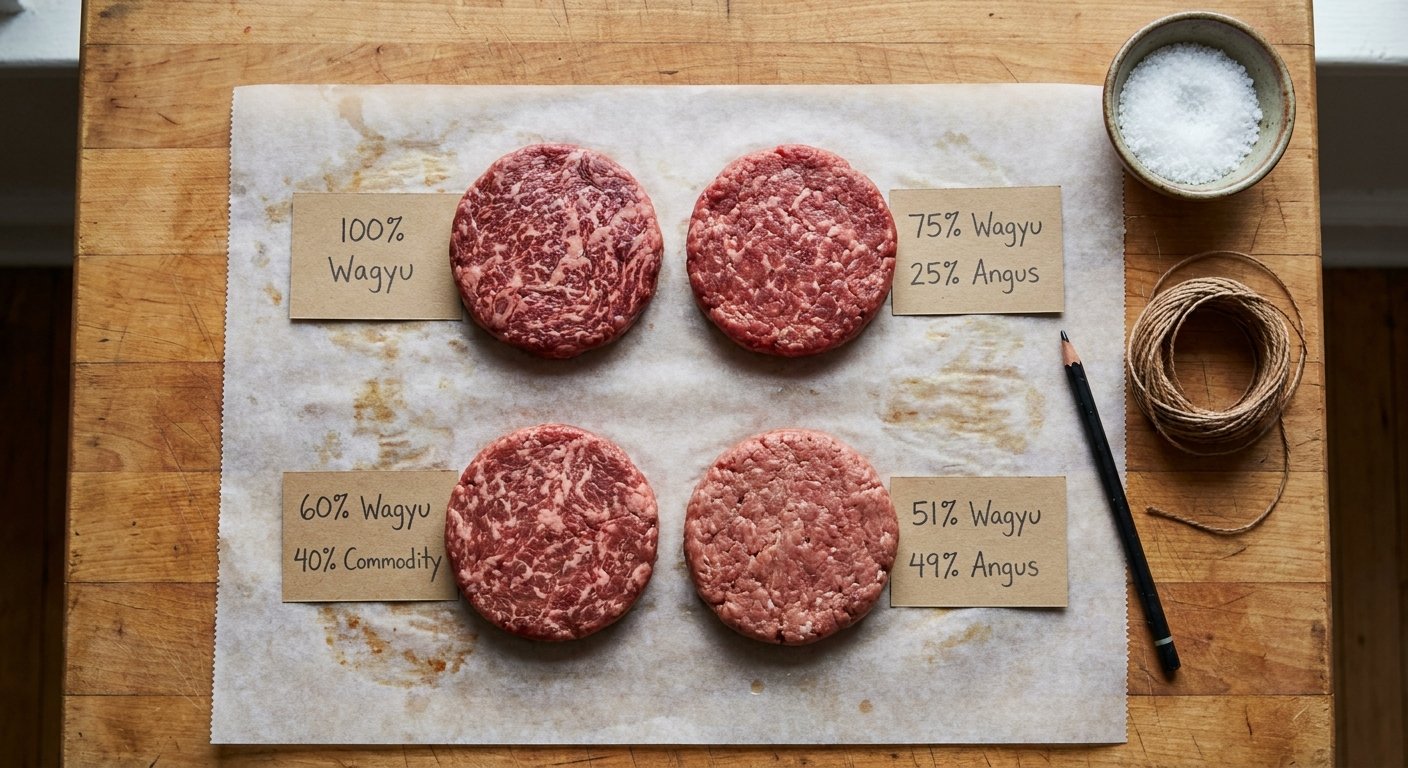
As long as Wagyu is the majority component, the box can legally be sold and the menu can legally read “Wagyu Burger.” No disclosure required.
This is not a loophole. It is the industry default.
So if the percentages are this loose, where does the Wagyu in your burger actually come from?
Where Most Wagyu Burger Grinds Actually Come From
Most guests assume Wagyu means Japan. The reality is different.
The Wagyu beef destined for restaurant burger grinds typically comes from:
- The United States
- Australia
- South America, which exports large volumes at notably low prices
These countries raise cattle with Wagyu genetics, often crossbred, and export significant volume specifically intended for grinding and blending. Not for luxury steak programs.
That does not make it bad beef. American Wagyu and Australian Wagyu can be excellent product. But the marketing implies something it almost never delivers. A direct connection to the prefecture-graded Japanese beef most diners picture when they read the word Wagyu.
It is the same gap that shows up in seafood, where the word “rockfish” can legally refer to dozens of different species sold under one umbrella name. One word on a menu. A very different product underneath.
The product on your plate and the image in your head are two different things.
So how does this end up in the kitchen?
How This Plays Out in Real Kitchens
Most chefs are not grinding Wagyu in-house. They are ordering:
- Frozen or fresh cases from a distributor
- Pre-formed patties at a target weight
- Boxes labeled simply “Wagyu Burgers”
And in almost every kitchen I have walked into:
- The exact Wagyu percentage is buried in a spec sheet
- It is never discussed at lineup
- It is never questioned at the order guide
Not because chefs are dishonest. Because the system does not encourage the question.
The supplier does not volunteer the breakdown. The menu does not require it. The guest does not ask. The chain holds because nobody pulls on it.
But what does it look like when a chef does pull on it?
Best Case: 100% Ground Wagyu (And Why It Is Brutal)
Let’s start with the high road.
There are suppliers, and I use one personally, that sell:
- 100% ground Wagyu
- No Angus
- No filler beef
- No cost-driven blending
And the price is unforgiving.
That is why:
- Burger menu prices have to land at $28 to $45
- Portions are controlled tightly
- Most restaurants will not buy it at all
Real Wagyu in the grind forces honesty. Financially, operationally, and on the menu.
So if 100% is the gold standard, what is the realistic middle?
The Most Common Reality: Blended Wagyu Grinds
This is where the majority of “Wagyu burgers” actually live.
Typical setup:
- A percentage of Wagyu beef, U.S. or Australian
- Blended with Angus or conventional commodity beef
- Designed to hit a specific food-cost target
Is this automatically bad?
No. A well-made 51/49 wagyu blend burger can be an excellent product. The fat content carries flavor. The cost stays workable. The guest gets a richer patty than commodity ground chuck.
Is it what most guests think they are ordering when they read “Wagyu Burger” at $24?
Also no.
The problem is not the blending. The problem is the silence around it.
That silence has a worst-case version, and it shows up at the bottom of the supply chain.
Worst Case: When “Wagyu” Is Doing All the Marketing Work
This is where the food-fraud factor shows up.
Large-scale foodservice suppliers, including warehouse-style distributors like Restaurant Depot, sell products labeled “Wagyu burgers” that:
- Are blended grinds
- Contain undisclosed Wagyu percentages
- Rely entirely on the Wagyu name to justify the markup
Legal? Yes.
Transparent? Not even close.
That gap between what the guest assumes and what is actually in the patty is exactly where trust is lost. It is the same pattern that shows up across the food system. The same dynamic that lets producers market organic wine made with conventionally farmed grapes when the rules are looser than the label implies, and the same dynamic food influencers profit from when they tell diners what “authentic” food is supposed to look like.
So if the blends are this common, why do chefs go along with it?
Why Chefs Choose Blended Grinds (The Uncomfortable Truth)
Here is the reality menus do not explain:
- 100% Wagyu destroys food cost
- Most guests resist $35 to $45 burgers
- Blends keep restaurants operational
A 25% food-cost target on a 100% Wagyu patty forces a $32 menu price minimum. Drop to a 51/49 blend and the same patty can hit the menu at $22. Drop to a 60/40 commodity blend and you can sell it at $18.
So most chefs compromise quietly. Often without any malicious intent. Often without even thinking about it as a compromise.
But quiet compromises lead to loud misunderstandings. And the fix is not complicated.
The Wagyu Honesty Test: 3 Questions Every Diner Should Ask
If you want to read between the lines on any wagyu beef burger listed on a menu, these three questions surface almost everything you need to know.
- What percentage of this burger is actual Wagyu beef? If the staff can answer specifically (51%, 60%, 100%), the kitchen is paying attention. If the answer is vague (“it’s a blend” or “it’s our Wagyu”), the percentage is almost certainly on the low end.
- Where does the Wagyu come from? U.S.-raised, Australian, and Japanese imported are very different products at very different price points. A confident answer signals a confident sourcing program.
- Is it ground in-house or pre-portioned? Pre-formed patties from a distributor box are the industry default. In-house grinding from primal cuts is rare and signals that the kitchen actually controls the product.
If the staff cannot answer any of them, you have your answer.
So what should menus do instead?
What Honest Menus Should Actually Say
Instead of the catch-all “Wagyu Burger,” transparent menus look more like this.

| Vague (typical) | Honest (rare) |
|---|---|
| Wagyu Burger | 50/50 Wagyu–Angus Blend Burger |
| Premium Wagyu | 75% American Wagyu, 25% Prime Angus |
| Wagyu Smash | 60% Australian Wagyu / 40% Beef Chuck |
| Chef’s Wagyu | 100% Ground Wagyu (Limited Availability) |
Transparency does not hurt sales. It builds loyalty. The same diners who feel misled by a vague $30 burger become repeat guests when a menu shows them exactly what they are paying for.
Frequently Asked Questions
Is a wagyu beef burger really 100% Wagyu?
Almost never. In U.S. restaurants, the term most commonly describes a pre-blended grind with 51% to 75% Wagyu mixed with Angus or commodity beef. Genuine 100% Wagyu burgers exist, but the wholesale cost typically forces a $28+ menu price.
What is a wagyu blend burger?
A patty made from ground Wagyu beef mixed with another type of beef, typically Angus or generic commodity ground beef. Common ratios are 51/49, 60/40, and 75/25. Blends are legal to sell as “Wagyu burgers” with no disclosure required.
How much Wagyu is actually in a Wagyu burger?
Industry standard ranges from roughly 51% to 75%. Some products marketed as Wagyu burgers contain even less, since federal labeling rules do not enforce a specific minimum percentage at the foodservice level.
Why are real Wagyu burgers so expensive?
100% ground Wagyu carries a wholesale cost several times higher than premium ground beef. With standard restaurant food-cost targets, that pushes the menu price into the $28 to $45 range before sides.
Where does the Wagyu in most U.S. burgers come from?
Predominantly the United States, Australia, and South America. Japanese imported Wagyu is almost never used in burger grinds because the price point makes grinding economically irrational.
How do I know if a restaurant’s Wagyu burger is legitimate?
Ask three questions: percentage, origin, and whether it is ground in-house. A kitchen that controls the product can answer all three. A kitchen relying on the word “Wagyu” to do the selling usually cannot.
The Bottom Line
A wagyu beef burger is not defined by hype, breed, or buzzwords. It is defined by how much Wagyu actually makes it into the grind, where that Wagyu comes from, and whether the restaurant respects you enough to put the answer on the menu.
Real luxury does not hide.
That is the mission.
Want to know what is actually on the menu before it hits your table? Join the Aroma Thyme Insider Membership for Chef Marcus's supplier-level breakdowns, sourcing reality checks, and the behind-the-line economics most restaurants never explain.
Chef Marcus Guiliano has spent 25+ years running professional kitchens, including Michelin-recognized properties and James Beard-nominated restaurants. He is the chef-owner of Aroma Thyme Bistro, one of the first certified-green restaurants in the United States, and the founder of Marcus Chef on a Mission, a consulting and education platform dedicated to honest sourcing, food-system transparency, and the chef-operator economics that shape what ends up on your plate.