






Why are roses planted in vineyards? The short answer: tradition. The longer answer is more interesting — and it says more about the people behind the wine than most visitors realize.
I’ve visited over 350 wineries across six countries. I’ve seen roses at the ends of vine rows in Tuscany, Piedmont, Burgundy, Napa, and the Finger Lakes — including the vineyards in Montalcino that shaped how I think about winemaking. Every time, someone on the tour repeats the same story: “The roses are an early warning system for disease.” That story is part of it. But the real reason roses are still there — in some vineyards — is deeper than disease detection. And the vineyards that have quietly stopped planting them? That tells you something too.
Here’s what’s tradition, what’s science, and what the roses actually reveal about a vineyard’s character.
Key takeaway: Roses in vineyards started as a practical tool. Today they are a tradition — and whether a vineyard keeps that tradition tells you something about how it thinks about its land.
Are Roses Really an Early Warning System for Vineyards?
You hear this one everywhere. The rose catches disease before the vine does, so the grower gets a head start. It’s a tidy story. But like most tidy stories, it smooths over some important details.
The “canary in the coal mine” story (where it came from)
The idea goes back to European viticulture — probably 19th-century France. Roses and grapevines share a vulnerability to powdery mildew (Erysiphe necator on vines, Podosphaera pannosa on roses). When mildew pressure builds, roses tend to show symptoms a few days before the vines do.
That timing gap gave growers a visual cue. No lab work. No sensors. Just walk the row, check the roses, and start planning your sulfur application.
Before weather stations and predictive models existed, that was genuinely useful.
The reality check
Here’s what the cute version leaves out.
Not all rose cultivars react at the same speed. Some modern hybrids resist mildew entirely — which means they tell you nothing. The timing gap between rose symptoms and vine symptoms depends on the microclimate, the season, and the specific fungal strain. Some years the roses show first. Some years the vines beat them to it.
And the bigger issue: a single rose bush at the end of a row reflects conditions at the end of the row. The middle of the block might be completely different — more humidity, less airflow, different exposure. A rose can hint at what is happening in that microclimate. It cannot diagnose an entire vineyard.
No serious grower today makes spray decisions based on a rose bush. That is the uncomfortable truth about roses planted in vineyards.
Key takeaway: The "canary" story is not totally wrong. It is just incomplete for modern vineyard IPM.
Why Some Vineyards Still Plant Roses — and Why Some Have Stopped
This is the part that gets interesting. Because it is no longer about disease detection. It is about identity.
The vineyards that keep the roses tend to share a few things in common. They are often family-run. They think in generations, not quarters. They see the roses the way a seaside restaurant sees the fishing nets on the wall — not because the nets catch fish anymore, but because they honor where the place came from.
At Château Feely in Saussignac, France, the roses are still there. The owner will tell you honestly that the mildew strains are different — roses do not actually predict vine disease. But the conditions that trigger mildew on roses are the same conditions that threaten the vines. So the roses still function as a general environmental cue, even if the science has moved past the old story. And they are beautiful. That matters too.
At Knudsen Vineyards in Oregon’s Willamette Valley, the roses represent — in their words — “respect for the land, attention to detail, and a little romance woven into the rhythm of vineyard life.” At Paradisos del Sol in Washington, they go further: yellow and white roses mark white wine rows, red roses mark red. The tradition has evolved into a color-coded wayfinding system.
The vineyards that have moved away from roses tend to be larger, more technology-driven operations. In regions where precision viticulture dominates — weather stations, spore models, GPS-guided sprayers — the roses simply do not fit the workflow. They are not wrong to skip them. They are just making a different choice about what matters in the row.
Here is what I have noticed across 350+ winery visits: the vineyards that keep the roses are usually the ones where the winemaker is also the farmer. The person who prunes the vines in winter is the same person who pours the wine in the tasting room. The roses are not a marketing decision in those places. They are a continuity decision. A way of saying: we remember where this started.
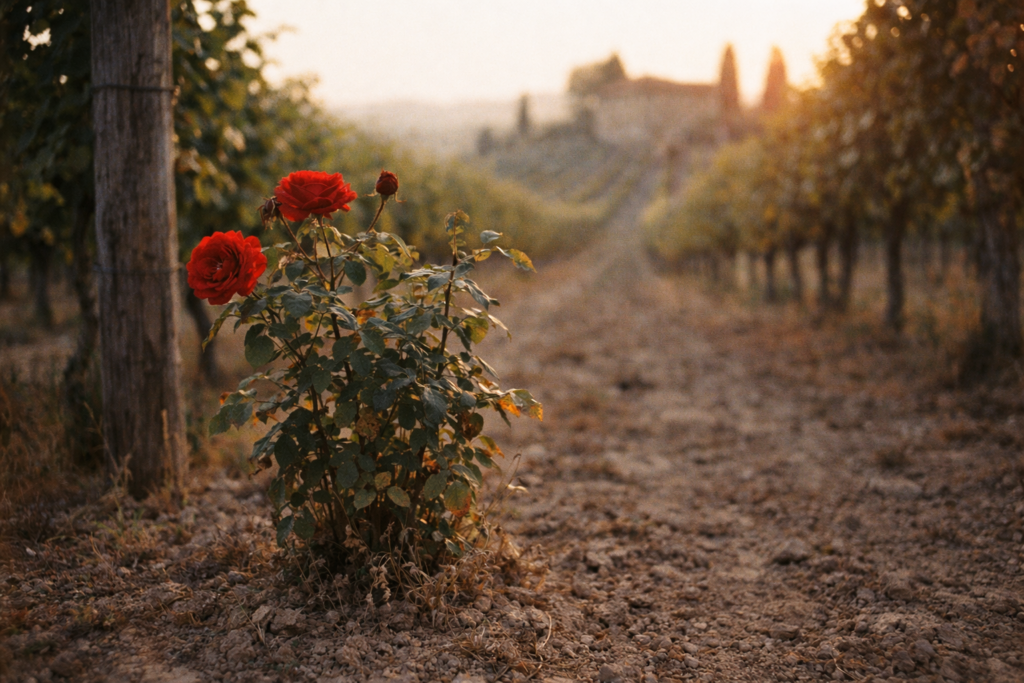
That does not mean roses are a farming tool. Modern pest management runs on data, not flowers. Real protection comes from disciplined scouting, weather data, and integrated pest management. But tradition and technology are not enemies. The best vineyards I have visited use both — the weather station and the rose bush, the predictive model and the walk through the rows at dawn.
Key takeaway: Whether a vineyard keeps its roses or removes them tells you something about its priorities. Neither choice is wrong. But the vineyards that keep them are usually the ones that think in generations.
Modern Integrated Pest Management in Vineyards: What Actually Protects the Vines
Integrated pest management — IPM — is the real system behind healthy vineyards. It is not glamorous. Nobody puts it on a postcard. But it is what separates a well-run vineyard from one that is guessing.
| Feature | The Old Way (Roses) | The Modern Way (IPM) |
| :— | :— | :— |
| Primary Role | Early warning signal (Traditional) | Comprehensive data tracking |
| Detection Speed | Lagging indicator (symptoms visible) | Predictive (before symptoms appear) |
| Coverage | End of row only (Microclimate) | Full vineyard (Scouting + Sensors) |
| Accuracy | Variable (resistant roses hide issues) | High (lab-tested thresholds) |
| Decision Driver | Visual cue | Weather data & spore models |
IPM works in a loop: monitor → set thresholds → take targeted action → review what happened.
That loop runs all season long. It is not reactive. It is built into the calendar before a single bud breaks.
Scouting basics that beat folklore
Vineyard scouts walk the rows on a schedule. They check for:
- Leaf tissue changes — yellowing, spots, curling, white powdery residue.
- Insect presence — leafhoppers, mites, sharpshooters — and whether they are at threshold levels.
- Canopy density — too much shade traps moisture and invites mildew.
- Weather station data — humidity, temperature, and rainfall trigger models that predict disease pressure.
All of that gets logged. Spray decisions come from accumulated data, not a single observation.
Powdery mildew context
Powdery mildew is the disease most connected to the rose story. It thrives in warm, dry conditions with moderate humidity — which describes most wine regions during growing season. Left untreated, it destroys fruit quality and can ruin a vintage.
Modern vineyards manage mildew through canopy management (leaf pulling, shoot positioning), sulfur or fungicide applications timed to predictive models, and resistant rootstock selection where possible.
This is why roses were planted in vineyards historically — an analog solution to a pre-digital problem. Today, vineyard teams have weather stations, forecasting software, and decades of trial data.
Powdery mildew context
Powdery mildew is the disease most connected to the rose story. It thrives in warm, dry conditions with moderate humidity — which describes most wine regions during growing season. Left untreated, it destroys fruit quality and can ruin a vintage.
Modern vineyards manage mildew through canopy management (leaf pulling, shoot positioning), sulfur or fungicide applications timed to predictive models, and resistant rootstock selection where possible.
This is why roses were planted in vineyards historically — an analog solution to a pre-digital problem. Today, vineyard teams have weather stations, forecasting software, and decades of trial data.
Where roses fit in (if they fit at all)
Roses in vineyards will not save a crop. They will not replace a weather station or a trained scout. But they were never supposed to — not really.
What roses do is mark a continuity. They connect today’s vineyard to the one that existed a hundred years ago, when a grower walked the row with no technology except attention. The rose was the first thing that told you the season was changing. It still is, if you are paying attention.
Think of it this way: roses are not the check engine light on a modern dashboard. They are the hand-built stone wall at the edge of the property. Functional once. Beautiful still. And a reminder that someone cared enough to build something that would outlast them.
Key takeaway: A rose bush will not tell you the health story of an entire vineyard. But it will tell you what kind of people run it.
What Should You Look for When You Visit a Vineyard?
This is where the rose story becomes actually useful — not for farming, but for visiting.
If you are walking through a vineyard and you notice roses planted at the end of a row, great. But do not stop there. Here is what I look for when I visit a vineyard, and I can usually read the whole operation in about 60 seconds.
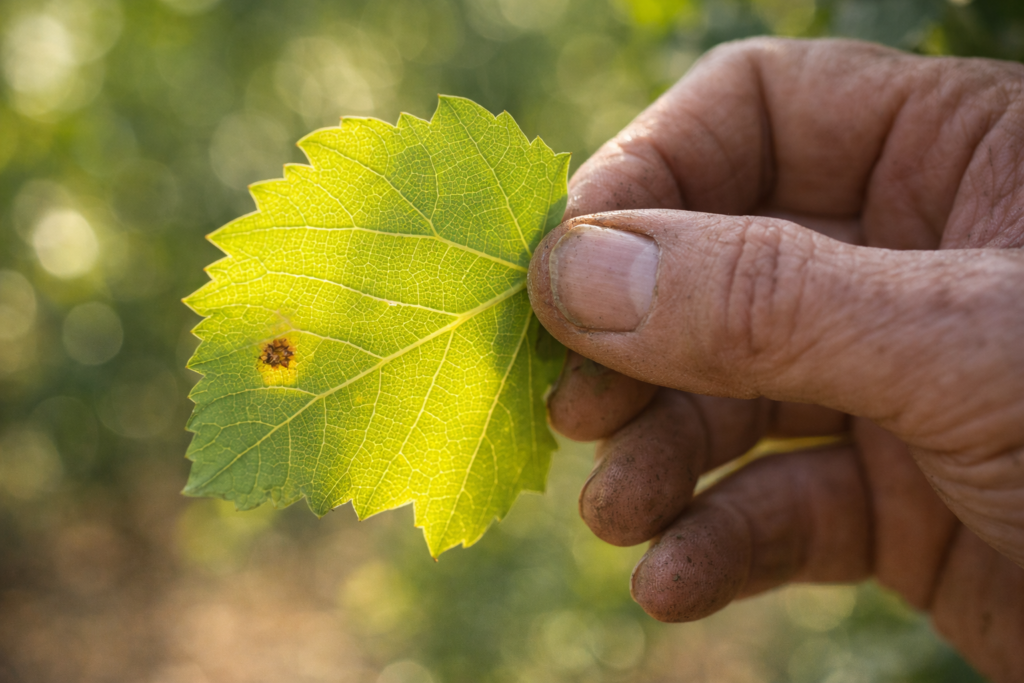
The 6 things Marcus notices in 60 seconds
- Canopy management. Are the vines neatly hedged with good airflow? Or is it a tangled wall of leaves? Good canopy work means someone is paying attention.
- Ground cover. Is there a cover crop between the rows, or is it bare dirt? Cover crops signal a commitment to soil health and biodiversity.
- Sprayer tracks. Fresh tire marks between rows mean someone is actively managing the vines. No tracks in mid-season is a red flag.
- Disease pressure signs. Look at the leaves. Powdery white residue, black spots, or curled edges all tell a story. Healthy leaves are the best sign.
- Biodiversity cues. Bees, butterflies, wildflowers in the row middles, bird boxes — these signal a farm that thinks beyond the vine.
- How people talk about their practices. The best growers speak plainly about what they do and why. Vague language or rehearsed lines usually mean the person giving the tour does not work the vines.
What to notice on a vineyard visit
Whether you are visiting Tuscany, Napa, or the Finger Lakes, these five questions will unlock the real story behind any vineyard. I wrote a deeper guide on what to expect when tasting wine in Italy — including why some wineries turn visitors away.
- “Do you farm organically, biodynamically, or conventionally?” — There is no wrong answer. What matters is whether they can explain why they chose their approach.
- “What is the biggest challenge in this vineyard right now?” — An honest grower will tell you. A marketing person will change the subject.
- “How do you decide when to spray?” — If the answer involves weather data and scouting, you are talking to someone who knows the vines. If the answer is vague, move on.
- “What is this soil like?” — Not because you need to understand geology. Because how someone talks about their soil tells you how deeply they understand their site.
- “Can we walk the vineyard?” — The best wineries say yes. The ones with nothing to show you say no.
The roses at the end of the row are a nice conversation opener. But the real story is in the canopy, the soil, and the honesty of the person walking next to you.
I learned this over 350+ winery visits across Italy, France, Spain, Mexico, and the United States. The prettiest vineyards are not always the best-run ones. And the scrappiest, dustiest operations sometimes make the most extraordinary wine — because every decision is intentional, from pruning to harvest.
That is what rose bushes in vineyards really teach you, if you are paying attention. Now you know why roses are planted in vineyards — and what to look for beyond them. Not that a flower protects a vine. But that the details matter. And the people who care about details — in the vineyard, in the cellar, and at the table — are the ones worth seeking out.
I wrote about that same philosophy in the career advice that shaped how I run my restaurant and in why discipline starts with the smallest things. It all connects. The standard you walk past is the standard you accept — in the kitchen, in the vineyard, and in life.
Key takeaway: The best vineyard visits are not about the prettiest rows. They are about the questions you ask and what you notice.
FAQ: Rose Bushes in Vineyards
Do all vineyards plant roses?
No. It is common in European wine regions — especially France and Italy — but not universal. Many New World vineyards skip them entirely. It depends on tradition, region, and whether the property hosts visitors.
Does it mean the vineyard is organic?
Not necessarily. Roses grow in organic, biodynamic, and conventional vineyards alike. The presence of roses tells you nothing specific about the farming method. Ask the grower directly.
Do roses actually protect vines from disease?
Not directly. Roses planted in vineyards can show early symptoms of powdery mildew, which may alert the grower. But they do not prevent disease or act as a barrier. Modern vineyards use IPM — integrated pest management — for actual protection.
Can roses affect the flavour or terroir of wine?
No. Rose bushes planted at the end of rows do not influence grape flavour, fermentation, or the finished wine. They are too far from the fruit and too small in number to have any measurable effect.
Should a home grower plant roses near grapevines?
It will not hurt. If you grow backyard grapes and enjoy roses, plant them nearby. They share similar soil preferences. But do not expect them to serve as a disease management tool. Monitor your vines directly.