


I pay twice the market price for quinoa from Colorado, and it travels 1,800 miles to reach my Hudson Valley kitchen. And I call it local.
That claim breaks every rule about local food sourcing that most people accept. The USDA draws the line at 400 miles. Farmers markets draw it at the county line. But after 20 years of building direct relationships with growers, ranchers, and independent food producers, I’ve learned something: locality has almost nothing to do with distance. It has everything to do with trust.
What Does Local Food Really Mean?
Ask ten people what does local food mean and you get ten answers. Your neighbor says “grown nearby.” A grocery chain says “from this state.” The USDA defines local food as anything produced within 400 miles of where it’s sold, or within the same state.
That local food definition creates an immediate problem. A concentrated animal feeding operation 30 miles away counts as local. A small family grain farm 401 miles away does not. The label describes geography. It says nothing about growing practices, animal welfare, or whether the farmer can make a living.
I started questioning this years ago. Before farm-to-table became a trend, I was driving my truck to farms in Ulster County. I shook hands with the people who grew my food. Not because it was fashionable. Because I needed to trust what I put on plates. That early farm to fork instinct shaped everything I do today.
Key Takeaway: "Local" is a relationship word, not a distance measurement. The USDA's 400-mile rule tells you where food traveled. It says nothing about how it was grown or who grew it.
Why Do Food Miles Miss the Point?
The food miles myth is one of the most stubborn ideas in the sustainable food sourcing conversation.
A 2022 study in Nature Food found that food miles account for about 19% of food-system emissions. Production methods, land use, and processing drive the rest. Our World in Data narrows it further: transport represents only about 6% of most foods’ total carbon footprint.
What you eat matters far more than where it comes from.
The real reason our food system is broken isn’t distance. It’s disconnection. Tomatoes from a mega-farm 200 miles away were bred for shelf life, not flavor. They were picked by workers no one meets, treated with chemicals no one lists, and sold by companies that view food as units shipped.
Food miles as a standalone metric distracts from what actually matters. The relationship between grower and buyer is the part that changes outcomes.
Key Takeaway: Food miles represent only about 6% of most foods' carbon footprint. How food is grown, processed, and distributed matters far more than how far it travels.
Why I Buy Colorado Quinoa and Call It Local
Here’s the part that makes people uncomfortable. I buy quinoa from a family-run operation in Colorado. It costs me roughly twice what I’d pay from a bulk distributor. It ships 1,800 miles.
Most of the world’s quinoa comes from South America — Peru and Bolivia grow the vast majority of it. The closest alternative source is Canada. White Mountain Farm in Colorado is one of the only domestic growers in the United States, which makes them the closest source I can actually buy from. By conventional standards, 1,800 miles disqualifies them as local. But when every other option is another continent or another country, Colorado starts to look pretty close.
By every conventional measure, this is not locally sourced food. By mine, it is.
I know the family. I know their soil practices, their crop rotation, and their refusal to use synthetic inputs. I trust them the same way I trust my egg farmer 12 miles down the road. The relationship is identical. Only the zip code is different.
This is what local food sourcing looks like when you strip away the marketing: direct connection, mutual accountability, shared values. I’ve always believed that ethical food sourcing starts with a handshake, not a map.
The Colorado Department of Agriculture once called me “the Willie Nelson of Farm to Table.” I took it as a compliment, because Willie fights for family farmers. So do I. When I have the option to buy an organic product from a multinational or from an independent, I buy independent. Every time.
Key Takeaway: Locality is about trust and direct accountability. A quinoa grower 1,800 miles away can be more "local" than an industrial farm next door if the relationship is real.
What Makes Farm-to-Table More Than a Label?
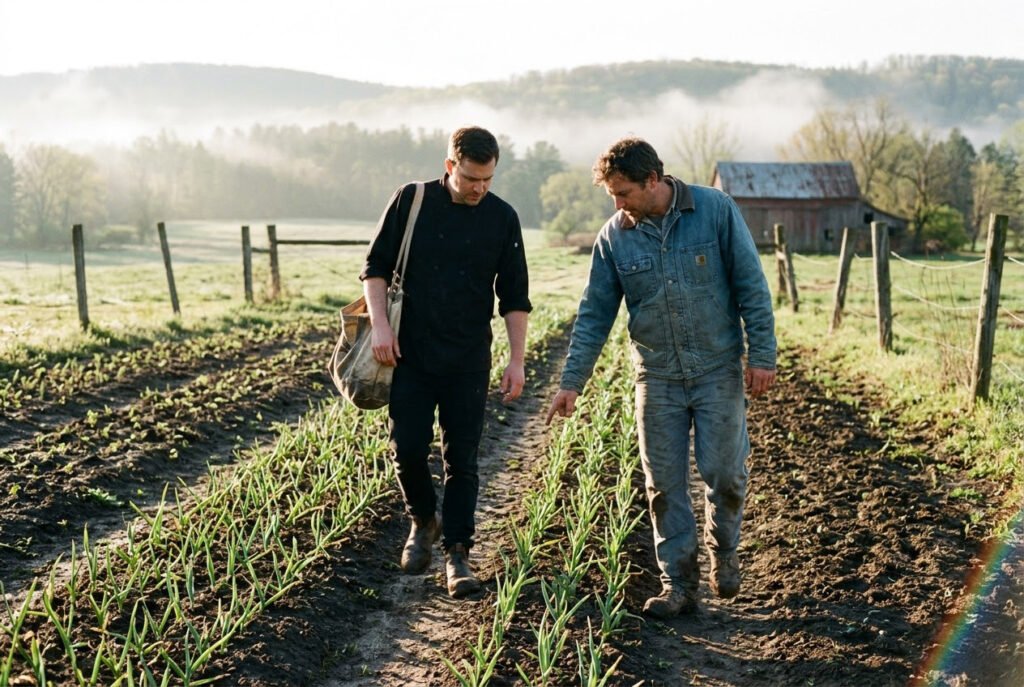
Every restaurant in America seems to claim farm-to-table status now. The real farm to table meaning is simpler and harder than most people think: you know your farmer by name, and they know you.
I’ve maintained over 45 working partnerships with farms and producers. These aren’t vendor contracts. They’re working relationships built over years of visits, conversations, and shared problem-solving. When a frost wipes out half a farmer’s crop, I adjust my menu. When I need a specific heirloom variety, a grower plants it for me.
That’s what it means to know your farmer. It goes both ways.
What “Authentic Italian” really means taught me about the Italian concept of chilometro zero. In Italy, the phrase describes food consumed where it’s produced. But the spirit behind it is about connection, not kilometers. When I partnered with Primo Imports to bring authentic Italian ingredients to my kitchen, I applied the same relationship standard. I visited the producers. I tasted their oil at the source. I shook their hands.
Farm-to-table without those relationships is marketing copy. With them, it’s a commitment.
Key Takeaway: Real farm-to-table means mutual accountability between chef and grower. If you can't name the farmer, it's just a label.
How Do Chefs Find and Keep Local Food Relationships?
Building local food relationships takes time, not money.
A few concrete ways to start:
- Visit your farmers market or local farms during growing season
- Ask growers about soil health, pest management, and harvest timing
- Return to the same stand each week and learn the grower’s name
Most producers are happy to talk. They rarely get asked.
Community supported agriculture programs offer a straight line to local producers. A CSA share isn’t just a box of vegetables. It’s a stake in someone’s growing season, where you share both the risk and the reward. That’s the foundation of the local food movement in practice.
I found some of my best suppliers by accident: a cranberry grower at a roadside stand, a cheese maker at a county fair. The feta fraud most people don’t know about taught me to verify everything. Real sheep’s milk feta from an independent producer in upstate New York tastes nothing like the industrial blocks sold under the same name. Once you’ve tasted the difference, you can’t go back.
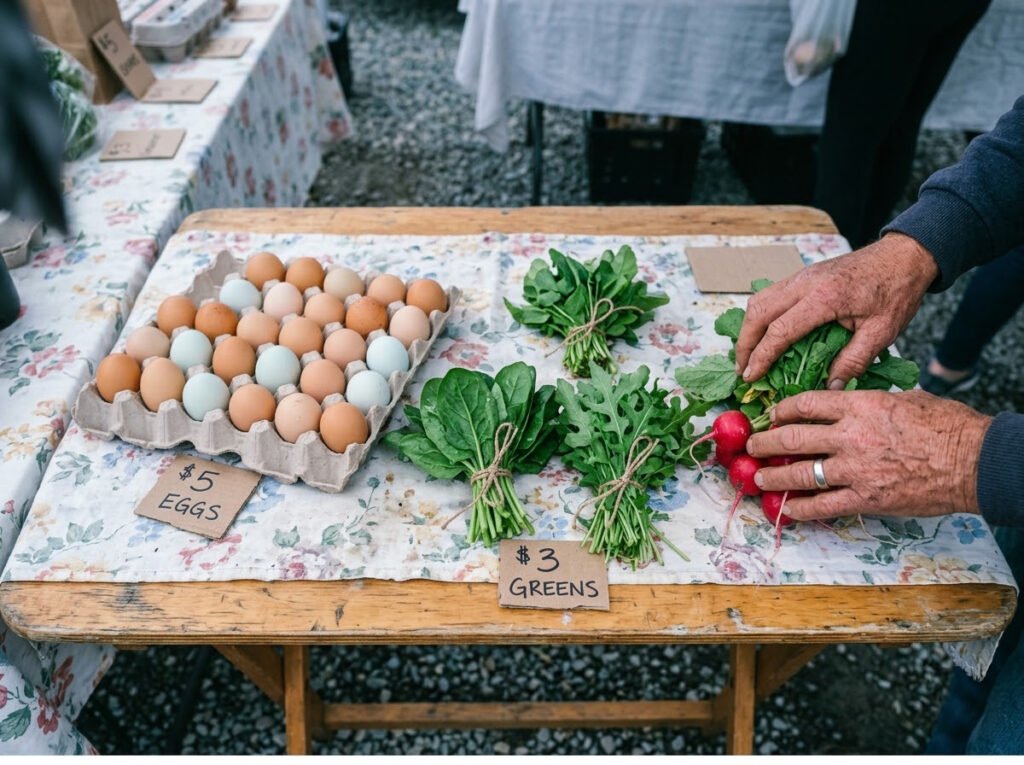
If you want to support local farms, start with one relationship. Buy eggs from the same person every week, learn their name, and ask what’s growing well this season. That single connection will teach you more about local food sourcing than any certification label ever could.
For chefs specifically, understanding what “clean eating” actually means is part of this work. Clean eating in my kitchen isn’t a trend. It’s knowing the full story behind every ingredient. Hudson Valley local farms gave me that foundation, and I’ve spent two decades building on it.
Key Takeaway: Start with one relationship. Buy from the same producer each week, learn their name, and ask questions. One genuine connection teaches more about local food than any label or certification.
Redefining Local Food Sourcing: A Framework That Actually Works
Most people evaluate food through a distance lens. I use a relationship lens. Here’s how they compare:
| Criteria | Distance-Based “Local” | Relationship-Based “Local” |
|---|---|---|
| Defining metric | Miles from farm to plate | Depth of producer-buyer connection |
| Trust verification | Labels and certifications | Farm visits and direct conversation |
| Supply chain visibility | Limited to origin state or region | Full transparency from seed to plate |
| Farmer livelihood | Often irrelevant to buyer | Central to purchasing decisions |
| Environmental impact | Measured by transport distance only | Measured by full production practices |
| Scalability | Easy for large retailers | Requires intentional effort |
The local food system doesn’t need more rules. It needs better questions. Instead of asking “how far did this travel?” ask “do I trust the person who grew it?”
Food activism in 2026 looks different than it did 20 years ago. Back then, supporting independent food producers meant driving to farms. Today it means researching CSAs online, joining co-ops, and choosing restaurants that name their sources. The tools changed. The principle stayed the same.
A chef’s guide to the types of mozzarella is one example of what relationship-based sourcing reveals. When you know the cheese maker, you know the difference between genuine buffalo mozzarella and the industrial version. That specific knowledge changes what you buy, who you buy from, and what you’re willing to pay.
Key Takeaway: Replace the distance question with a trust question. "Do I know the person who grew this?" is a better guide to local food than any mileage radius.
What Local Really Means
Local food sourcing was never about miles. It was always about trust.
The quinoa from Colorado costs me more, and it travels farther than most of my other ingredients. But the family who grows it picks up the phone when I call. They tell me about their crop rotation and send photos of the harvest. That connection makes their grain more local to me than anything on a supermarket shelf stamped “locally grown.”
You don’t need to be a chef to do this. You need one farmer, one conversation, and the willingness to pay attention to where your food actually comes from. Start with one producer and build from there, because the local food system changes one relationship at a time. Make yours count.