


I run a restaurant in Ellenville, New York. An honest restaurant menu sits on every table at Aroma Thyme Bistro. Each dish names the farm, the method, and the standard. That is how I built guest trust over two decades of sourcing decisions that anyone can read for themselves.
Most restaurants do not lie on the menu. They just avoid being specific. The words sound right. “Local.” “Fresh.” “Sustainable.” But none of those words tell a guest where the food came from or who grew it. That gap between language and sourcing is where the greenwashing food industry thrives.
This guide breaks down what menu transparency looks like when it is real. I will show you how vague menu words let bad systems win, and the exact staff rule I use to keep every plate accountable.
What Makes a Restaurant Menu Truly Honest?
An honest menu does one thing that most menus skip. It names sources.
Not in a manifesto pinned to the wall. Not in a mission statement buried on the website. Right there, next to the dish, in the description a guest reads before ordering.
At Aroma Thyme Bistro, dishes list up to three facts: where the ingredient came from, how it was raised or caught, and why we chose that producer over a cheaper option. My team calls it the three-fact rule.
Here is what that looks like on a real menu:
- “Local Heermance Farm organic spinach”
- “Line-caught wild Alaskan coho salmon”
- “Local McGrath raw cow’s milk Rascal cheese”
Those are not marketing lines. Those are sourcing records printed in plain language.
When a source changes mid-week, we reprint new menus. Accuracy and trust are super important.
Local food sourcing is not about distance. It is about relationships with the people who grow your food. An honest restaurant menu makes those relationships visible to every guest who sits down.
Key Takeaway: An honest restaurant menu names the producer, the method, and the standard for every dish. If the menu does not tell you where the food came from, it is not honest. It is vague.
Why Vague Menu Words Let Greenwashing Win
Most greenwashing does not start with a lie. It starts with a word nobody defines.
“Local” can mean the farm down the road or a regional distributor with a warehouse two states away. “Fresh” describes everything until it rots. “Sustainable” can be a verified third-party certification. It can also be a sticker someone printed in the back office.
I have walked into restaurants that say “farm-to-table” on the wall and serve commodity lettuce from a broadline distributor. I have seen “sustainable seafood” on menus where no one on staff can name the fishery or the catch method. I watched a place charge premium prices for “local” produce sourced 200 miles away.
The farm to table meaning has been diluted to the point where it signals almost nothing. Guests feel that erosion even if they never mention it at the table. They just stop trusting you. Once trust breaks, repeat business disappears.
Vague words protect bad systems by design. Nobody is held accountable because nobody made a specific claim. The menu said something pleasant. The kitchen delivered something cheaper.
The real meaning of “fresh” deserves a harder look. And the food industry has a long track record of hijacking terms that once meant something concrete.
The FTC Green Guides exist for a reason. Environmental marketing claims need proof. The same standard should apply to every restaurant menu in the country.
Key Takeaway: If no one on staff can name the producer behind a menu claim, that claim is decoration. Vague words protect the kitchen, not the guest.
How Does Your Menu Shape What Farms Grow?
A menu is not just a sales tool. It is a purchasing document that the public reads.
What you print on the menu tells suppliers what you value. It tells vendors what you will pay for. It tells farms what to grow next season. When I started putting farm names next to every dish at Aroma Thyme, something shifted in my supply chain.
One of my producers called me and said: “Marcus, if my name is on your menu, I need to make sure what I’m sending you is right.” That call changed how I think about ethical food sourcing forever.
Before that moment, sourcing was a private transaction between me and a vendor. After it, sourcing became a public commitment. The menu held both of us accountable. The farmer stepped up because his reputation was on the line too. Not just mine.
A sustainable restaurant menu holds that hidden power. It does not just inform guests. It disciplines the entire supply chain. Naming a producer creates a standard that nobody wants to fall below.
When a menu says “seasonal vegetables” with no detail, the supplier can send whatever moves fastest. When a menu says “Roasted Hudson Valley asparagus” that supplier knows you will notice if the quality drops.
A menu is purchasing, in public. What you name in public, suppliers deliver differently.
Key Takeaway: Your menu talks to more than guests. It talks to your entire supply chain. What you name, suppliers protect. What you hide, nobody improves.
The Anti-Greenwashing Checklist for Restaurant Menus
This is the test I run at Aroma Thyme every time we print a new menu. The rules are simple, but they cut deep.
Three rules:
- If you cannot name the source, do not claim it
- If you will not show guests where it came from, do not sell it as special
- If the description reads like an ad, rewrite it as a sourcing fact
The menu should be clear enough to defend at the table when a guest asks.
Here is a concrete comparison of greenwashing language versus honest menu language:
| Greenwashing Language | Honest Menu Language | Why It Matters |
|---|---|---|
| “Local greens” | “Local Heermance Farm organic spinach” | Names the producer and place |
| “Sustainable seafood” | “Line-caught wild Alaskan coho salmon” | Names the method and origin |
| “Farm-fresh eggs” | “Local McGrath raw cow’s milk Rascal cheese” | Names the standard and farm |
| “Artisan bread” | “House-baked sourdough, King Arthur flour” | Names the process and ingredient |
| “Seasonal vegetables” | “Roasted Hudson Valley asparagus” | Names the farm and the date |
Every vague word on a menu is a missed chance to name a real producer. Every named producer is proof that you did the work.
Food labels mislead diners more often than most people realize. The feta in your salad may not be real feta. The menu is one of the few places where a restaurant can cut through that noise with facts.
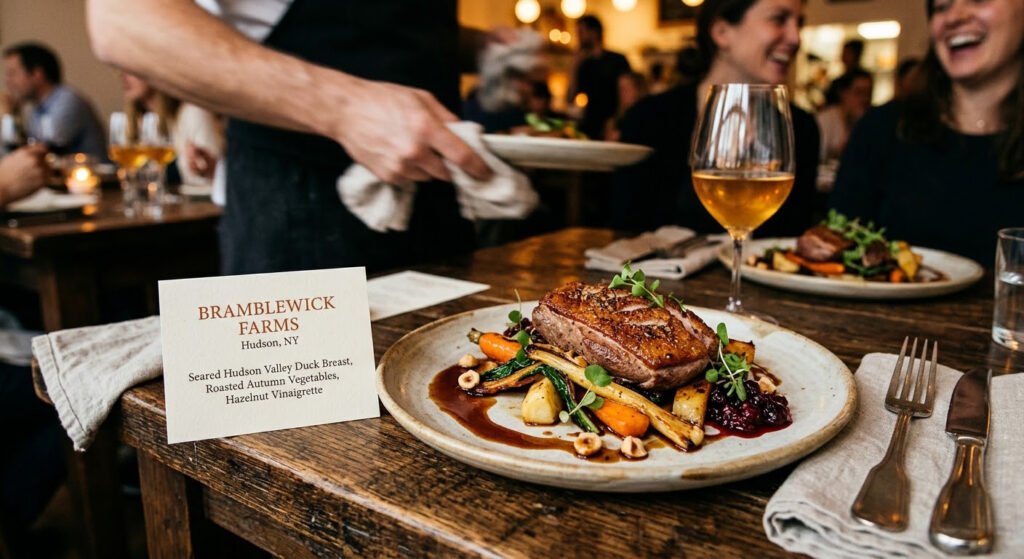
Key Takeaway: Run every menu description through three questions. Can I name the source? Will I show it? Does it read like a fact or an ad? If it fails any question, rewrite it.
7 Steps to Building an Honest Restaurant Menu
These are operational. They work in real restaurants on a busy Friday night with a full dining room.
- Put the producer name in the dish description. “Hudson Valley Farms carrots” tells the guest and the supplier that sourcing is not an afterthought.
- Call out real standards. “Certified organic” or “pasture-raised” mean something. “All-natural” does not.
- Add a rotating “Today’s sourcing” line for items that change. A chalkboard, a printed insert, or a verbal note from the server all work.
- Write one short sourcing note per menu section. Two sentences. Where the protein comes from. Who grew the produce.
- Replace “local” with the actual town or county name. “Ellenville” is specific. “Local” is not.
- Train your staff on three sourcing facts per dish. Every service. No scripts. If they cannot answer a guest’s question about the plate, they are not ready to serve it.
- Price honestly. If sourcing costs more, say so and charge for it. Do not hide the real cost behind coupons or portion tricks.
That last point matters more than people think. When you charge a fair price for real ingredients and explain why, guests respect it. When you hide the cost, you train them to expect cheap food dressed up with expensive words. That is the real vs. fake problem at the heart of restaurant pricing.
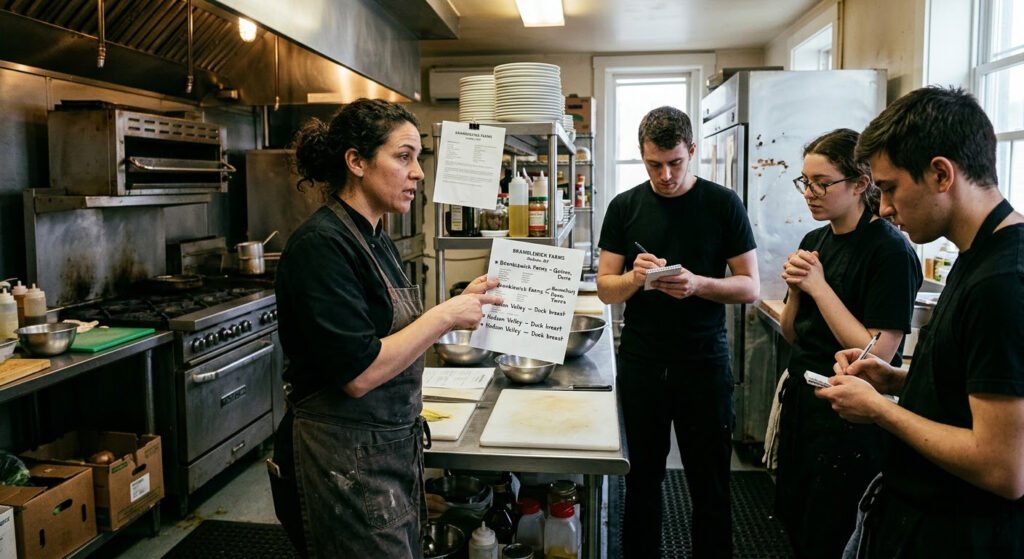
Key Takeaway: Train your team on three sourcing facts per dish. That one rule changes every conversation at the table and every relationship with your suppliers.
What Guests Feel When the Menu Tells the Truth
Guests do not need perfection. They need proof.
When I committed to running an honest restaurant menu at Aroma Thyme, two things happened. First, guests stopped asking skeptical questions. The proof was right there on the menu. They relaxed, ordered with confidence, and trusted the kitchen without needing reassurance from the server.
Second, repeat business became the backbone of our revenue. Regulars started bringing friends because they trusted us. Not because of a promotion or a review. Because the menu told the truth, and they wanted to share that experience with people they cared about.
Trust is not a marketing strategy, and you cannot manufacture it with a tagline. When you name sources, suspicion drops. When you explain standards, respect rises. When you stay consistent season after season, loyalty builds on its own.
The National Restaurant Association tracks guest dining trends. The data is clear: diners value transparency over novelty. FDA menu labeling requirements set a regulatory floor. But the restaurants that build real loyalty go far beyond compliance.
That is business. It is also ethics. They are not enemies. They never were.
Key Takeaway: Guests do not want a speech about your values. They want a menu that proves them. When the proof is on the plate and on the page, trust does the selling for you.
Change the Menu. Change the System. One Honest Line at a Time.
If you want to run an honest restaurant menu, start small. Do not rewrite everything in one night.
Pick one menu section and rewrite every description until it names something real. Name one farm. Name one standard. Cut one buzzword you cannot defend at the table.
Then train your team on three facts per dish. Every service, no exceptions.
The menu is not decoration. It is a promise. It is purchasing, in public. What you name, suppliers deliver differently. What you print, guests trust or question.
I have watched this work for over twenty years at Aroma Thyme Bistro. The farms got better. The staff got sharper. The guests stayed longer and came back more often.
That is how you change the food system, and it does not require a manifesto or a speech.
One menu. One honest line at a time.
Read more about why local food is about relationships, not miles.