



If you cut through butter paper, you’ll cut corners everywhere else — chef professionalism is built in the moments no one sees.
You can tell everything about a chef’s standards by watching one thing.
Not the plating. Not the knife work. Not the tasting menu.
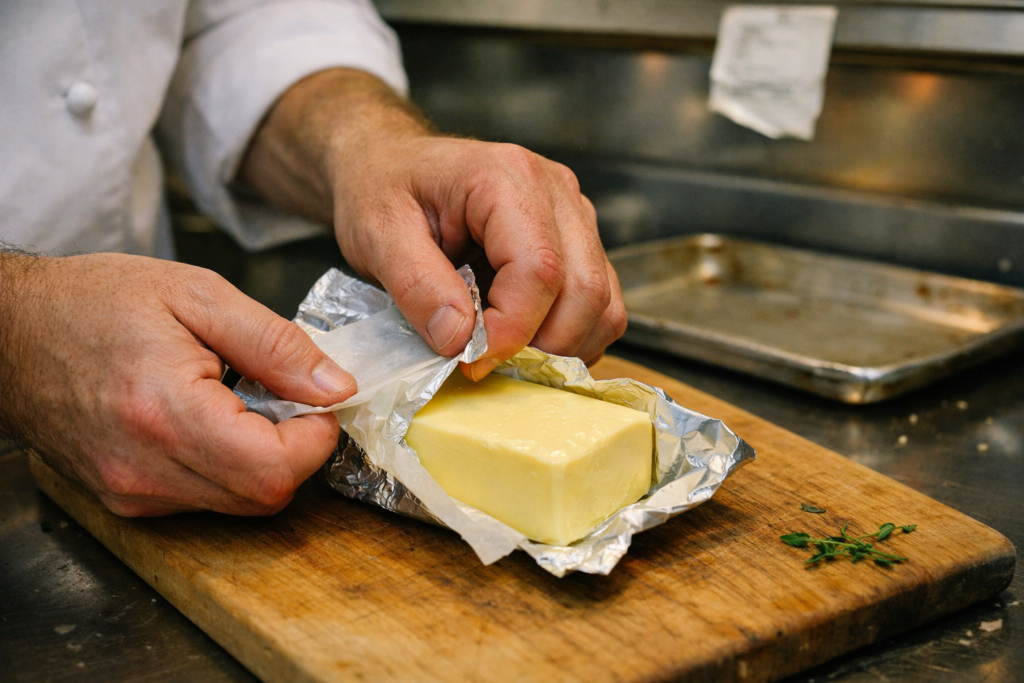
Watch how they unwrap a stick of butter.
Cutting straight through the paper looks harmless. Most cooks wouldn’t notice. Some would justify it. Others would laugh it off.
But that tiny shortcut tells a much bigger story about chef professionalism — and where it actually lives.
Taking five extra seconds to unwrap the butter isn’t about butter. It’s about standards. It’s about saying: I do things the right way, even when nothing seems to be at stake.
I’ve spent over 30 years in professional kitchens. From Pierre Koffmann’s three-Michelin-star La Tante Claire in London to Aroma Thyme Bistro in the Hudson Valley. And after all of it, I can tell you this:
Discipline isn’t built in big, dramatic moments. It’s forged in tough decisions no one else will ever see.
What Does Unwrapping Butter Have to Do with Chef Professionalism?
The short answer: everything. How you handle the smallest task reveals your standard for all the others.
Professional kitchens run on invisible discipline. Not the kind you see on cooking shows. The kind that happens at 2 PM during prep when no guest is watching and no camera is rolling.
The cook who peels the butter wrapper cleanly is the same cook who:
- Tastes the sauce a second time before it leaves the pass.
- Sharpens the knife before service — not after something goes wrong.
- Wipes down the station without being told.
- Labels and dates every container, even when they “know” what it is.
The cook who slashes through the paper? That’s a different pattern entirely. And it shows up everywhere.
Key Takeaway: Chef professionalism is revealed in the tasks that seem to carry zero consequence. The butter paper test isn't about butter — it's about whether your default setting is precision or "close enough."
So what makes small habits compound into something much bigger — or much worse?
Why Do Small Habits Define Professional Standards?
Because every shortcut trains your brain to take the next one. That’s the compound effect working against you.
Nothing is insignificant. Every habit you repeat is a vote for the kind of professional you are becoming. Every corner you cut is a vote too — just in the wrong direction.
When you rush small things, you train yourself to rush everything. When you justify one shortcut, you normalize the next. And when “good enough” becomes your acceptable floor, excellence walks out the door.
Jim Rohn called this “daily discipline” — the unglamorous compound effect of doing ordinary things with extraordinary consistency. Stephen Covey built an entire leadership framework around principle-centered living. Brian Tracy wrote about the execution mindset — the gap between knowing what to do and actually doing it. Napoleon Hill called it self-mastery, the prerequisite for every other form of success.
Four different thinkers. Four different eras. The same conclusion.
Chef professionalism isn’t a skill you learn in culinary school and keep forever. It’s a standard you practice — or lose — every single day.
People with real results don’t move faster by skipping steps. They move faster because they’ve mastered the fundamentals so deeply that precision becomes automatic. They slow down to speed up. They respect basics. They execute simple things with grit, consistency, and discipline.
Key Takeaway: Small habits compound. Rushing one task trains your nervous system to rush everything. Conversely, doing each task with care builds a pattern of precision that extends to every plate, every service, and every career decision.
What does this kind of discipline actually look like inside the world’s best kitchens?
How Do the World’s Best Kitchens Build Discipline?
Through non-negotiable standards on invisible details. Not because great chefs are obsessive — because details are the dividing line between amateur and professional.
No chef at La Tante Claire or The French Laundry yells about butter paper for its own sake. They see what it represents. Marcus wrote about why the espresso-vs-coffee-bean distinction matters more than most cafes admit. Precision in sourcing reflects precision in standards.
If a cook won’t take the time to unwrap the butter properly, will that cook really:
- Taste the sauce a second time before it hits the plate?
- Sharpen the knife before the dinner rush — not during it?
- Prep with intention instead of just speed?
- Follow through on the hardest tasks when fatigue sets in at hour twelve?
Marcus Guiliano learned this firsthand at Pierre Koffmann’s three-Michelin-star La Tante Claire in London. Every movement in Koffmann’s kitchen demanded precision. Every station carried weight. Every cook understood one unspoken rule: the invisible work is the real work.
Marcus has run Aroma Thyme Bistro for three decades. A farm-to-table restaurant built on sourcing integrity and operational discipline. He sees the same pattern repeat everywhere. The cooks who unwrap the butter cleanly are the same ones who show up early. They reset their stations before being asked. They never phone in the prep on a slow Tuesday.
The ones who slash through the paper? They’re gone within six months. Every time.
Key Takeaway: The world's best kitchens don't enforce discipline through fear. They build it through standards so deeply embedded that cutting corners feels wrong — the same way a concert violinist wouldn't skip tuning before a performance.
But what actually happens when those invisible standards start to slip?
What Separates Culinary Excellence from Cutting Corners?
The pattern is always the same — and it always starts smaller than you think.
Undisciplined habits never stay in one place. They leak into everything. One small shortcut opens the door to the next, and the next, until the whole system runs on “close enough.”
Here’s what the two paths look like side by side:
| Discipline-Driven Chef | Shortcut Chef |
|---|---|
| Unwraps butter cleanly every time | Cuts through the paper — “it’s faster” |
| Tastes sauce twice before plating | Assumes the seasoning is probably fine |
| Sharpens knives before every service | Uses dull knives until forced to sharpen |
| Wipes plates before they leave the pass | Leaves smudges for the server to catch |
| Preps with intention, even on slow days | Rushes to get prep done faster |
| Builds systems that compound over years | Puts out the same fires every shift |
Sloppy prep. Dull knives. Sauces that weren’t tasted twice. Plates that weren’t wiped. These aren’t isolated mistakes. They’re symptoms of the same root cause: a standard that slipped — and no one corrected it.
Marcus has written about how the gap between real and fake balsamic vinegar comes down to the same principle. Standards you can’t see still shape the final product.
And here’s where it gets bigger than the kitchen.
Businesses that never quite work. Goals that never quite land. Relationships that slowly erode without a single dramatic event. The pattern is always the same.
Culinary excellence doesn’t come from talent alone. Talent without discipline is a chef who peaks early and fades fast. Excellence comes from the decision — made fresh every morning — to do the small things right. Every. Single. Time.
Key Takeaway: Shortcuts compound just like discipline does — but in reverse. One "it doesn't matter" leads to a kitchen (or a business, or a life) running entirely on "good enough." The table above isn't two types of chefs. It's two versions of the same chef, separated only by which habits they chose to repeat.
If shortcuts are the disease, what’s the actual cure?
Why Standards of Excellence Matter More Than Goals
You don’t rise to the level of your goals. You fall to the level of your standards.
Goals are aspirational. Standards are operational. You can set a goal to run the best kitchen in town. But if your actual standard allows a smudged plate to leave the pass, the goal means nothing.
This is the distinction most people — chefs and entrepreneurs alike — miss completely.
A goal lives in the future. A standard lives right now, in this task, in this moment. And standards are revealed in the moments that “don’t matter.” The moments no one is watching. The moments where the easy path and the right path split — and you choose the right one anyway.
This is the “slow down to speed up” principle that elite performers across every field understand. Master the fundamentals first. Build precision into your muscle memory. Then — and only then — does real speed come naturally.
The best career advice Marcus Guiliano ever received from a chef mentor reinforced this exact lesson: the chefs who last aren’t the most talented. They’re the most disciplined.
Marcus puts it simply: discipline is invisible — until the results show up. The chef who unwraps the butter properly, wipes the plate, tastes again, resets the board — that chef doesn’t just run a better station. That chef builds a better career, a better restaurant, and a better life.
According to the National Restaurant Association’s State of the Industry Report, the restaurant failure rate remains staggeringly high. Many factors contribute to that failure rate. But operational discipline — the kind built in invisible prep moments — separates restaurants that last from those that don’t.
Key Takeaway: Goals tell you where you want to go. Standards determine whether you actually get there. Set goals high, absolutely — but invest your real energy in raising the floor of what you'll accept from yourself every day. That floor is your true ceiling.
Ready to find out where your own standards actually stand?
The Kitchen Standards Self-Audit
Five questions. Honest answers only. Run through these before your next service.
- Prep — Did I prep every item with the same discipline I’d bring if Pierre Koffmann were standing behind me?
- Tools — Is every knife sharp, every station clean, every tool exactly where it belongs?
- Taste — Did I taste everything twice — and actually adjust based on what I tasted?
- Plating — Would I serve this plate to someone I deeply respect without hesitation?
- Reset — Did I leave my station stronger than I found it?
If any answer is “no” or “sort of” — That’s not a failure. That’s where the fight starts. That’s the butter paper moment where you decide: do I accept “close enough,” or do I raise the standard right now?
The chefs who run this audit honestly — every day — are the ones who build the kind of mentorship-worthy careers that younger cooks want to learn from.
Key Takeaway: Self-auditing is the highest form of professional discipline. The five questions above aren't a test — they're a daily practice. Print them. Post them in your kitchen. Run them before every service. The gap between your honest answer and "yes" is exactly where your growth lives.
Discipline Over Talent — The Chef’s Manifesto
Unwrap the butter. Wipe the plate. Taste again. Reset the board.
Do the small things right — every time.
Excellence isn’t loud. It doesn’t announce itself. It shows up hard, consistent, and without excuses.
Chef professionalism is not a title you earn once. It’s not a line on your resume. It’s not the Michelin star or the magazine feature or the standing ovation after a sold-out dinner.
It’s the sum of every invisible decision you make when no one is watching.
It’s the butter paper.
It’s always been the butter paper.
As Jim Rohn said: “Success is nothing more than a few simple disciplines, practiced every day.” In the kitchen and beyond — that truth has never changed.
Discipline over shortcuts. Standards over excuses. Every. Single. Detail.
Chef on a Mission 🔥
Key Takeaway: Discipline over talent isn't a motivational slogan. It's an operational truth. The most successful chefs, restaurant owners, and entrepreneurs Marcus Guiliano has met in 30+ years share one trait: they never cut through the butter paper. Start there. The rest follows.
Frequently Asked Questions
Why is discipline important for chefs?
Discipline determines consistency, and consistency determines quality. In a professional kitchen, every dish must meet the same standard every time. Small disciplined habits — tasting twice, sharpening knives, clean prep — compound into the kind of reliability that builds reputations and keeps guests returning.
What does chef professionalism mean in a professional kitchen?
Chef professionalism means holding the highest standard in every task — visible or invisible. It includes technical skill, but goes deeper: how you prep, how you maintain your station, how you communicate with your team, and whether you cut corners when no one is looking.
How do small habits affect culinary excellence?
Small habits are the building blocks of culinary excellence. Rushing one task trains your brain to rush everything. Doing each task with care builds precision that extends to every plate and every service. Excellence is never one moment — it’s thousands of small ones done right.