





Risotto vs. Paella: Two Legendary Rice Dishes, Two Completely Different Philosophies
Before you dive into my deep breakdown of Risotto vs. Paella, I want to personally tell you about something very special that’s happening at Aroma Thyme Bistro.
On Monday, May 25 at 3:00 PM, we’re bringing Spain to our garden with live-fire paella cooking, incredible Spanish wines from Gramona Winery, and an unforgettable outdoor experience.
This isn’t just dinner.
This is tradition, technique, wine, fire, and hospitality all coming together the way food was meant to be experienced.
If you love great food, wine, and culinary culture, this event is for you.
PAELLA IN THE GARDEN at Aroma Thyme Bistro
Featuring Special Guests from Gramona Winery, Catalonia Spain
Grab your tickets here before we sell out: Buy Tickets Here
TL;DR: Risotto vs. Paella at a Glance
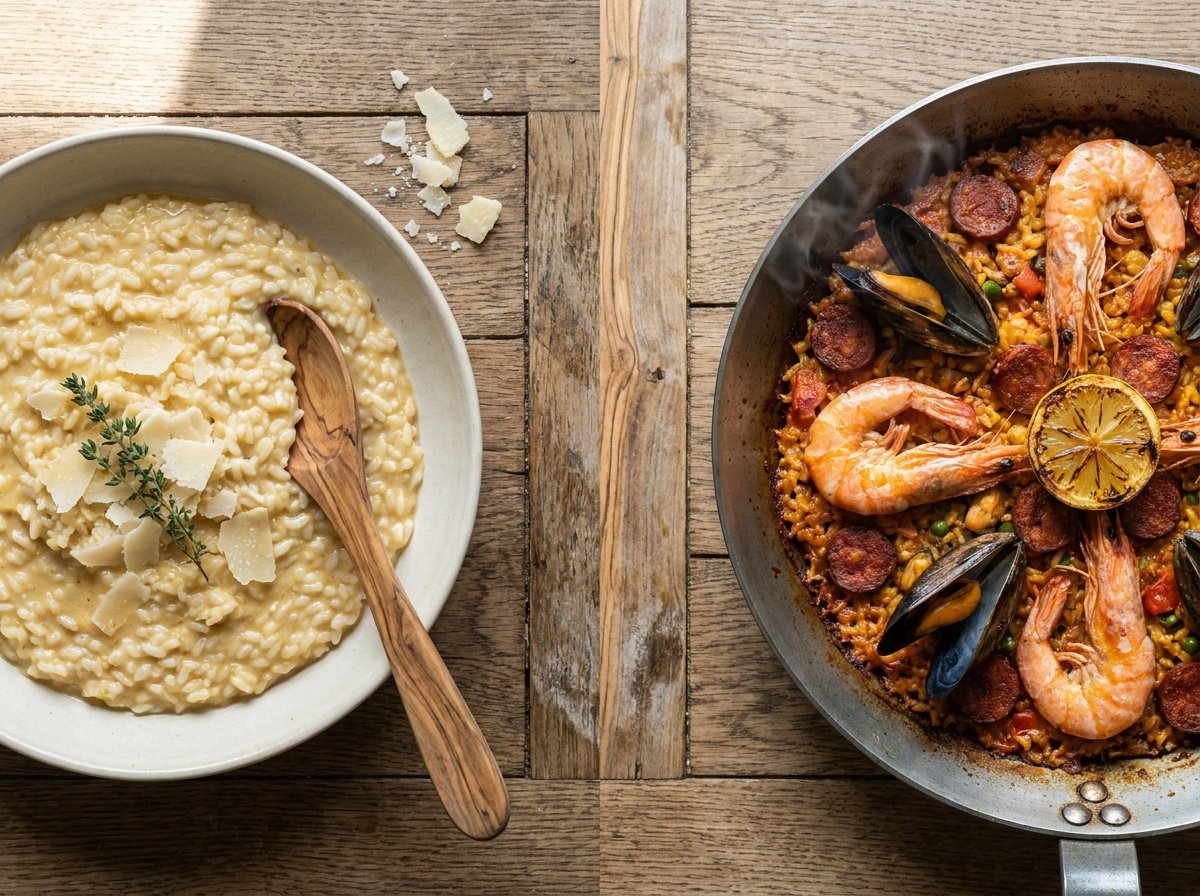
The single biggest difference between risotto and paella is movement. Risotto is stirred constantly. Paella is never stirred. Everything else, from the rice variety to the pan to the wine pairing, follows from that one rule.
| Element | Risotto | Paella |
|---|---|---|
| Origin | Northern Italy (Po Valley) | Valencia, Spain |
| Traditional Rice | Carnaroli, Vialone Nano, or Arborio | Bomba or Calasparra |
| Cooking Vessel | Deep heavy-bottomed pot | Wide shallow paella pan |
| Stirring | Constant | None after rice goes in |
| Texture Goal | Creamy, all’onda (wave-like) | Separate grains + socarrat crust |
| Heat Source | Stovetop, gentle simmer | Wood fire or wide flame |
| Liquid Added | Slowly, ladle by ladle | All at once, then left alone |
| Signature Finish | Mantecatura (butter + cheese) | Socarrat (toasted bottom crust) |
If you’ve ever been confused about the difference between risotto and paella, that table is the short answer. The rest of this post is the long answer, from a chef who learned both traditions the hard way.
Two Legendary Rice Dishes. Two Completely Different Philosophies.
There’s one question that instantly sparks debate among serious food lovers:
Risotto or Paella?
At first glance, they might seem similar. Rice. Broth. Technique. Comfort. Tradition.
But once you understand the history, culture, and cooking philosophy behind each dish, you realize these are two completely different worlds.
One is constantly stirred.
One should never be stirred.
One embraces creaminess and movement.
The other celebrates restraint, patience, and even controlled burning.
And if you truly want to understand great cooking, understanding the difference between risotto and paella is one of the best culinary lessons you can get.
I’ve spent decades studying food traditions around the world. I’ve trained in luxury resorts, cooked professionally for years, and traveled extensively through Italy and Spain. Along the way I’ve become obsessed with how cultures transform simple ingredients into iconic dishes.
And these two dishes tell incredible stories.
The Biggest Difference Between Risotto and Paella
Let’s start with the controversy.
Risotto is one of the only rice dishes in the world where constant stirring is not only accepted… it’s required.
Paella is the complete opposite.
Once the rice goes into paella, you stop touching it.
No stirring.
No fidgeting.
No mixing.
That alone confuses many cooks.
People naturally want to interfere with paella because they think something is wrong. They start moving the rice around. They stir it because they’re nervous.
That’s how you ruin it.
Paella is about trust. Heat control. Patience. Timing.
And then there’s the holy grail of paella:
The socarrat.
That beautiful, intentionally toasted layer of rice on the bottom of the pan that delivers incredible texture, smokiness, and flavor. The Spanish trade authority Foods & Wines from Spain explains that the word socarrat comes from the Valencian socarrar, meaning to scorch. There’s no good Valencian paella without one.
Most people think burnt rice is a mistake.
In great paella, it’s the prize.
Where I Learned Risotto
I learned risotto technique in the mid 1990s while working at the legendary The Greenbrier in West Virginia. At the time, it was a Mobil Five-Star property where I trained alongside chefs from some of the world’s most serious kitchens.
One of the chefs I worked with had spent time in Alba, Italy, working in a Michelin-starred restaurant in northern Italy. He brought back authentic risotto technique that completely changed how I understood rice cookery.
One of the biggest misconceptions Americans have about risotto is the rice itself.
Most people think Arborio rice is the gold standard because that’s what they see in grocery stores.
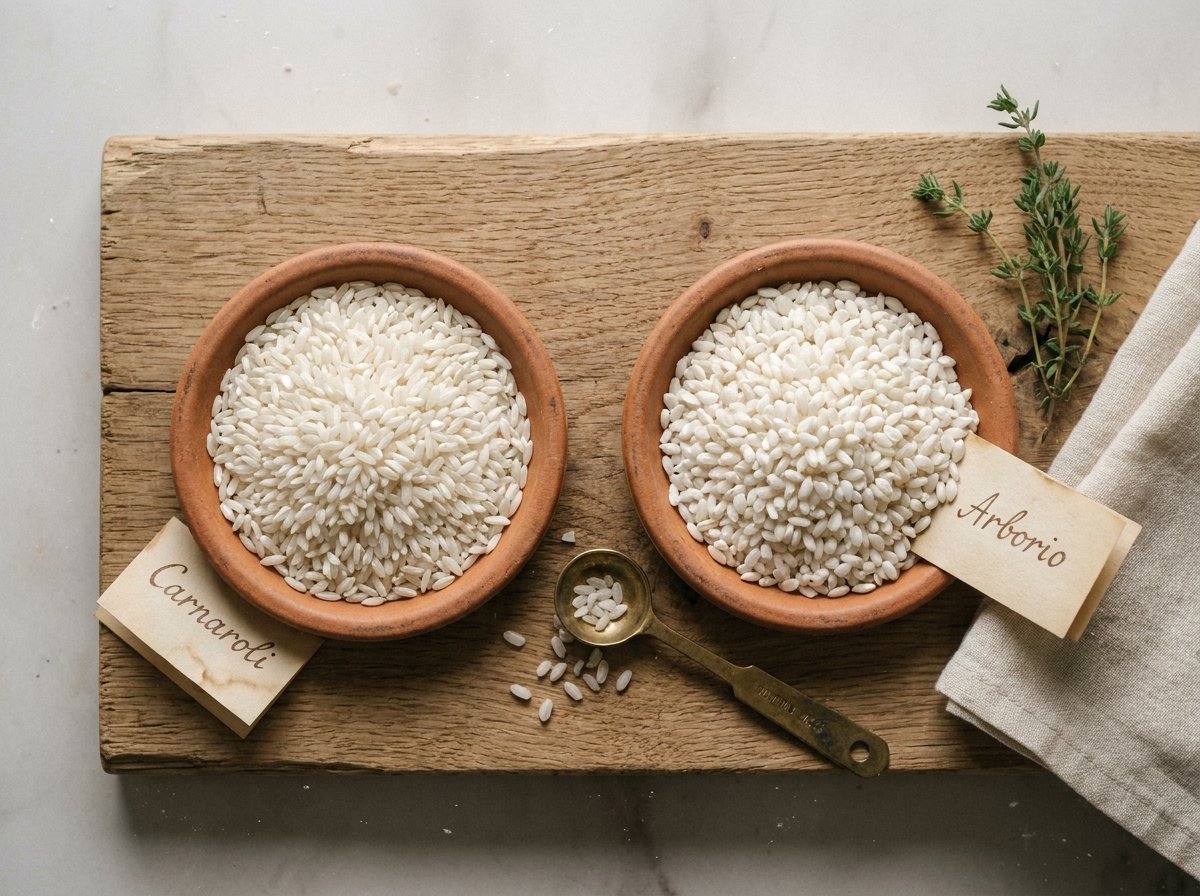
In Italy, many serious chefs prefer Carnaroli or Vialone Nano.
Those rices behave differently.
They absorb differently.
They create better texture.
They give you a more refined risotto.
According to Wikipedia’s entry on Carnaroli, the variety is grown in the Pavia, Novara, and Vercelli provinces of northern Italy. It has a higher starch content and firmer grain than arborio. Italians call it the king of risotto rice for a reason.
That’s the difference between learning from tradition and learning from marketing. The best rice for risotto is rarely the most famous one. It’s the one that keeps its shape while still releasing the starch you need for that all’onda texture. That is the wave-like ripple a properly finished classic Italian risotto should have when you tilt the plate.
The Rice That Matters: Bomba Rice vs. Arborio for Paella
Here’s where most home cooks lose paella before they even start.
They use the wrong rice.
Bomba rice (also called arroz bomba or Valencia rice) is grown in the Albufera wetlands outside Valencia, Spain. It’s a short-grain variety with a near-magical ability to absorb two to three times its volume in liquid without turning sticky or mushy.
That absorbency is the entire reason paella works.
Forbes reports that the Albufera region supplies roughly 15% of the rice consumed in Spain. Three varieties dominate the lagoon: senia, bomba, and albufera. A true paella connoisseur tastes the rice first. The shrimp, the chicken, the saffron, the chorizo. They are all supporting cast.
So how does bomba rice compare to arborio?
Arborio is bred to be creamy. It releases starch as it cooks. That’s exactly why it works for risotto, and exactly why it ruins paella.
Use arborio in paella and you’ll get a sticky, soupy mess. No defined grains. No socarrat. No texture.
Bomba does the opposite. The grains stay separate. The starch stays locked inside the grain. The bottom layer toasts cleanly against the pan instead of gluing itself into a paste.
There’s a price tag attached to that engineering. Authentic Spanish bomba rice costs roughly two to four times the price of standard arborio. Many restaurants quietly substitute. It always shows in the final dish.
If you’re serious about an authentic Spanish paella recipe at home, buy the right rice once. The technique will reward you forever.
Paella Is About the Pan
If risotto is about movement, paella is about surface area.
The pan matters enormously.
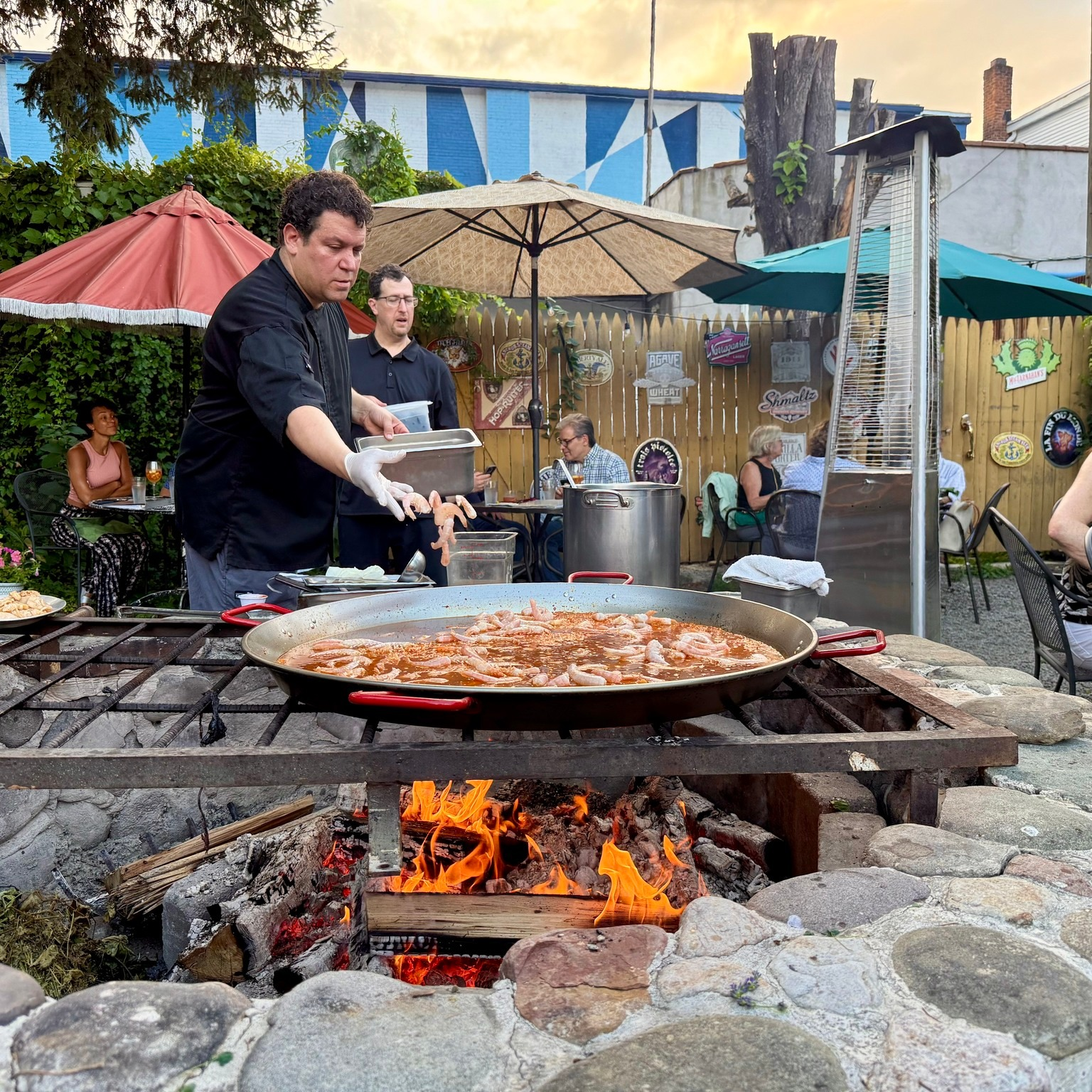
Traditional paella requires a very wide, shallow pan that allows the rice to cook evenly across a large surface.
That wide exposure creates evaporation, texture, and ultimately the socarrat.
You cannot properly execute paella in a deep pot.
And this is where many restaurants fail.
Paella is actually harder to execute consistently than risotto.
The heat distribution must be even. The flame matters. The pan matters. The rice matters.
And wood fire takes it to another level.
One of the biggest mistakes inexperienced cooks make is cooking over active flames instead of hot embers.
The real cooking happens from radiant heat.
That’s where magic starts happening.
A quick note on paella pan size, since this trips up almost everyone: the standard rule is about 1 inch of pan diameter per serving. A 13-inch pan feeds 4 people. A 16-inch pan feeds 6 to 8. A 22-inch pan feeds the whole garden. Go too small and the rice piles too deep, killing the socarrat before it can form.
My Experiences Cooking Paella in Spain
I’ve traveled throughout Spain multiple times, from Valencia to Rioja to Catalonia, studying food and wine culture firsthand. That includes the wine and food tours through Italy and Spain my wife Jamie and I now run for guests.
I’ve seen paella cooked in vineyards.
On open fire.
In Michelin-starred restaurants.
In tiny countryside kitchens.
And every great version had one thing in common:
Respect for the process.
That inspiration led me to start cooking live-fire paella in the garden at Aroma Thyme Bistro.
I invested in multiple traditional paella pans for different party sizes and sourced authentic Bomba rice from Spain.
And here’s something most people do not realize:
Bomba rice is incredibly expensive.
In many cases, it can cost several times more than premium risotto rice.
Why?
Because the rice matters.
The wrong rice destroys both dishes.
You cannot fake proper risotto with generic rice.
You cannot fake paella with random medium grain rice.
Tradition exists for a reason.
Want to taste it cooked the real way?
On Monday May 25, 2026 at 3:00 PM, we’re firing up traditional paella pans in the Aroma Thyme garden, paired with sparkling wines flown in from Catalonia’s Gramona Winery. Live fire. Bomba rice. The full tradition.
Buy Tickets Here before they sell out.
One of the Biggest Myths About Risotto and Paella
Here’s where I’ll probably upset some chefs.
You do not need an insanely rich stock to make incredible risotto or paella.
People obsess over stock.
Meanwhile, they ignore technique.
I’ve made risotto with water that people called the best risotto they’ve ever eaten.
Why?
Because texture, timing, seasoning, butter incorporation, rice quality, and proper cooking matter more than dumping salty fake stock into a pan.
And please…
Do not use cheap bouillon cubes or fake stock bases.
Most are loaded with artificial flavorings and overpower the dish.
If you do not have seafood stock for paella, make a simple vegetable or herb broth instead.
Use fennel. Herbs. Dill. Onion. Garlic.
Build real flavor.
Not chemical flavor.
Wine Pairing for Risotto vs. Paella
A great rice dish deserves a great wine. And the right pairing is built around the dish’s texture and acidity, not just its proteins.
For risotto, the move is almost always a wine with bright acidity that cuts through the creaminess. A classic mushroom or saffron risotto sings next to a Northern Italian white, like a Gavi di Gavi, a Soave Classico, or an unoaked Chardonnay. If you’re working with a heavier risotto (radicchio, bone marrow, gorgonzola), step up to a structured red like a Barbera d’Asti or a young Barolo. The rule for wine pairing for risotto: match the weight of the dish, then chase the acidity.
For paella, the move is Spanish from start to finish.
A seafood paella loves a crisp Albariño from Rías Baixas or a chilled dry sherry like a Fino or Manzanilla. For a meat-heavy paella valenciana with rabbit and chicken, lean into a Tempranillo-based red from Rioja or Ribera del Duero.
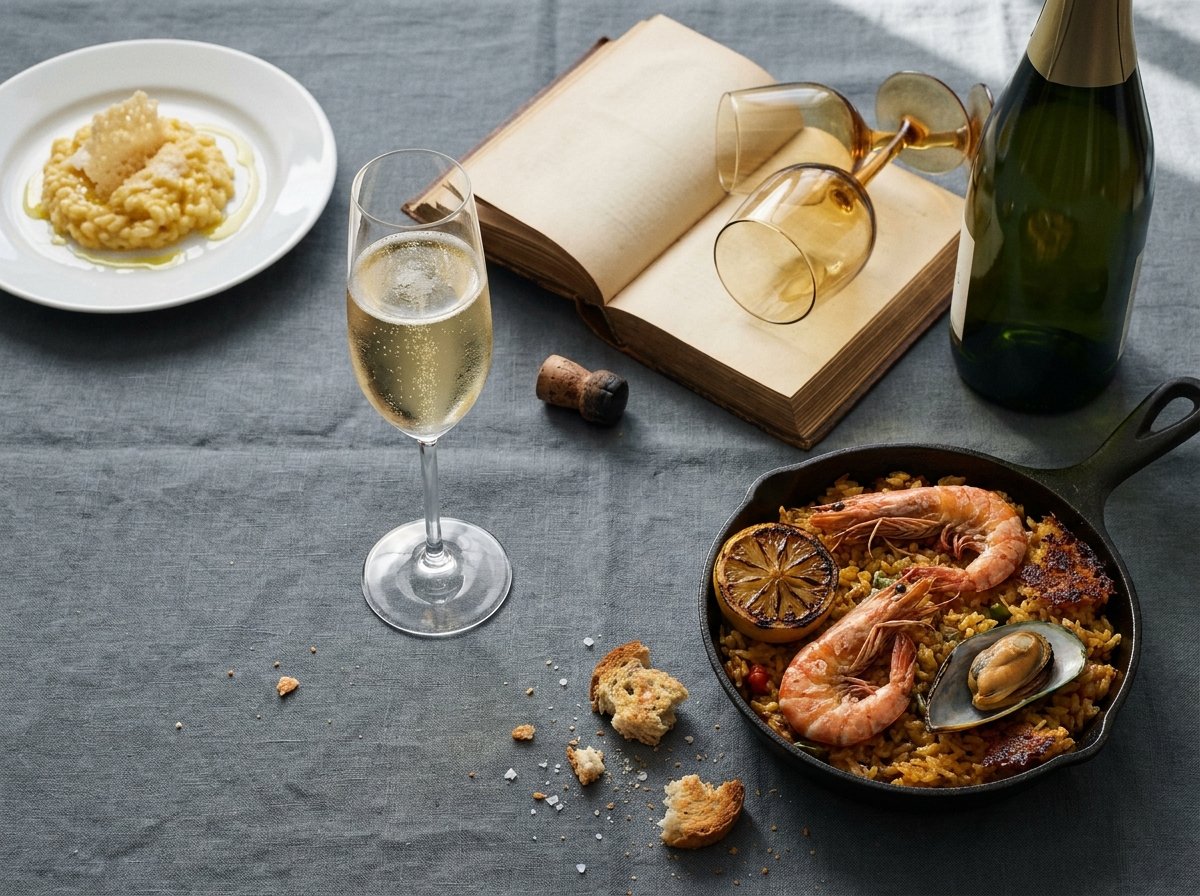
And if you want the pairing that ties both worlds together: traditional method sparkling wine.
That’s what we’re pouring on May 25, 2026 with our friends at Gramona Winery. They are a sixth-generation Catalan estate aging their sparkling wines on the lees for as long as 180 months. Most American drinkers know the region for Cava. Gramona long ago left the Cava DO to join Corpinnat, a smaller denomination built around organic, biodynamic, long-aged Penedès sparkling wine. Once you taste the difference, you understand why.
At Aroma Thyme, our 250-bottle wine list is built to support exactly this kind of pairing thinking. Old World structure, real producers, and wines that respect the food on the plate.
Why These Dishes Exist Matters
One of the most important things cooks can do is understand why dishes were created in the first place.
Risotto evolved around northern Italian rice cultivation and slow, deliberate cooking.
Paella evolved from resourcefulness.
Fishermen. Fire. Bycatch seafood. Rice cooked outdoors.
These dishes were born from culture, geography, and necessity.
That history matters.
Because once you understand the why, you stop looking for shortcuts.
And shortcuts are exactly why so many versions today fall flat.
Want to Learn Risotto or Paella Hands-On?
Reading about technique gets you maybe 30% of the way there.
The other 70% only comes from doing it next to someone who knows what they’re looking for.
That’s why we built two ways for our guests to learn this in person.
The first is Paella in the Garden at Aroma Thyme Bistro on Monday May 25, 2026 at 3:00 PM. Bring an appetite, bring your curiosity, and watch traditional paella come together over live fire with our team. A paella cooking class is the fastest way to stop guessing. Buy Tickets Here.
The second is broader. Jamie and I run small-group wine and food tours through Italy and Spain. These are the same regions where I learned these dishes. You’ll cook risotto in northern Italy. You’ll eat paella over a wood fire in a Spanish vineyard. You’ll taste the difference between learning from a recipe and learning from a tradition.
The Real Lesson Behind Risotto and Paella
Food is more than recipes.
It’s philosophy.
Tradition.
Technique.
Patience.
Regional identity.
Risotto teaches attention.
Paella teaches restraint.
Both teach respect.
And both remind us that the greatest dishes in the world were often created from humble ingredients handled properly.
That’s the lesson modern food culture desperately needs to remember.
FAQ: Risotto vs. Paella
What is the main difference between risotto and paella?
Risotto is stirred continuously to release starch and create creaminess. Paella is never stirred after the rice is added, so it develops a toasted bottom layer called socarrat instead. Risotto is built on movement. Paella is built on restraint. That single rule shapes every other choice: the rice variety, the pan, the heat source, even the wine pairing.
What is the best rice for risotto?
Traditional risotto is most often made with Carnaroli or Vialone Nano rice, both grown in northern Italy. Arborio is the most common option in American grocery stores. Carnaroli is considered the king of risotto rice by most Italian chefs because of its higher starch content and firmer grain.
What is the best rice for paella?
Authentic paella is made with Bomba or Calasparra rice from Spain. These short-grain varieties absorb two to three times their volume in liquid without turning sticky, which is essential for socarrat. Substituting arborio rice in paella produces a mushy, sticky result, the opposite of what paella should be.
Should you stir paella?
No. After the rice is added to the pan, paella should not be stirred. Stirring releases starch and prevents the rice from forming socarrat, the prized crispy bottom layer. The temptation to stir is the single most common mistake home cooks make with paella.
Is paella stirred at any point?
The sofrito and broth are stirred before the rice goes in. Once the rice is added and spread evenly across the pan, the stirring stops completely. From that point forward, the only thing you should do is rotate the pan over the heat to even out hot spots.
What is socarrat?
Socarrat is the toasted layer of rice that forms at the bottom of a paella pan in the final minutes of cooking. The word comes from the Valencian socarrar, meaning to scorch. It is intentional, not a mistake. In Valencia, a paella without socarrat is considered incomplete.
How long does it take to cook risotto?
A classic Italian risotto takes about 18 to 22 minutes once the rice hits the pan. After that comes a short mantecatura rest with butter and cheese off the heat. Anything faster usually means the starch hasn’t released. Anything longer usually means the heat is too low.
Can you cook paella over a wood fire?
Yes, and many serious paella cooks consider live fire the only authentic method. The radiant heat from glowing embers (not active flames) creates the even cooking surface required for socarrat. Live-fire paella over wood is how it was cooked in Valencia for centuries, and it’s how we cook it in the garden at Aroma Thyme.
What size paella pan do I need?
The standard rule is about 1 inch of pan diameter per serving. A 13-inch pan feeds 4. A 16-inch pan feeds 6 to 8. A 22-inch pan feeds 15 to 18. Going too small forces the rice into a deep layer and kills the socarrat before it can form.
Do you need homemade stock for risotto or paella?
A good stock helps, but technique and rice quality matter more. Avoid artificial bouillon or fake stock bases whenever possible. For paella, I would rather use plain water with a real sofrito base than a cheap cube. For risotto, even a clean vegetable broth made from fennel, herbs, dill, and onion will outperform a bouillon-driven stock.
Ready to taste the real thing?
Buy Paella in the Garden tickets for Monday May 25, 2026 at 3:00 PM, featuring Gramona Winery from Catalonia.
Or make a reservation at Aroma Thyme Bistro any night of the week for the 250-bottle wine list, farm-to-table menu, and the rest of our garden program.
Final Thoughts
If you really want to understand food, stop chasing trends and start studying traditions.
Learn why dishes exist.
Learn how cultures cook.
Learn why technique matters.
That’s where great cooking begins.
And if you ever get the chance to experience properly executed risotto in northern Italy or authentic paella cooked over live fire in Spain…
Take it.
Because once you taste the real thing, you never look at rice the same way again.
About the author. Chef Marcus Guiliano has spent 30+ years in professional kitchens. That includes The Greenbrier and The Broadmoor (both Mobil Five-Star properties at the time), plus Michelin 3-star La Tante Claire in London under chef Pierre Koffmann. He is the chef-owner of Aroma Thyme Bistro in Ellenville, NY (the first Certified Green Restaurant in upstate New York). He is also a three-time business author and a Forbes Business contributor. He has traveled extensively through Italy and Spain, studying regional rice and wine traditions firsthand. He also co-leads small-group wine and food tours with his wife Jamie.