






Most people order an espresso and never ask why it tastes the way it does.
Salty. Bitter. Burnt. Watery. Flat.
But here’s what most people never find out: almost every time espresso tastes burnt, it’s not the beans, the grinder, or the barista. It’s the machine.
I’ve been running an espresso program at Aroma Thyme Bistro for over two decades. I’ve seen this problem in every kind of operation, from chain cafes to high-end restaurants.
Why Does My Espresso Taste Burnt?
Rancid coffee oils baked into your group head. That’s the answer.
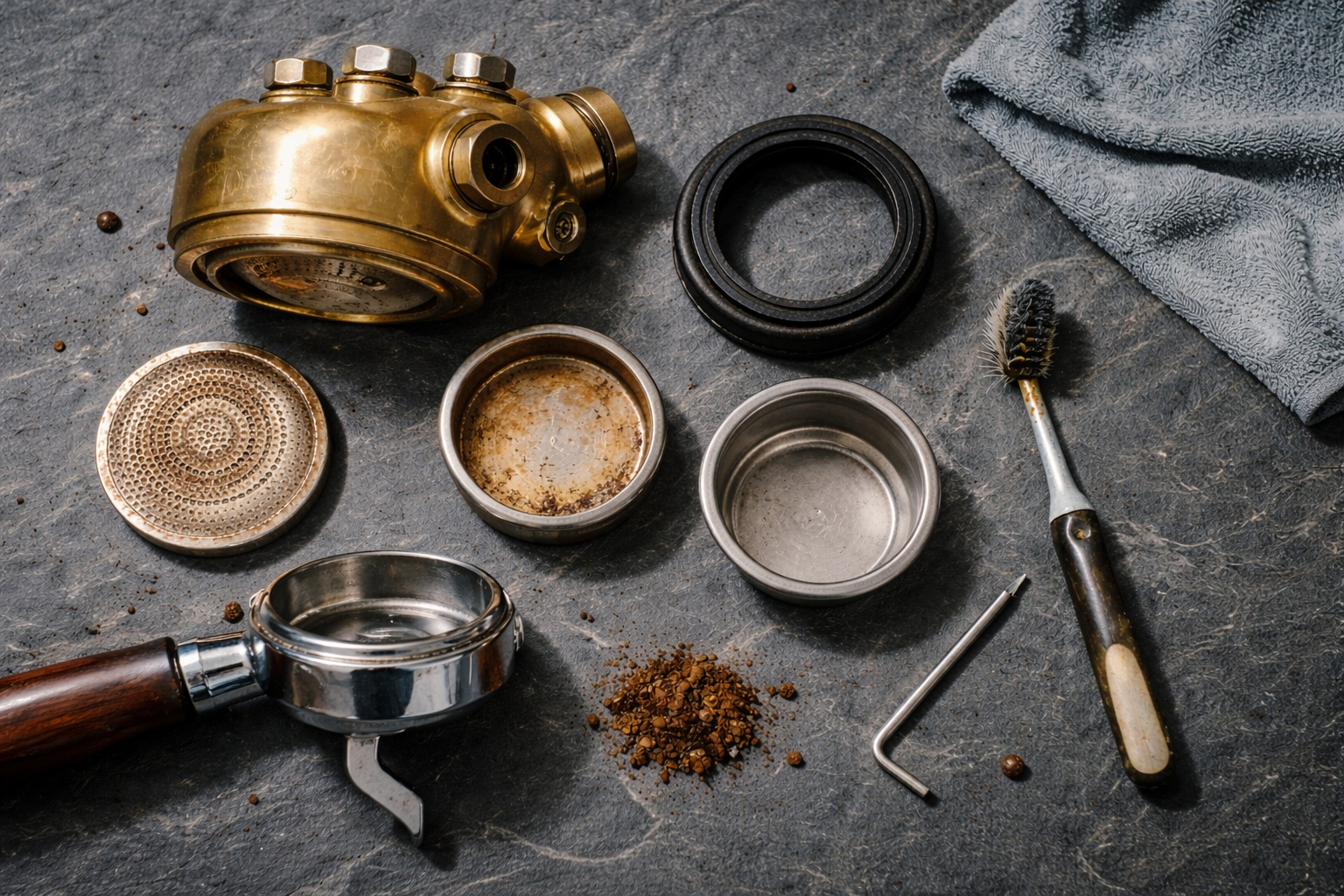
Every shot leaves oils, fines, and residue behind. Within days those oils oxidize into a sticky, tar-like sludge coating the shower screen, the gasket, and the internal passages where water flows.
When you pull your next shot, fresh water hits that sludge first. It dissolves bitter, burnt compounds on the way through, and carries them straight into your cup. Before the water ever touches your puck.
Better beans will not fix this. A better grinder will not fix this. Clean the machine first. (I’ve written before about why most cafes get espresso wrong — same root cause.)
Key Takeaway: Burnt espresso is almost never a bean, grinder, or barista problem. It's rancid oil residue in a dirty group head. The water picks it up before it ever reaches your coffee.
I Judge a Restaurant by How It Handles the Simple Things
Bread. Olive oil. Coffee.
I staged at Pierre Koffmann’s Michelin three-star La Tante Claire in London. One lesson from that kitchen repeated every service: fundamentals over flash.
No shortcuts. No powdered sauces. No fryer masking weak technique.
That same rule applies behind the bar. If a kitchen can’t get espresso right, I already know what’s happening with everything else. It’s the same reason I stopped cooking with Coca-Cola years ago. If a shortcut is sitting on the line, it’s there for a reason, and that reason is rarely about the guest.
Key Takeaway: Espresso is a benchmark, not an afterthought. When the fundamentals are broken at the simplest touchpoint, the rest of the operation is usually broken too.
I’ve Seen It Firsthand
The Foam Disaster (Hudson Valley)
I’m sitting at the bar after dinner, watching a bartender make an espresso.
Right away I see it. Zero crema. Red flag.
Then it gets worse. The bartender calls over a server who says, “I know how to do it.” He loads the portafilter wrong. He actually puts in a blind cleaning basket, the one used for backflushing the machine.
I tell him, “I think that’s wrong.” He insists he’s right.
What comes out next is a violent, high-pressure explosion of foam pouring out of the group head, not even through the spout. A chaotic, bubbly mess that looked more like a science experiment than espresso.
And they served it.
The $7 Throwaway (New York City)
Another time I stop into a coffee shop in New York City. I order an espresso.
It comes out flat. Watery. Dead. No body. No structure. No life.
One sip, walk outside, throw it out. Seven dollars, gone.
I already knew the machine was the problem, and they had no idea.
Key Takeaway: A dirty machine announces itself before the first sip. Zero crema, pale color, watery body. If those show up, the shot will not recover in the cup.
What’s Actually Happening Inside Your Machine
Inside your espresso machine’s group head, the part where water meets coffee, you have a high-heat, high-pressure environment.
Every shot leaves behind:
- Coffee oils
- Microscopic grounds (fines)
- Residue on the shower screen
- Buildup in the gasket and internal passages
Those oils go rancid, fast. Within days they oxidize into a sticky, tar-like sludge.
Add hard water, and you also get:
- Limescale (calcium buildup) clogging internal channels
- Restricted flow
- Uneven pressure
- Temperature instability
So what happens on your next shot?
- Fresh water passes through that rancid sludge first
- It dissolves bitter, burnt compounds
- It carries that straight into your cup, before it ever touches the coffee
That’s why your espresso tastes burnt.
Key Takeaway: The group head is not a passive pipe. It's a residue trap. Water picks up whatever lives there and delivers it to your cup first.
Bitter vs. Burnt: They’re Not the Same Thing
Most home users lump these together. They’re two different problems with two different fixes.
Bitter is over-extraction. Grind too fine, shot runs too long, water too hot. The fix is in your dial-in: coarser grind, shorter pull, water in the 195 to 205°F range the Specialty Coffee Association recommends.
Burnt is something else entirely. Burnt tastes like rubber, ashtray, or scorched tire. That flavor does not come from your beans or your extraction. It comes from rancid oil residue in your group head, shower screen, and gasket.
If your espresso tastes like an ashtray, the beans are not the problem. Clean the machine.
Key Takeaway: Bitter is a dial-in problem. Burnt is a machine problem. Treat them as separate diagnoses or you'll keep buying new beans to fix a cleaning issue.
Why Dirty Machines Destroy Espresso
You can see it and taste it immediately.
Clean machine: even water flow, balanced extraction, sweetness, clarity, aromatics, stable crema with structure.
Dirty machine: channeling (water blasting some areas, starving others), mixed sour-and-bitter extraction, patchy collapsing crema, harsh bitterness, burnt rubber or ashtray finish.
Here’s the kicker: you cannot fix this with better beans. You could be using the best coffee in the world. It will still taste like garbage if the machine is dirty.
That’s why “best espresso beans for burnt taste” is the wrong search. The right search is “how to clean my group head.” Same principle I’ve written about in what ‘clean eating’ actually means: if the foundation is contaminated, no upgrade on top will fix what’s underneath.
Key Takeaway: Better beans cannot clean a dirty machine. Search for maintenance information, not premium beans, when your espresso tastes burnt.
The $500 Machine-Killer
This is not just about taste. Neglecting your group head leads to:
- Worn gaskets
- Failing solenoids
- Clogged jet holes
- Slow or inconsistent flow
- Full group failure
Those repairs? $300, $400, $500, easily.
I’ve seen it happen. Even in my own operation, before I dialed in water quality and maintenance.
I run distilled water now. Yes, minerals can enhance extraction. I made a conscious trade-off: consistency and machine longevity over variability and breakdowns. At Aroma Thyme, our espresso program sits inside an 800-item Libation Library. Predictability wins. Every service.
This is not a luxury choice. It’s a responsibility choice.
Key Takeaway: Skipping maintenance doesn't save money. It costs you $300 to $500 in repairs, a dead boiler, and every bad shot you served in between.
Cleaning Protocol
Not complicated. But it requires discipline.
After Every Shot (Non-Negotiable)
- Knock out the puck
- Run water through the group head
- Brush around the gasket and screen
- Wipe the basket dry
Don’t let wet coffee oils sit and bake.
Daily Backflush
At the end of the day:
- Lock in a blind basket (no holes)
- Run pump 5 to 10 seconds
- Wait 10 seconds
- Repeat 4 to 5 times
You should see dirty water at first. Keep going until it runs clear.
Weekly Deep Clean with Cafiza
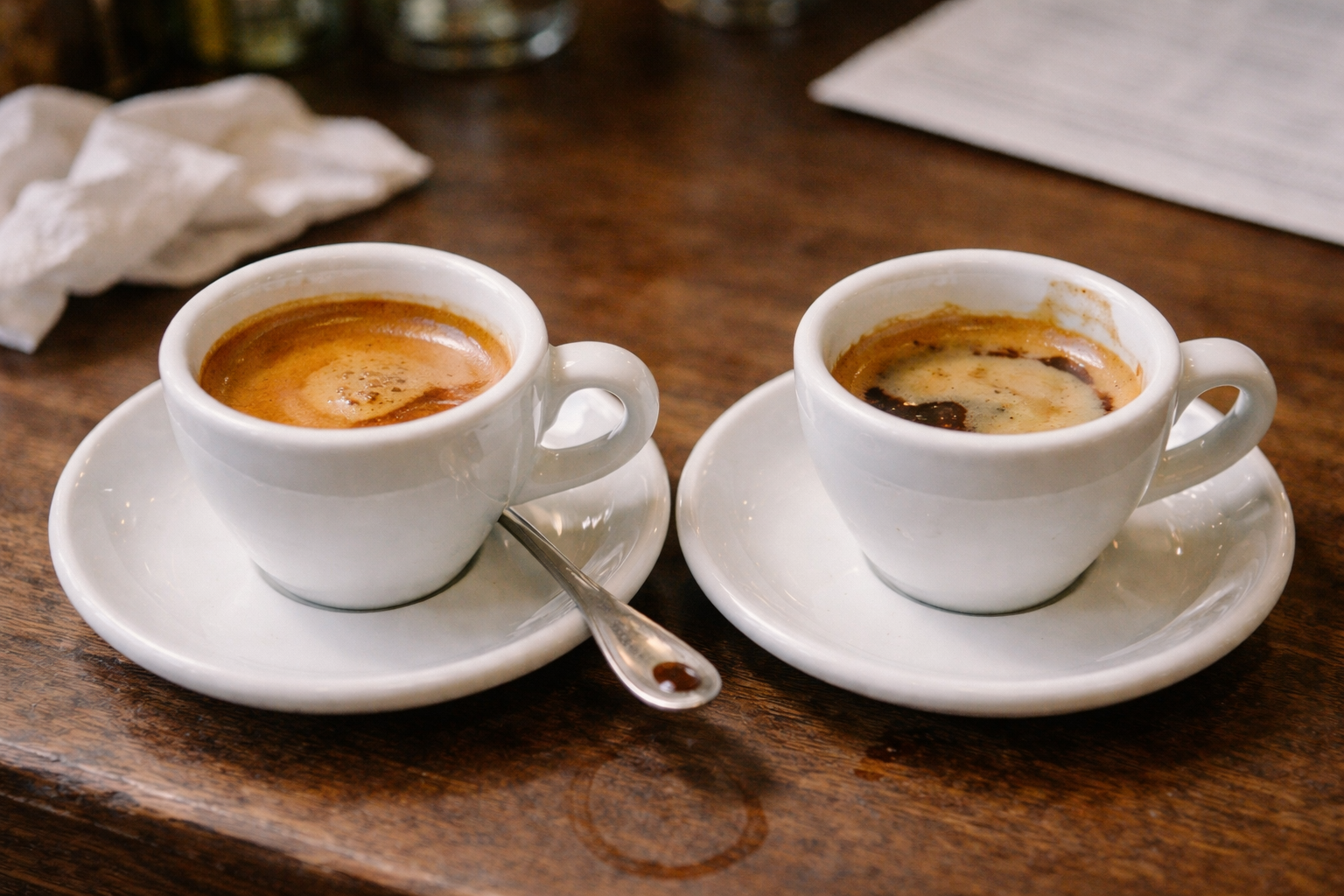
Add Cafiza or a proper espresso machine detergent to the blind basket.
- Run 8 to 10 seconds on, 10 seconds off
- Repeat 5 to 8 cycles
You’ll see foam and brown residue. Good. It’s working.
Then rinse thoroughly (multiple cycles) until detergent is completely gone. If you haven’t cleaned your machine in a while, do this two days in a row.
Drop the Screen and Go Deeper
- Turn off the machine and let it cool
- Remove the shower screen and dispersion plate
- Soak in hot water and cleaner (15 to 30 minutes)
- Scrub until the metal looks clean again
You’ll see brown oily clouds coming off the parts and built-up sludge you didn’t know existed. Clean the group cavity too. Reassemble. Flush. Test.
Monthly Descale
Hard water leaves limescale behind. Backflushing won’t touch it.
- Use a proper descaling solution (follow your manufacturer’s spec)
- Run through the boiler and brew path
- Rinse multiple cycles until water runs clean
- Pull a throwaway shot before serving
If you’re on well water or hard municipal water, descale every 3 to 4 weeks. On softened or distilled, every 6 to 8 weeks.
Key Takeaway: Four rhythms: after every shot, daily, weekly, monthly. Skip any one of them and residue builds somewhere else in the system.
Biggest Mistakes I See
Using Vinegar or Acid
Stop. This is not a kitchen sink. Acids can damage internal components and seals.
Using Bleach or Harsh Degreasers
Even worse. You’re destroying rubber parts and risking contamination.
Only Cleaning the Outside
Shiny machine. Dirty guts. Meaningless.
Not Training Staff
If your team doesn’t know what great espresso tastes like, they won’t know when it’s wrong. This is foundational.
Throwing Parts in the Dishwasher
Bad move. Pits metal. Clouds finishes. Damages gaskets. Always soak and hand clean.
Key Takeaway: Most "cleaning" isn't cleaning. Vinegar, bleach, dishwashers, and shiny exteriors all miss where the residue actually lives.
If You’ve Never Cleaned Your Machine, Start Here
Start today. Backflush with water. Brush the group head. Run multiple cycles. Won’t fix everything, but it’s your first step out of the mess.
Espresso Is a Ritual
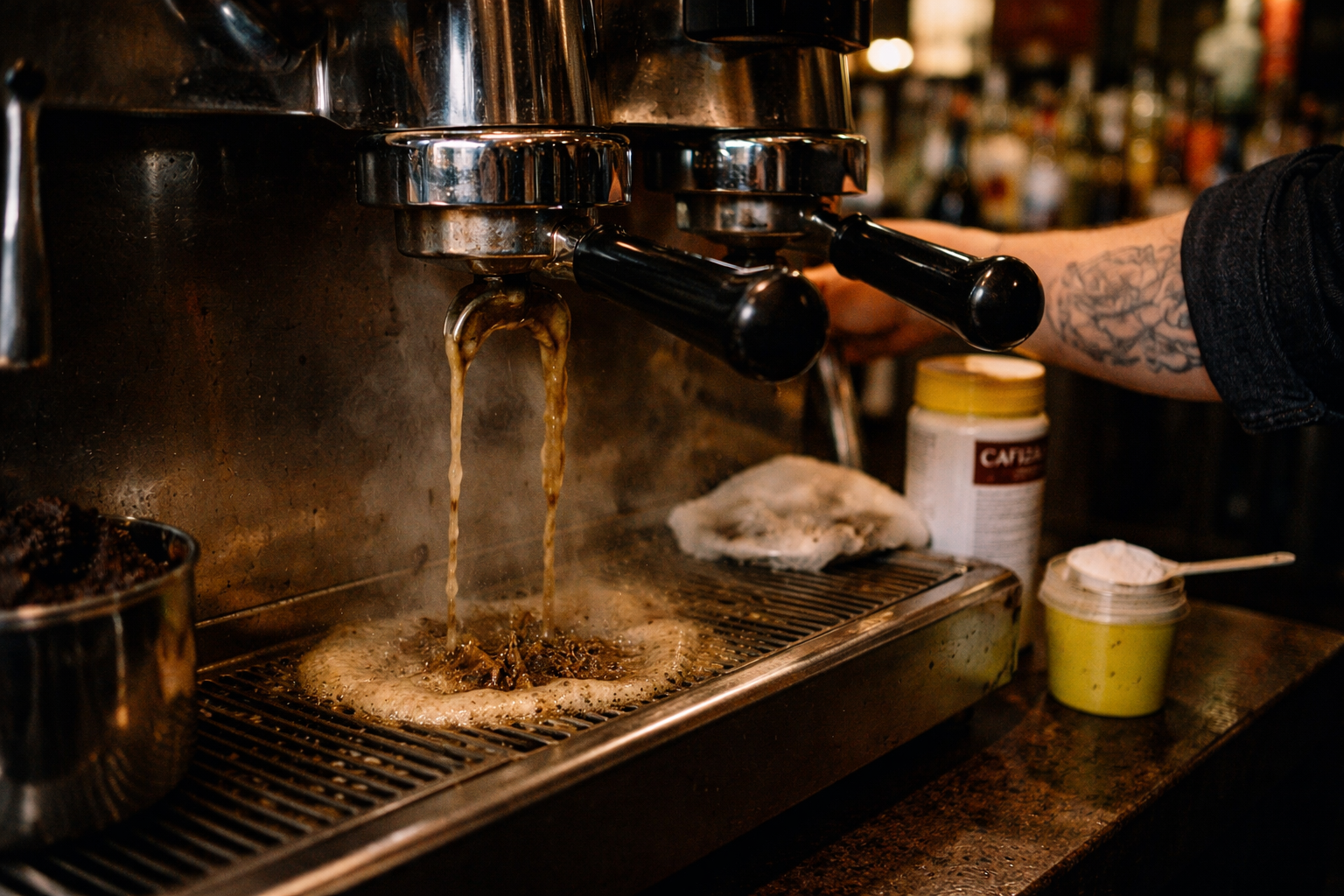
My family is from Bari, in Puglia. My grandmother taught me pasta by hand when I was a kid. She also taught me the espresso rule: mid-morning, no milk, no snack. You sit, you drink, you go.
It’s not just a drink. It’s a moment. It’s cultural. It’s precise. It’s intentional.
In Italian culture, espresso is a daily ritual, a standard of quality, and a reflection of care.
When you serve bad espresso, you’re not just serving a bad drink. You’re ruining someone’s moment. The photo might perform. The coffee will not.
Key Takeaway: Espresso is cultural currency. A bad shot doesn't just taste bad. It tells your guest the rest of the meal was built the same way.
Frequently Asked Questions
Why does my espresso taste bitter and burnt?
Bitter and burnt are two different problems. Bitter comes from over-extraction (grind too fine, shot too long, water too hot). Burnt comes from rancid coffee oils in a dirty group head. If it tastes like rubber or ashtray, the machine is the cause, not the beans.
Will better coffee beans fix burnt-tasting espresso?
No. If your group head is coated in rancid oil residue, fresh water will dissolve those compounds before it ever touches your puck. The world’s best beans will still taste burnt. Clean the machine first, then evaluate your beans.
Is my coffee grinder causing burnt espresso taste?
Usually no. A dull or overheated grinder can add harshness, but true burnt flavor (rubber, ashtray) is almost always a dirty machine. Clean the group head, shower screen, and gasket first. Only then troubleshoot your grinder.
Which espresso machines prevent burnt coffee taste?
No machine prevents burnt coffee if it isn’t maintained. A $3,000 dual-boiler will taste just as bad as a $300 single-boiler after two weeks of zero backflushing. The machine doesn’t make the coffee. Maintenance does.
What’s the ideal water temperature for espresso?
Standard is 195 to 205°F (90 to 96°C), per the Specialty Coffee Association. Too hot scorches the grounds and produces bitter, burnt flavors. Too cool leaves the shot sour and underdeveloped. Water quality matters as much as temperature. Hard water builds limescale that destabilizes temperature over time. At Aroma Thyme I run distilled water to hold temperature stable and protect the boiler.
How often should I clean my espresso machine?
After every shot: wipe and flush. Daily: backflush with water. Weekly: Cafiza deep clean. Monthly: descale (more often on hard water). Shower screen and dispersion plate: pull and soak at least once a week.
How much does espresso machine repair cost?
A worn gasket or shower screen runs $20 to $60 in parts. A failing solenoid runs $150 to $300. A clogged or seized group head can run $300 to $500 or more. Most of those repairs come from skipped backflushing and descaling. Prevention is free. Repair is not.
Final Takeaway
If your espresso tastes bitter, flat, burnt, or inconsistent, don’t blame the beans. Don’t blame the grinder. Look at your machine.
Start with the group head. Clean it like it matters.
Because it does.
If you’re ever in the Hudson Valley, come by Aroma Thyme and taste what clean machines actually pour.
Marcus Guiliano is the executive chef and owner of Aroma Thyme Bistro in Ellenville, NY, built on real food, honest sourcing, and the belief that the fundamentals show up in every cup.