





Most people grab feta from a restaurant salad without a second thought.
Salty. Crumbly. White cheese.
But here’s what most diners never find out: the sheep milk feta that makes real Greek feta distinct is almost never what lands on your plate in an American restaurant.
I learned this firsthand — buying cheese for my own kitchen.
What Is Sheep Milk Feta, Exactly?
Real feta is sheep milk feta.
In the European Union, feta carries PDO status — Protected Designation of Origin. EU Regulation 1829/2002 sets three non-negotiable rules:
- It must come from Greece.
- It must be made from sheep’s milk, or sheep’s milk with up to 30% goat’s milk.
- It must contain zero cow’s milk.
That protection has been EU law since 2002. Feta is the product of a specific place, a specific animal, and a specific tradition.
In the US? No such rule exists.
Sheep milk feta is a legally protected name in Europe. In America, "feta" can be made from any milk — and most of the time, it is.
The Moment I Realized Something Was Off
Early in my career, feta cheese behaved strangely.
Sometimes it was incredible. Tangy, creamy, crumbly, rich. Complex in a way I couldn’t explain at first.
Other times it was flat. Salty white rubber.
Same menu item. Completely different product.
Later, when I started ordering cheese for Aroma Thyme Bistro, the invoice told me everything.
Price.
Real Greek feta can cost 30% to over 200% more than domestic cow-milk feta. When a restaurant sees that gap on a price sheet, most never ask what the cheaper option actually is. They just order it.
That gap in curiosity is where the problem starts.
The price difference between real and fake feta is significant. Most restaurants default to the cheaper domestic version without questioning what milk it came from.
The Truth About “Feta” in the United States
Here’s the practical problem.
In the US, “feta” is not regulated by origin or milk source. The USDA Agricultural Marketing Service has standards for some cheeses. But feta is not subject to the milk-source rules that apply under EU PDO law.
That means American producers can legally call a cheese “feta” if it’s made from:
- Cow milk
- Sheep milk
- Goat milk
- Any blend of the three
Most domestic producers use cow’s milk. It’s cheaper. It’s available at scale. It produces a consistent, mild product that ships well.
The result looks like feta. But it doesn’t taste like real feta — and it doesn’t carry the same nutritional profile.
"Feta" on a US label says nothing about what milk was used. Without "PDO," "Greek," or "sheep's milk" on the package, assume it's domestic cow-milk cheese.
What Does Restaurant Feta Actually Contain?
Almost certainly cow’s milk.
Here’s how the supply chain works: most restaurants buy from broadline distributors — Sysco, US Foods, and similar companies. The default feta those distributors stock is domestic cow-milk feta. It’s cheap, ships well, and nobody complains.
A chef has to specifically request PDO feta cheese — Greek PDO — to get the real thing. Most don’t.
In my experience buying cheese for restaurant kitchens, the vast majority of feta served in America has never been near a sheep. It’s domestic cow-milk feta sold under a name that implies something different.
The “90% figure” gets repeated in food service circles. I can’t cite a peer-reviewed study. But it matches everything I’ve seen from inside a commercial kitchen.
Restaurant feta defaults to domestic cow-milk feta unless a chef specifically requests Greek PDO. That's not deliberate deception — it's a supply chain default nobody questions.
Is European Feta the Same as Greek Feta?
Not always — and this is where it gets confusing.
Some menus say “European feta” as a quality signal. That phrase does not mean PDO Greek feta cheese.
Take Bulgaria. Their traditional white brined cheese is called sirene. It looks and feels similar to Greek feta. But Bulgarian feta cheese — or what gets exported as “feta-style” from Bulgaria — can be made from cow milk, sheep milk, goat milk, or any combination.
Authentic feta cheese — the kind protected by EU law — will say one of these things clearly:
- Greek feta
- PDO feta
- Sheep’s milk feta
- Sheep and goat milk feta
It will often carry the EU PDO mark: a red and yellow circular logo. The Greek Ministry of Rural Development and Food oversees PDO enforcement for Greek dairy products.
If the label says “feta” with nothing else, you don’t know what you’re eating.
"European feta" is not the same as Greek PDO feta. Look for "PDO," "Greek," or "sheep's milk" explicitly on the label before assuming it's the real thing.
Why Sheep Milk Feta Tastes Different
Sheep’s milk is not cow’s milk with a different animal.
It’s a denser product. Sheep produce far less milk than cows. But that milk carries nearly double the fat, more protein, and a higher concentration of short-chain fatty acids.
Those fatty acids are why sheep milk feta has a sharpness and depth domestic feta can’t copy. The difference isn’t just saltiness. It’s layered — tang, cream, a slight mineral note underneath.
When I taste both side by side, the gap is obvious within one bite. Domestic cow-milk feta is milder, softer, simpler. Not bad. Just not the same product.
The animal matters. The milk matters.
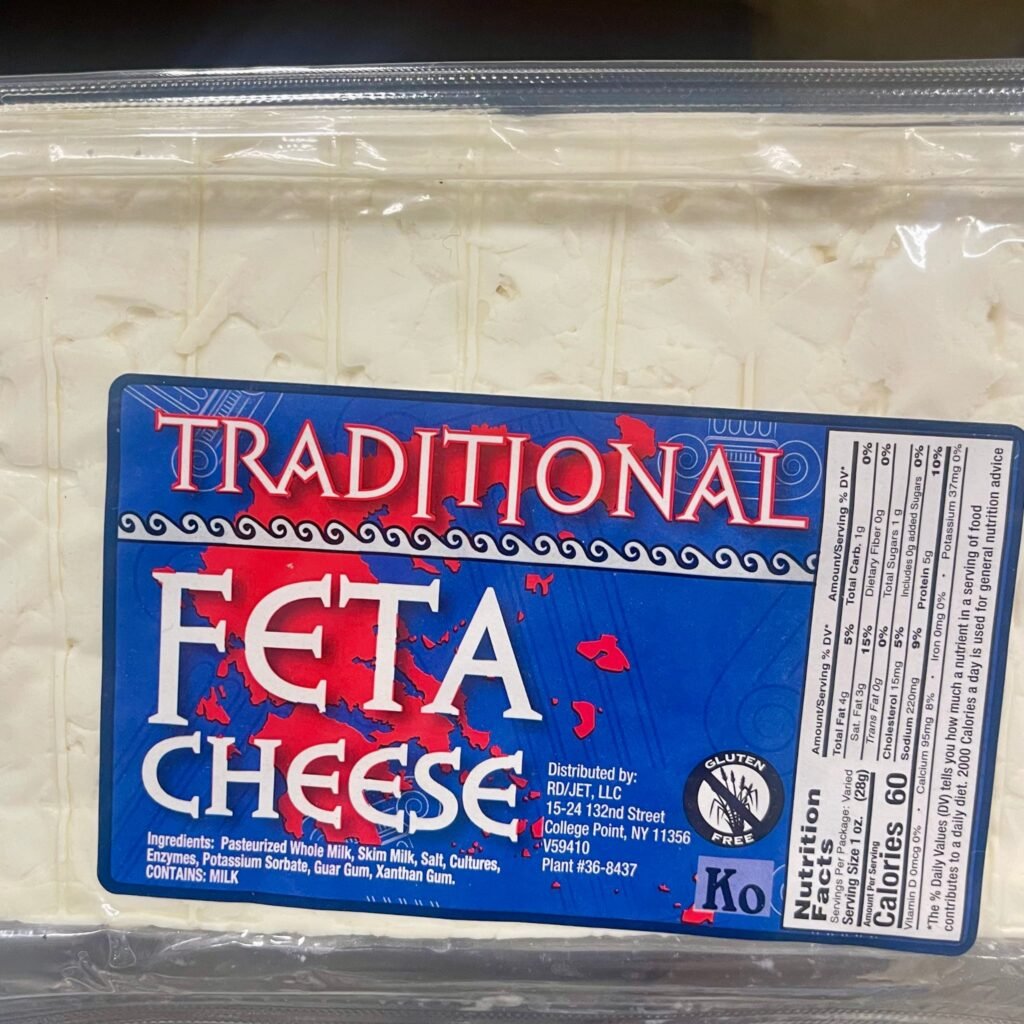
Sheep's milk carries nearly double the fat of cow's milk. That's what makes real feta tangy and complex — qualities domestic cow-milk feta simply can't match.
Sheep Milk Feta vs. Cow Milk Feta: The Nutritional Difference
The flavor gap has a nutritional explanation.
Sheep’s milk is more concentrated than cow’s milk — more fat-soluble vitamins, more calcium, higher protein per 100g.
| Comparison | Sheep Milk Feta (PDO) | Cow Milk Feta (Domestic) |
|---|---|---|
| Milk source | Sheep + up to 30% goat | Cow |
| Fat (per 100g) | ~26g | ~14g |
| Protein (per 100g) | ~14g | ~11g |
| Calcium | Higher | Lower |
| Flavor profile | Tangy, complex, aromatic | Mild, soft, one-dimensional |
| EU PDO protected | Yes | No |
Both are high-protein, low-carb cheeses. But sheep milk feta delivers more per bite — more flavor, more fat, more nutrients.
For anyone who eats with purpose, that’s not a small distinction.
Real feta has nearly double the fat and more protein than domestic cow-milk feta. You're not just getting a better-tasting cheese — you're getting a more nutritious one.
Why Real Greek Feta Uses Both Sheep and Goat Milk
The PDO rules allow up to 30% goat milk in feta. That’s not a loophole. It’s tradition.
In many parts of Greece, farmers raise mixed herds of sheep and goats. The animals graze the same hillsides. Their milk gets collected together. Small producers sell to local cooperatives, which blend the milk into feta.
Goat milk adds a sharper, more mineral note. Sheep milk brings the richness. Together, they create something neither animal produces alone.
When you see “sheep and goat milk feta” on a label, that’s a sign of traditional sourcing — not a technicality.

PDO feta includes up to 30% goat milk because Greek farmers traditionally raise sheep and goats together. The blend is part of what gives real feta its complex flavor.
How to Find Real Sheep Milk Feta
You can find it. You just have to know what to look for.
At most grocery stores, domestic feta and real Greek feta sit side by side. The price difference is visible. So is the label, if you read it.
What to look for:
- “Greek feta,” “PDO feta,” or “sheep’s milk feta” on the label
- The EU PDO certification mark — red and yellow circular logo
- Country of origin: Greece
- Ingredients: sheep’s milk, or sheep’s milk and goat’s milk — no cow’s milk
Where to buy:
- Specialty cheese shops and Greek markets
- Mediterranean delis and importers
- Whole Foods and natural grocery stores
- Online Greek food retailers who ship nationally
Real sheep milk feta costs more. If the price matches a domestic brand, read the label carefully.
→ Related: A Chef’s Guide to the Types of Mozzarella: Spotting Real Italian Cheese
Look for "PDO," "Greek," or "sheep's milk" on the label. The EU PDO certification mark is the clearest sign you've found the real thing.
What This Means for You as a Diner
Restaurants respond to demand. That’s purchasing reality.
When diners start asking questions, chefs take note. When enough tables ask “Is this Greek feta? Is it sheep’s milk?” — the distributor call changes.
Three questions worth asking at your next restaurant:
- Is your feta Greek?
- Is it PDO certified?
- Is it sheep’s milk?
A confident answer means the kitchen knows what they’re buying. A vague one usually tells you what you need to know.
This isn’t about shaming restaurants. Most aren’t deliberately misleading anyone. They’re buying what the distributor delivers. But informed diners create informed chefs — and informed chefs change what ends up on your plate.
→ Related: Real Wasabi vs Fake: A Restaurant Owner’s Consumer Alert
Three questions — "Is it Greek? Is it PDO? Is it sheep's milk?" — are enough to shift what a restaurant orders. Demand changes supply.
The Real Food Fight
Feta is one example.
Sheep milk feta is one entry point into a much bigger conversation about what we actually eat versus what we think we’re eating.
Olive oil has the same problem. So does Parmesan. So does balsamic vinegar. Products that carry names implying origin and authenticity — often masking something cheaper and less specific.
The more we ask, the more restaurants and retailers have to answer. That’s how standards improve. Not through regulation alone — through diners who know the difference.
Real feta is sheep milk feta. It tastes better. It’s more nutritious. And it represents a food tradition worth asking about by name.
→ Related: Real vs. Fake Balsamic Vinegar: The Balsamic Deception
Marcus Guiliano is the executive chef and owner of Aroma Thyme Bistro in Ellenville, NY — built on real food, honest sourcing, and the belief that what’s on the label should match what’s on the plate.