



I trained under Pierre Koffmann, chef at La Tante Claire in London. That kitchen reshaped my entire understanding of food. Not plating. Not presentation. Not the art of making things look good on a phone screen. Flavor. Depth. Foundation.
Koffmann held three Michelin stars. He earned them through classical French technique rooted in his native Gascony. He never designed plates to impress your eyes first. He built them to stop you mid-bite.
That training defines everything I do today at Aroma Thyme Bistro in the Hudson Valley.
What Did Pierre Koffmann’s Three Michelin Star Kitchen Actually Teach?
Koffmann’s kitchen taught one principle above all others. You build flavor through discipline, not decoration.
Pierre Koffmann did not chase trends. He cooked from the fundamentals of cooking that his Gascon grandmother passed down. Decades of classical French training refined those roots into three Michelin stars.
In his kitchen at La Tante Claire, there were no shortcuts. No powdered sauces. No artificial flavor boosters. No chicken base loaded with excitotoxins. No deep fryer masking weak technique.
If the sauce lacked depth, you reduced it longer. If the seasoning was off, you corrected it. If the carrot was not cooked properly, you started over. Period.
I walked into that kitchen expecting to learn recipes. What I found instead was silence, intensity, and a standard that broke you down before it built you up. Every station ran on precision. Every chef moved with purpose. Nobody spoke unless the food demanded it. I walked out understanding that real food cooking starts with respecting the process, not rushing it.
Key Takeaway: Pierre Koffmann earned three Michelin stars not through spectacle, but through classical French technique rooted in Gascony. His food was engineered for flavor.
The Pig’s Trotter That Proved Fundamentals Win
The dish that changed my perspective was not complex. It was not tall. It did not arrive under a glass dome filled with smoke. It was a stuffed pig’s trotter.
One of the most iconic dishes from pierre koffmann chef Koffmann was his Pâté de Cochon. Every Tuesday at La Tante Claire, I received buckets of pig trotters. My job: debone each one down to the knuckle. Remove every hair. Clean them until spotless. That process took most of the day.
We stuffed the trotters with sweetbreads and morel mushrooms, folding them into a precise chicken mousseline made from a metric recipe I still remember today.
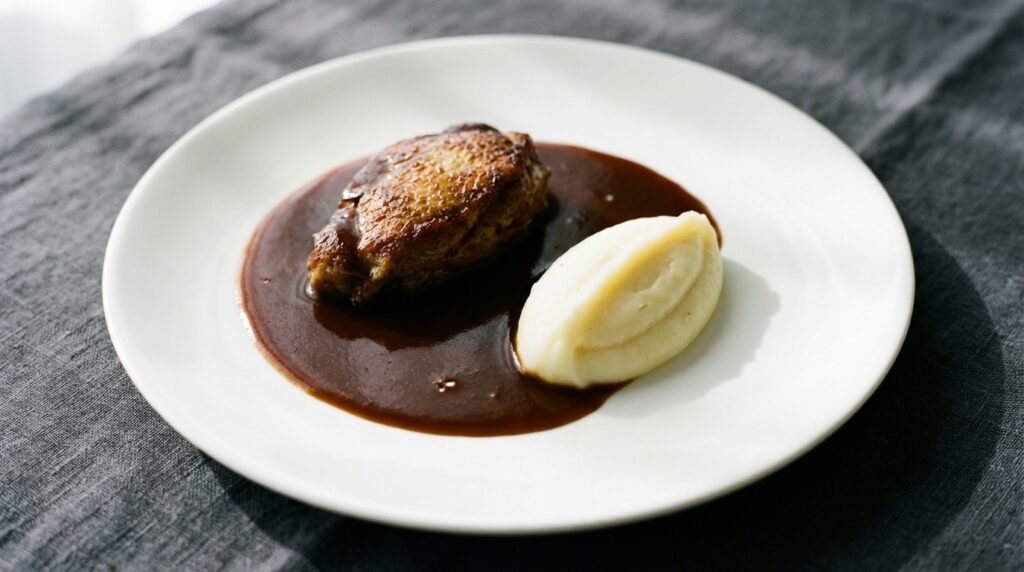
On the plate? A pork demi-glace. A quenelle of mashed potatoes. That was it.
No green vegetables. No color contrast. No artistic garnish. Visually, almost one-dimensional.
But when you tasted it? Profound. Deep. Layered. Balanced. Luxurious.
Other chefs noticed. Even Marco Pierre White paid homage and listed “Koffmann’s Trotters” on his own menu. The plate did not need decoration. The fundamentals were flawless.
This is what chef mentorship looks like in a Michelin kitchen. Not lectures. Not theory. Pig trotters on a Tuesday morning.
Key Takeaway: Marco Pierre White put Koffmann's Trotters on his own menu. The plate needed zero decoration. The fundamentals were flawless.
Why Do So Many Modern Plates Look Great But Taste Average?
Too many chefs today design plates before they build flavor. The photo comes first. The taste comes second, if it comes at all.
| What Gets Prioritized | What Gets Skipped |
|---|---|
| How the plate photographs | Proper seasoning |
| How tall the stack reaches | Proper sauce reduction |
| How many components fit | Proper ingredient sourcing |
| How the smoke dome looks on video | Proper knife work |
| How “unique” the ingredient list reads | Proper cooking times |
When you skip the fundamentals, the plate might look exciting. But it lacks soul. You taste the concept. You do not taste the food.
Under pierre koffmann chef Koffmann, I learned something permanent. Flavor first. Always. No exceptions. That is what makes a great chef.
Key Takeaway: When you skip the fundamentals, the plate might look exciting, but it lacks soul. The photo might perform. The food will not.
How Pierre Koffmann Chef Training Shapes Aroma Thyme Bistro
I am Chef Marcus Guiliano. I trained under Pierre Koffmann at La Tante Claire in London. Today I own Aroma Thyme Bistro in Ellenville, New York.
Every decision in my hudson valley chef kitchen traces back to that training. We focus on:
- High-quality ingredients sourced with intention
- Grass-fed meats from farms I know by name
- Wild seafood selected for integrity, not price
- Additive-free sourcing across every supplier
- Classical technique applied to every dish
- Proper seasoning verified before any plate leaves the pass
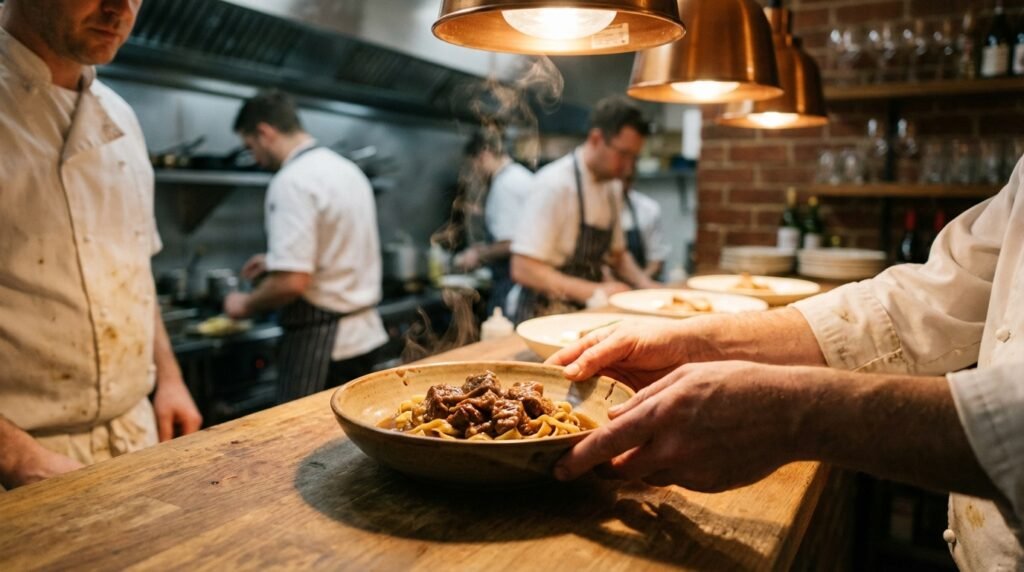
Right now, I am serving a pasta dish with braised pork cheeks. Visually? Pasta with pieces of pork folded in. Not dramatic. Not architectural.
But the braise is deep. The seasoning is exact. The technique is correct. One bite, and guests stop talking. They look up. They nod. Then they ask for more. That is the standard Koffmann set. I refuse to lower it.
This also shapes how I think about sourcing. The same discipline Koffmann applied to his sauces, I apply to where my seafood comes from and why I reject certain ingredients entirely.
Key Takeaway: At Aroma Thyme Bistro in the Hudson Valley, depth over decoration is the standard. Every ingredient, every technique traces back to Koffmann's three-star kitchen.
Foundation Is the Real Measure of Culinary Excellence
In a three Michelin star kitchen, you cannot hide. There is no fryer to make something addictive. There is no artificial enhancer to trick the palate. There is no shortcut that replaces time.
The art is in reducing a sauce properly. Seasoning correctly. Sourcing ingredients that do not need to be masked. Respecting the hours a braise needs to develop.
The best career advice I ever received came from kitchens like Koffmann’s. Not from textbooks. Not from social media. From standing at a stove, watching a master work in silence.
When you do the simple things better than anyone else, the plate does not need to shout. It speaks quietly. And guests remember it long after the meal ends.
Key Takeaway: Do the simple things better than anyone else. The plate does not need to shout. It speaks quietly, and guests remember.
The Real Lesson from Pierre Koffmann
The greatest lesson from my training under pierre koffmann chef Koffmann is this. Master the fundamentals.
High-quality ingredients. Proper execution. No shortcuts. No hype.
Because when the foundation is strong, the plate becomes unforgettable. Even if it does not look flashy. Even if it never trends online.
That philosophy defines who I am as Chef Marcus Guiliano. It defines Aroma Thyme Bistro, a Hudson Valley restaurant built on real food, classical technique, and standards I will not lower.
Why I turned down an executive chef position at a NY Times-rated restaurant comes from this same place. Standards over status. Foundation over flash.
Great cuisine is not about looking impressive. It is about tasting extraordinary.
Key Takeaway: When the foundation is strong, the plate becomes unforgettable. Fundamentals over flash. Always.