





By Chef Marcus Guiliano | Chef on a Mission | Hudson Valley Real Food Advocate
Let me say this clearly.
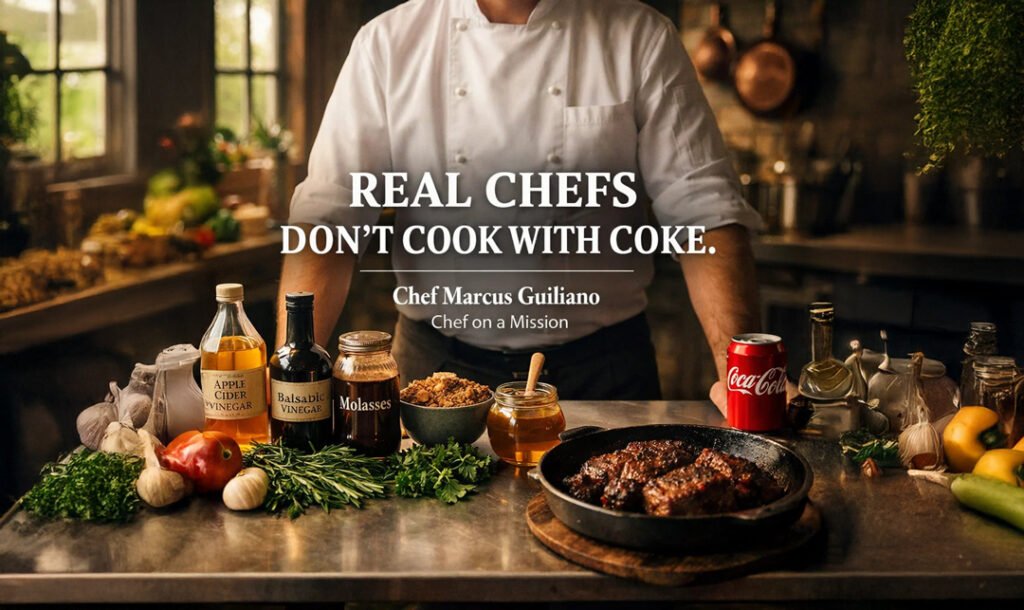
I’m disappointed when I see chefs cooking with Coca-Cola.
Not just line cooks experimenting on TikTok. I’m talking about television chefs. Cookbook authors. Culinary influencers with massive platforms.
As chefs, we shape how people eat. We influence the health of our communities. We help decide what ends up on dinner tables across America.
When we choose ultra-processed soda over real ingredients, we move in the wrong direction.
This isn’t about being dramatic. It’s about responsibility.
As Chef on a Mission and chef-owner of Aroma Thyme Bistro in the Hudson Valley, my commitment is clear. Real food, real ingredients, real flavor.
Cooking with Coca-Cola goes against everything I stand for.
The First Time I Heard About Cooking with Coca-Cola
I didn’t always identify as a “real food activist.”
The first time I heard about chefs using Coca-Cola in cooking, I wasn’t immersed in the natural food movement. I was working in a kitchen. Other cooks talked about adding Coke to braises.
Someone mentioned using Coca-Cola in bear meat because it was “so tough.”
Even then, before I knew what I know now, a red flag went up.
I remember thinking: Why would you put soda into a braised dish?
It didn’t make sense.
If you need sweetness, use sweetness.
If you need acidity, use vinegar.
If you need caramelization, develop it properly.
Later, I saw it on television — probably the Food Network. A chef pouring Coke into a pan like some kind of secret weapon.
It didn’t sit right.
Now, with decades of experience and over 350 wineries visited across six countries, I understand exactly why it bothered me.
Coca-Cola isn’t a culinary ingredient. It’s an industrial product.
Key Takeaway: If you need sweetness, acidity, or caramelization in a braise, real culinary tools exist for each. Coca-Cola replaces technique with industrial processing.
What’s Actually in Coca-Cola?
Let’s break it down.
Coca-Cola contains:
- High fructose corn syrup or refined sugar
- Phosphoric acid
- Caramel color (industrial, not kitchen caramel)
- Natural flavors (proprietary blend)
- Caffeine
- Sodium benzoate (preservative)
- Carbonated water
Ask yourself this.
Would you buy phosphoric acid for your pantry? Would you source sodium benzoate for your kitchen? Would you measure industrial caramel coloring into a sauce?
Of course not.
So why is it acceptable just because it comes inside a red can?
Research links ultra-processed ingredients to inflammation and metabolic disruption. These are not neutral substances in the human body.
If I can’t source the individual components of an ingredient in a meaningful, culinary way, I don’t consider it real food.
That’s the standard I hold at Aroma Thyme Bistro in the Hudson Valley.
Key Takeaway: Coca-Cola contains phosphoric acid, sodium benzoate, and industrial caramel color. No chef would stock these individually. A red can doesn't change what they are.
The Real Food Standard at Aroma Thyme Bistro
Here’s the rule I live by.
If I add an ingredient to a dish, I should be able to explain and source everything inside it.
We don’t use commercial soup bases at Aroma Thyme Bistro.
Many fine dining restaurants still buy lobster base for their bisque. Even high-end establishments do this.
I would never.
Instead, we roast lobster shells. We toast them properly. We extract maximum flavor. We simmer, blend, strain, and build our stock from scratch.
No artificial enhancers. No MSG-loaded bases. No hydrolyzed wheat extract. No hidden flavor boosters designed to manipulate the palate.
Just real technique. Real extraction. Real flavor.
That’s the difference between building flavor in a pot and buying it in a jar.
This same philosophy applies to everything on our menu. It’s why I say no to seed oils in our kitchen. It’s why I personally investigate every ingredient — from the fish we source to the vinegar on our shelves.
Key Takeaway: The real food standard is simple. If you can't explain and source every component inside an ingredient, it doesn't belong in your kitchen.
The Addiction Factor in Modern Food
Here’s something most chefs don’t want to talk about.
Modern industrial food is engineered.
Ultra-processed ingredients trigger reward responses for a reason. Sugar, acid, and synthetic enhancers create a neurological “buzz.”
Gary Null explored this in The Food-Mood-Body Connection — how certain ingredients stimulate responses that feel good. A rush. A hit. A spike.
Many diners today are accustomed to that stimulation.
When someone eats truly clean food for the first time, they sometimes say: “This tastes different.”
Yes. It does. Because it isn’t chemically amplified.
At Aroma Thyme Bistro, guests who understand real food taste the freshness immediately. Others — accustomed to highly processed flavor systems — need time to recalibrate.
That’s okay.
Part of being a Chef on a Mission is helping people rediscover what real food actually tastes like.
Key Takeaway: Ultra-processed ingredients like those in Coca-Cola are engineered to trigger reward responses. Real food tastes different because it isn't chemically amplified.
Why Chefs Should Stop Cooking with Coca-Cola
Chefs are not just cooks.
We are educators. We are influencers. We are gatekeepers of ingredients.
When we choose shortcuts, we normalize shortcuts.
When we normalize soda in braises, processed bases in soups, and industrial additives in sauces, we send a clear message. That message: convenience matters more than integrity.
And it ripples outward.
I’ve written about this responsibility before — whether it’s choosing the right cookware or understanding what “fresh” really means when sourcing seafood. Every decision in a professional kitchen teaches the public something.
If we want to improve the health of our nation — and yes, that matters — it starts in professional kitchens.
It starts with leadership.
Key Takeaway: Chefs are educators and gatekeepers. When we normalize cooking with Coca-Cola, we tell the public that convenience outweighs integrity.
What to Use Instead of Coca-Cola in Cooking
Now let’s talk solutions.
If a chef claims Coca-Cola adds sweetness, acidity, and caramel notes, that reveals something. They’re chasing flavor structure.
So let’s build it properly.
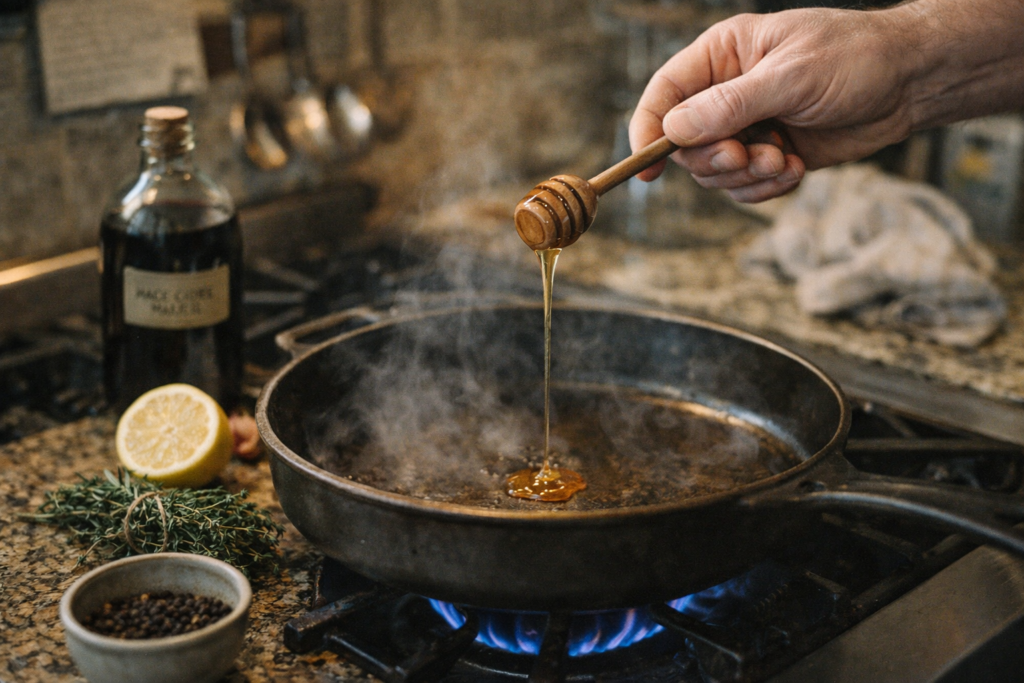
| Flavor Goal | Real Ingredient Alternatives | Why It’s Better |
|---|---|---|
| Sweetness | Brown sugar, raw sugar, local honey, maple syrup | Single-source, traceable, no industrial additives |
| Acidity | Apple cider vinegar, balsamic vinegar, red wine vinegar, pomegranate molasses | Clean acid with complex depth and terroir |
| Depth and Color | Molasses, proper stock reduction, toasted aromatics, caramelized tomato paste | Built through technique, not synthetic caramel color |
| Caramelization | Sear the meat properly, don’t crowd the pan, control your heat | The Maillard reaction is free — it just requires patience |
The Maillard reaction is one of the most powerful tools in any kitchen. It requires heat, patience, and dry surface contact — not soda.
Every alternative on this list is something you’d proudly explain to a guest. Can you say the same about sodium benzoate?
Real flavor comes from technique. Not from cooking with Coca-Cola.
Key Takeaway: Every flavor Coca-Cola claims to provide — sweetness, acidity, depth, color — can be achieved with real, single-source ingredients and proper technique.
Hudson Valley Real Food Matters
Here in the Hudson Valley, we are surrounded by farms.
We have access to grass-fed meats, local produce, heritage poultry, wild mushrooms, and artisanal producers who care deeply about what they grow and raise.
Why would I ignore that abundance and reach for a can of soda?
Real food isn’t trendy here. It’s foundational.
At Aroma Thyme Bistro, our identity is built on transparency and integrity. Guests trust us because we take sourcing seriously.
That trust matters.
Key Takeaway: When you're surrounded by farms, heritage producers, and real ingredients, reaching for an industrial soda is a choice to ignore abundance.
This Isn’t About Judgment — It’s About Standards
Some chefs will say: “It’s just an ingredient.”
No. It’s a signal.
It signals what we’re willing to accept in our kitchens.
When I call this out, it’s not about ego. It’s about standards.
If we want to be taken seriously as culinary professionals, we must hold ourselves to a higher bar than pouring soda into a braise.
We can do better. We know better.
Key Takeaway: Using Coca-Cola in cooking isn't just a recipe choice. It's a signal about what standards you accept as a professional.
A Call to Chefs
If you’re a chef reading this, look at your ingredient list.
Ask yourself:
Would I serve each component of this product individually?
Would I proudly explain it to my guests?
Would I feed it to my family?
If the answer is no — reconsider it.
Being a chef means we have power. Let’s use it wisely.
Key Takeaway: The test is simple. If you wouldn't serve an ingredient's individual components to your guests, it doesn't belong in your kitchen.
Final Thoughts from Chef Marcus Guiliano
Even before I fully embraced the real food movement, cooking with Coca-Cola didn’t feel right.
Now I understand why.
It represents everything that separates industrial food from honest food.
As Chef Marcus Guiliano — Chef on a Mission — I believe in real ingredients, real technique, and real responsibility.
The future of American food depends on the decisions we make in our kitchens.
And I choose real food. Every single time.