





If you’ve ever ordered “rockfish” at a restaurant, you probably assumed it was one fish.
You weren’t buying one fish.
You were buying a category.
What is rockfish? It’s a group of over 60 species in the Sebastes genus. They hide behind trade names like “rock cod,” “Pacific snapper,” and “ocean perch.” None of those names tell you what’s actually on your plate.
Same menu word. Completely different fish. Different lifespans. Different sustainability stories.
I’ve sourced and cooked fish for over 20 years at Aroma Thyme Bistro in New York’s Hudson Valley. The deeper I got into seafood, the more I realized something: most people — including some chefs — have no idea what they’re buying when they see “rockfish.”
This is what you need to know — the names, the species, the sustainability stakes, and how to cook it right.
What Is Rockfish, Really?
The bottom line: rockfish is a label, not a species.
When you ask what is rockfish, you’re asking about fish in the genus Sebastes. More than 60 species belong to this group in the Northeast Pacific alone. They range from the Bering Sea down to Baja California.
In coastal California alone, 50 to 60 species can overlap in the same waters.
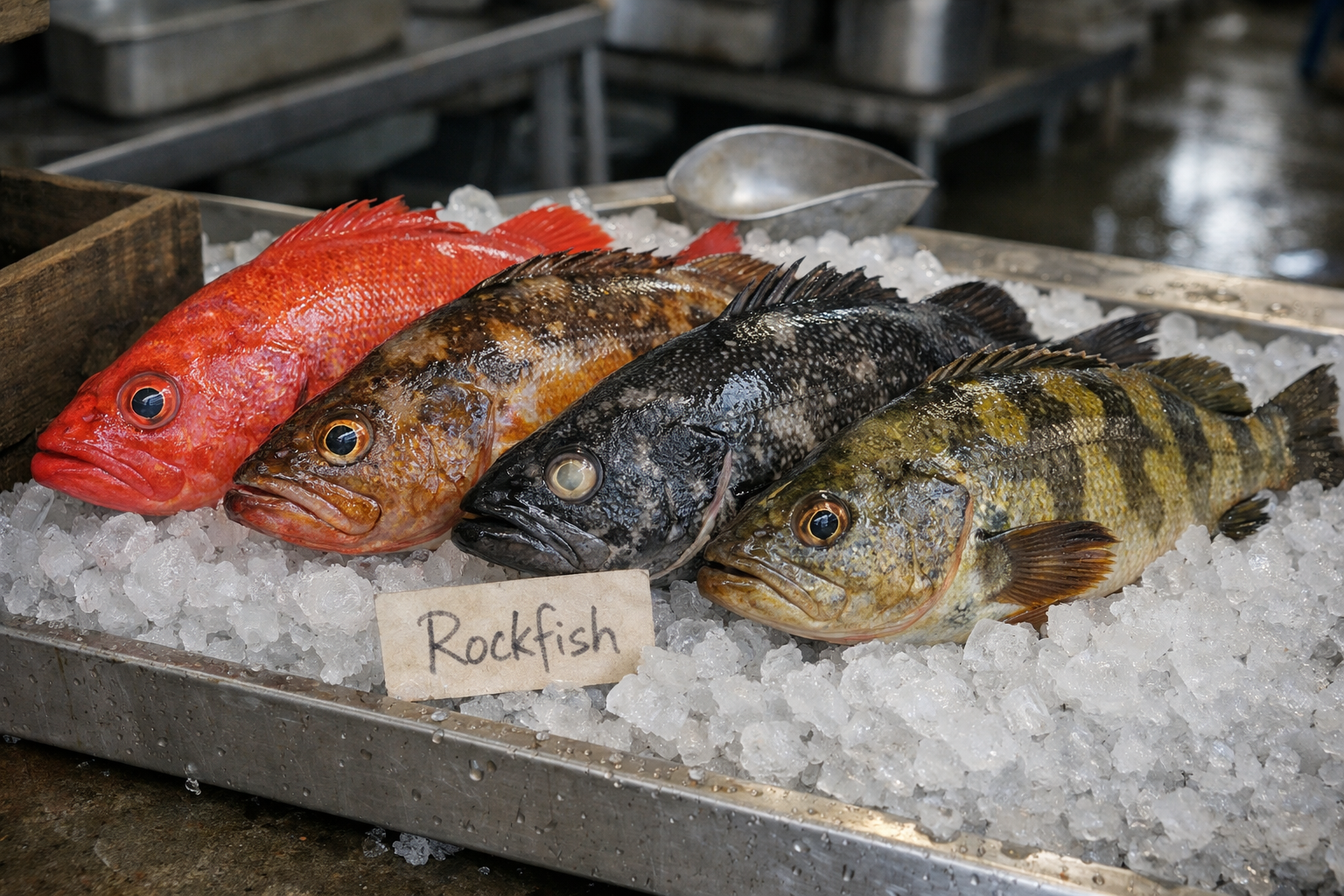
They look similar. Big heads. Spiny dorsal fins. Stocky bodies. Large eyes. Armored, camouflage-style skin — mottled, speckled, striped, or blotched.
They’re reef-built predators that live in and around rocky structures.
But beyond that family resemblance, the differences are real.
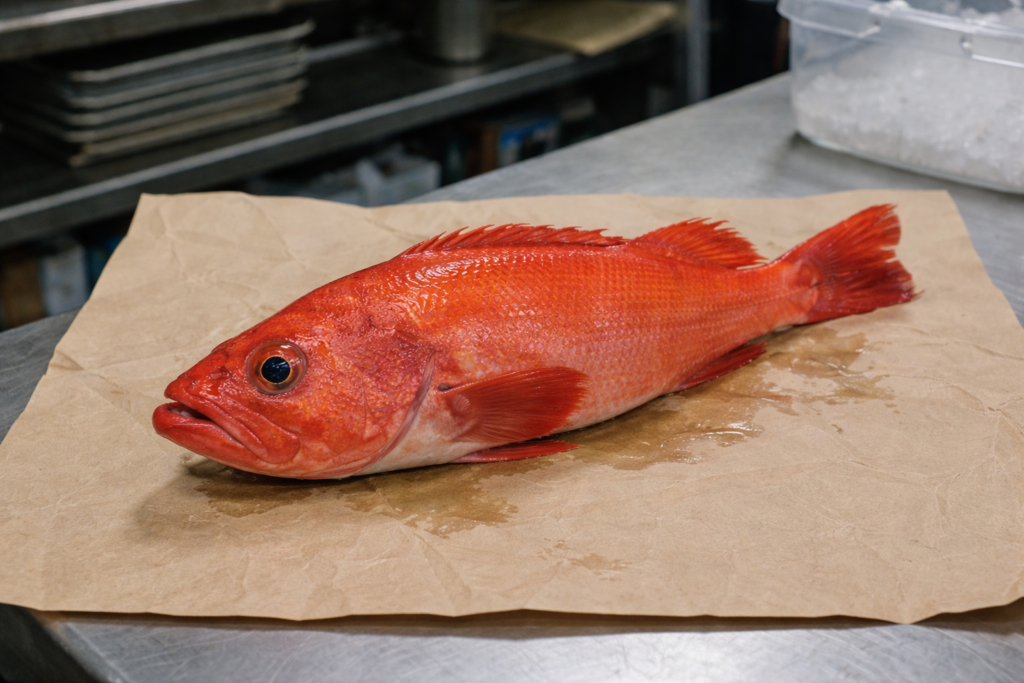
Some species are solid red. Others are mottled brown. Some have dark bars and light stripes. Others carry signature blotches on the gill plate or dorsal fin.
Color pattern is the cheat code. It tells you which species you’re dealing with — if you’re looking at a whole fish.
Here’s the problem I’ve seen throughout my career. Once a fish is skinned and filleted, it loses its identity.
A whole fish tells a story. A fillet could be almost anything.
Why Does Rockfish Have So Many Names?
Rockfish didn’t become confusing by accident. It became confusing because of marketing.
As West Coast fishing expanded in the mid-1900s, processors realized something. Rockfish is mild, flaky, versatile, and abundant. But “rockfish” didn’t sound appealing.
So the seafood industry borrowed names people already liked.
That’s how “ocean perch,” “rock cod,” and “Pacific snapper” ended up on menus and in seafood cases across the country.
Here’s the catch: Pacific snapper is not snapper.
Real snapper belongs to the Lutjanidae family. Pacific rockfish belongs to Scorpaenidae. They’re not even close relatives.
The name “Pacific snapper” exists because it sounds premium. It’s a marketing label, not a species name.
| Trade Label | What It Usually Refers To | Why It’s Confusing | What to Ask Instead |
|---|---|---|---|
| Rockfish | Any of 70+ Sebastes species | Too broad to mean anything specific | “Which rockfish species is this?” |
| Rock cod | Various Sebastes species | Not related to Atlantic or Pacific cod | “Is this a cod or a Sebastes species?” |
| Pacific snapper | Vermilion or other red rockfish | Not a true snapper (Lutjanidae) | “Is this a true snapper or a rockfish?” |
| Ocean perch | Pacific ocean perch (S. alutus) or others | Not related to freshwater perch | “Which species, and where was it caught?” |
This naming problem isn’t unique to rockfish. The same pattern shows up across the seafood industry — labels that sound specific but hide the truth.
I’ve written about it with fresh vs. frozen fish and real wasabi vs. fake.
When dozens of species get shoved under one umbrella, consumers lose the ability to know what they’re buying.
Why Does the Species Behind “Rockfish” Actually Matter?
This is where asking what is rockfish stops being a curiosity and becomes a real problem.
Rockfish species don’t all grow the same way. They don’t reproduce at the same rate. They don’t handle fishing pressure the same way.
Some rockfish species live for decades. Some can live over 100 years.
That’s not a typo.
According to NOAA Fisheries, rougheye rockfish (Sebastes aleutianus) can live past 200 years. That makes them among the longest-lived fish on earth.
What is rockfish really asking, then? It’s asking about a group with wildly different biology hidden behind one word.
Rockfish tend to be slow-growing and late-maturing. If you overfish them, they don’t bounce back quickly like sardines or anchovies.
This is exactly what happened in the 1980s and 1990s along the U.S. West Coast. Heavy fishing pressure crushed several key rockfish populations.
The Pacific Fishery Management Council responded with conservation zones and science-based rebuilding plans.
Many populations have since recovered. Rockfish went from overfished to a sustainability success story.
But that recovery only works when we track species individually. Lumping everything under “rockfish” makes accurate management harder.
How Should You Buy Rockfish? A Chef’s Framework
Here’s what I think about every time I source fish for Aroma Thyme Bistro.
I don’t start with “does it taste good?” I start with “what is it?”
Five questions to ask before you buy rockfish
If you’ve ever wondered what is rockfish beyond the menu label, start here.
- What species is this? If the answer is just “rockfish,” push further.
- Where was it caught? Region matters for population health.
- How was it caught? Hook-and-line has less bycatch than trawl.
- Is this wild or farmed? Most rockfish is wild-caught.
- Is the population healthy? Check Seafood Watch for current ratings.
These five questions work for any fish. Print them out and bring them to the counter next time.
Why whole fish tells a better story
A whole fish gives you identification clues. Color, pattern, fin structure, eye size — all visible.
A fillet gives you almost nothing.
If your fishmonger sells whole rockfish, that’s a good sign. It means they’re comfortable with transparency.
Wild vs. farmed: the honest answer
Most rockfish you’ll find is wild-caught. Farming rockfish isn’t common.
But the wild vs. farmed debate in general deserves honesty.
Wild isn’t automatically better. Farmed isn’t automatically worse.
A responsible approach looks at details. Catch method. Population stability. Feed quality. Stocking density.
The point isn’t to be “pro wild” or “anti farm.” The point is to be pro truth.
That’s the same principle behind how I evaluate cold water vs. warm water lobster — context matters more than categories.
How to Cook Rockfish (4 Chef-Approved Methods)
Rockfish shines when you cook it with confidence and restraint.
The flavor is mild but not boring. The texture is flaky but holds together. It’s one of the most versatile white fish on the planet.
And it makes you look like a better cook than you are — if you don’t overcook it.
Pan-roasted rockfish (the restaurant method)
Hot pan. A little oil. Crispy skin. Finish with butter and herbs.
Serve with roasted fennel, cherry tomatoes, a white wine pan sauce, capers, lemon, garlic, and fresh parsley.
Simple. Clean. The kind of dish that wins a table.
Rockfish tacos (the crowd favorite)
Rockfish was born for tacos. Go one of two ways: lightly battered and fried, or blackened in a cast iron pan.
Build it right. Cabbage slaw. Cilantro. Pickled onions. Chipotle crema. Fresh lime.
This is how you turn a “mild white fish” into something people crave.
Rockfish in a brothy bowl (Mediterranean style)
Rockfish stays moist and delicate in broth.
Think tomato saffron broth with mussels or clams. Olive oil. Garlic. Chili flake. Crusty bread.
That’s not just dinner — that’s an experience.
Fish and chips (the classic)
Rockfish makes a killer fry. Flaky, clean, not overly oily.
Pair it with tartar sauce, malt vinegar, and old-school slaw.
Simple food done right is undefeated. It’s the same philosophy behind the lobster roll story — respect the ingredient, keep it honest.
The chef rule: don’t overcook it
Rockfish will forgive a lot. But it won’t forgive being cooked into cardboard.
Cook it until it just flakes. Then stop.
Use a thermometer. Pull it at 130–135°F and let carryover finish the job.
Rockfish Deserves a Better Reputation (And Better Labels)
Rockfish has been marketed, renamed, lumped, and confused for decades.
But underneath all of that? It’s one of the most useful, delicious, chef-friendly fish in the ocean.
What is rockfish at its core? It’s a whole world of species, ecosystems, and decisions — hidden behind a single word on a menu.
When we respect that complexity, we get the best version of seafood. Not hype. Not shortcuts. The real deal.
So next time you see “rockfish” at the counter or on a menu, don’t just order it. Ask about it.
The fish deserves that. And honestly? So do you.
FAQ: What Is Rockfish and How Do You Cook It?
What is rockfish?
What is rockfish? It is a common name for over 60 species in the Sebastes genus. They live along the Pacific coast from Alaska to Baja California. The name covers many species with different traits, lifespans, and population statuses.
Is rockfish the same as snapper?
No. “Pacific snapper” is a trade name for certain rockfish species. Real snapper belongs to the Lutjanidae family. Rockfish belongs to Scorpaenidae. They are not closely related.
Is rockfish sustainable?
It depends on the species. Many populations have recovered thanks to rebuilding plans from the Pacific Fishery Management Council. Check Seafood Watch for current species-level ratings.
How do you cook rockfish without drying it out?
Use a thermometer. Pull rockfish off heat at 130–135°F and let carryover cooking finish it. Pan-roasting, tacos, brothy bowls, and frying all work well.
Why does rockfish have so many different names?
Marketing. The seafood industry adopted familiar names like “snapper,” “cod,” and “perch” to make rockfish sound more appealing. These are trade labels, not scientific names.